

Last updated: September 22, 2026
Explore Rhythm360 For Your Heart Failure Program
Each unplanned hospitalization for ADHF marks a turning point—the risk of death and rehospitalization increases incrementally with every subsequent admission. That escalating risk drives the very real clinical anxiety about missing early warning signs and explains why the cost to health systems keeps climbing.
Approximately 60–80% of ADHF hospitalizations are associated with one or more identifiable precipitating factors, many of which are reversible if caught early. That figure defines both the problem and the opportunity. Most readmissions arise from a monitoring gap between acute stabilization and the patient’s return home, where clinical visibility disappears and early warning signals go undetected.
Continuous remote patient monitoring (RPM) that extends care beyond the hospital walls addresses that gap directly. Platforms that integrate cardiac implantable electronic device (CIED) data with RPM parameters give clinicians the visibility they need to intervene before a compensated patient decompensates again.
See How Rhythm360 Extends Visibility After Discharge
Heart failure is a chronic condition characterized by the heart’s inability to meet the body’s circulatory demands. Decompensation is the acute worsening of that underlying condition. It represents a deterioration of an existing disease rather than the arrival of a new one.
The nomenclature of “acute” in ADHF may create confusion because decompensation usually occurs gradually as deterioration of the underlying cardiovascular condition rather than a new acute disease. Clinicians managing these patients should recognize two distinct long-term trajectories. The first is a downsloping, progressive course, commonly though not exclusively seen in HFrEF, that culminates in advanced heart failure. The second is a remitting-relapsing course, more common in HFpEF, with recurrent decompensations that do not necessarily imply irreversible decline. Understanding which trajectory a patient is on informs escalation decisions, GDMT optimization timing, and the urgency of post-discharge monitoring. That urgency becomes concrete when you look at the symptoms that signal a patient is decompensating.
The following symptoms reflect fluid backing up into the lungs and body and warrant immediate clinical attention:
Early recognition of these signs is critical. Daily weight monitoring is the cornerstone of outpatient heart failure assessment: a gain of at least 2 lb in 24 hours or at least 5 lb in 1 week should prompt immediate contact with the healthcare team.
Rhythm360’s alert triage system flags early signs of fluid overload, such as significant weight gain or changes in CIED-derived hemodynamic parameters, before they escalate to an emergency. This capability enables proactive intervention during the highest-risk post-discharge window.
The Stevenson/Nohria hemodynamic framework classifies ADHF by two bedside dimensions: wet vs. dry for congestion and warm vs. cold for perfusion adequacy. The table below maps each of the four profiles to its management implication, showing how the same diagnosis can call for diuresis, inotropes, or a volume challenge depending on where the patient sits.
| Profile | Congestion | Perfusion | Management Implication |
|---|---|---|---|
| Wet-Warm | Yes | Adequate | IV loop diuretics, vasodilators if hypertensive |
| Wet-Cold | Yes | Low | Inotropes, cautious diuresis, consider mechanical circulatory support |
| Dry-Warm | No | Adequate | Optimize GDMT, investigate other causes |
| Dry-Cold | No | Low | Volume challenge, inotropes, evaluate for cardiogenic shock |
In recent registries, 6–9% of ADHF patients have neither congestion nor signs of hypoperfusion, complicating the wet/dry, warm/cold classification and underscoring the value of continuous, objective monitoring data rather than reliance on point-in-time clinical assessment alone.
Nonadherence to medications or dietary restrictions is the most common precipitant in decompensated chronic heart failure across global regions and accounts for up to 20% of ADHF hospitalizations in North America. Arrhythmias account for 7–40% of ADHF hospitalizations, with atrial fibrillation predominating in HFpEF and ventricular arrhythmias more common in HFrEF.
Continuous monitoring through Rhythm360 can flag early signs of fluid overload and arrhythmia, including new-onset atrial fibrillation with rapid ventricular response. These early alerts support timely intervention before a full decompensation occurs.
Guideline-directed acute management of ADHF follows a structured sequence based on hemodynamic profile and precipitant identification:
The 2022 AHA/ACC/HFSA guideline recommends measuring BNP or NT-proBNP at admission for prognosis (COR 1A) and predischarge BNP/NT-proBNP (COR 2a) to inform trajectory and postdischarge prognosis. A 2026 cross-guideline synthesis published in the European Heart Journal: Acute Cardiovascular Care reinforces this international consensus on the sequencing of acute heart failure management.
Predictors of the downsloping/progressive trajectory include persistent congestion at discharge, recurrent precipitants, low blood pressure limiting therapy, and elevated risk scores. Predictors of a more favorable remitting-relapsing course include effective decongestion, blood pressure control, timely aetiological treatment, and evidence of ejection fraction improvement.
Among ADHF discharge survivors, approximately one quarter may experience heart failure hospitalization or all-cause death within 90 days. Continuous monitoring that catches decompensation early and enables timely intervention is the most actionable lever available to clinicians managing these patients after discharge.
The post-discharge period is where readmissions happen. Clinical visibility often ends at the hospital door, and the monitoring gap that follows is a primary driver of preventable rehospitalization. Remote patient monitoring closes that gap by extending the clinical reach of the care team into the patient’s home.
The evidence for hemodynamic-guided remote monitoring is substantial. The CHAMPION randomized trial enrolled 550 NYHA Class III heart failure patients and demonstrated a statistically significant 30% reduction in heart failure hospital readmissions at 6 months in the pulmonary artery pressure-monitored group (HR 0.72; 95% CI 0.60–0.85; p=0.0002). The COAST registry, enrolling 304 NYHA Class III patients across 37 centres in 6 countries, found CardioMEMS implantation was associated with a 69% reduction in heart failure hospitalizations in the year after implantation compared with the year before. Analysis of PROACTIVE-HF trial data confirmed that daily transmitted pulmonary artery pressure, weight, blood pressure, and heart rate all changed before heart failure events, with mean PAP rising from 27.8 mmHg at day −60 to 32.6 mmHg at day 0, demonstrating that hemodynamic trends can precede events by weeks.
Rhythm360 is the premier platform for operationalizing post-discharge ADHF management at scale. Key capabilities include:
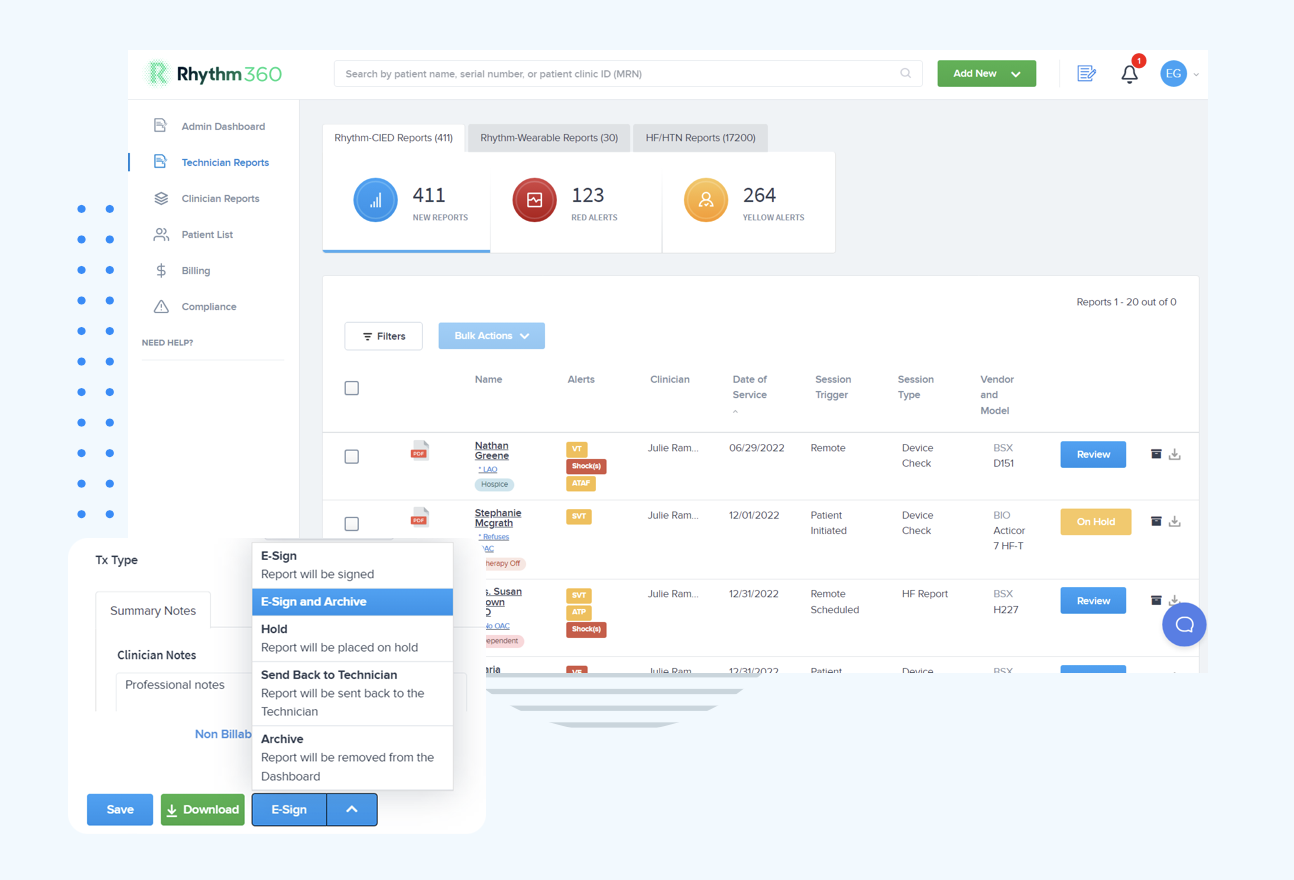
These capabilities work together to close the post-discharge monitoring gap and support guideline-directed care between visits.
See How Rhythm360 Reduces Readmissions
The following signs require immediate emergency care and should not be managed through remote monitoring alone:
Patients presenting with any of these findings require immediate emergency evaluation. Rhythm360’s alert infrastructure is designed to escalate these signals to the clinical team in real time, but emergency services should always be activated without delay when these thresholds are met.
Many patients recover from an acute decompensation with appropriate treatment. Recovery in ADHF means returning to a compensated state rather than curing the underlying heart failure. The distinction matters clinically. Patients who achieve effective decongestion, blood pressure control, and GDMT optimization are more likely to follow a remitting-relapsing trajectory with stable periods between decompensations. Those with persistent congestion at discharge, recurrent precipitants, or low blood pressure limiting therapy are at higher risk of a progressive, downsloping course. Continuous monitoring and GDMT optimization are essential to prevent relapse and detect early signs of the next decompensation before it requires hospitalization.
Prognosis varies widely based on ejection fraction, comorbidities, precipitant type, and response to therapy. In-hospital mortality is approximately 30–50% for cardiogenic shock presentations. For ADHF without shock, 1-year mortality is significantly higher in patients with worsening chronic heart failure compared to de novo acute heart failure. Poor prognostic markers include low LVEF, elevated BNP at discharge, hyponatremia, renal insufficiency, NYHA Class III–IV at presentation, and poor self-care adherence. Continuous monitoring and GDMT optimization improve outcomes by enabling earlier intervention and supporting medication titration between hospitalizations.
Patients with heart failure should not stop prescribed medications without consulting their clinician, as withdrawal of GDMT—even in patients with normalized ejection fraction—is associated with a high rate of relapse. High-sodium foods should be avoided, as dietary nonadherence is the most common precipitant of decompensation in chronic heart failure across global regions. Patients should respond promptly to the weight-gain threshold described earlier and contact the care team when it is reached. Worsening symptoms should prompt early outreach to clinicians, because delayed care is a primary driver of preventable hospitalization.
End-stage heart failure is characterized by marked symptoms interfering with daily life, recurrent hospitalizations despite optimized GDMT, and refractory congestion. The 2022 AHA/ACC/HFSA guideline defines Stage D advanced heart failure as this clinical picture and recommends specialty referral to an advanced heart failure team for assessment of LVAD candidacy, cardiac transplantation, or palliative inotropes. Palliative care should be integrated alongside curative efforts rather than sequentially. Rhythm360 can support goals-of-care conversations by providing objective, longitudinal data on disease trajectory, giving clinicians and patients a shared, evidence-based foundation for advanced care planning discussions.
ADHF is a leading cause of hospitalization, and the gap between acute stabilization and home monitoring is where many readmissions occur. Clinicians stabilize these patients successfully in the hospital, then lose visibility the moment the patient goes home. That visibility gap represents an infrastructure problem with a defined solution.
Rhythm360 provides the operational infrastructure that prevents the next hospitalization. Vendor-neutral CIED data integration gives the care team one view of every device. AI-powered alert triage delivers the 80% response-time reduction described earlier. Automated CPT code capture helps practices recover up to 300% more revenue, and bi-directional EHR integration eliminates manual data transcription. For cardiology practices, electrophysiology clinics, and integrated health systems managing heart failure populations across the acute-to-outpatient continuum, Rhythm360 serves as a definitive post-discharge monitoring platform.
Talk With Rhythm360 About Your Heart Failure Workflow





