Last updated: August 24, 2026
A cardiology practice that implants devices from Medtronic, Boston Scientific, Abbott, and Biotronik manages four separate, non-interoperable portals. Staff log into each system, reconcile conflicting data formats, and manually move findings into the EHR before billing documentation can even start. For large cardiac monitoring programs, the gap between CMS-allowed billing time and actual monitoring time becomes significant uncollected revenue on patients the practice already serves. Staff burnout, technician turnover, and claims that never reach submission because documentation windows close add further hidden costs.
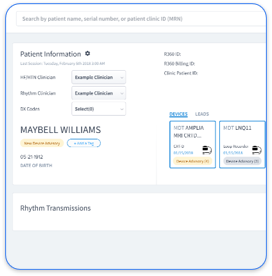
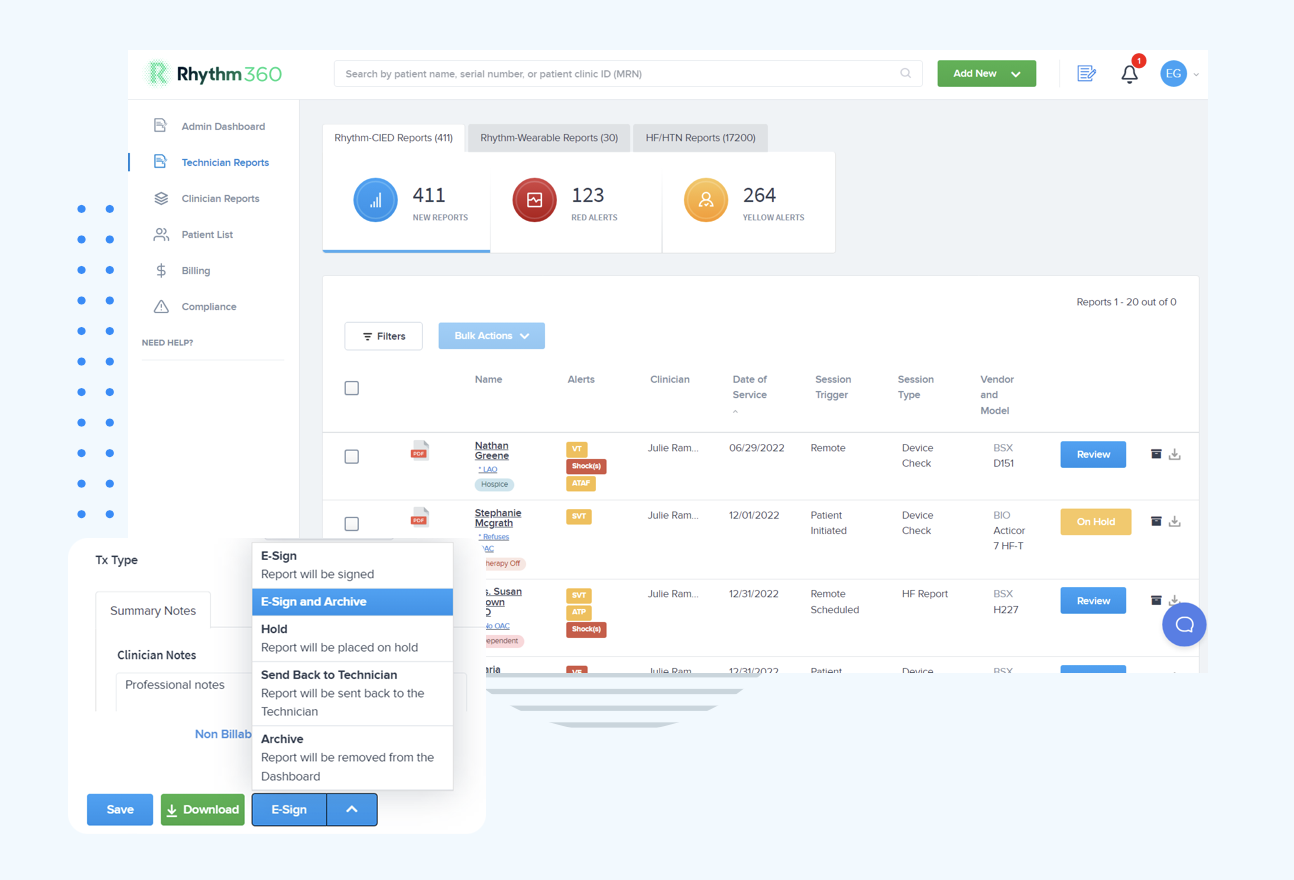
Rhythm360 ingests data from all major device manufacturers through APIs, HL7, XML, and PDF parsing via computer vision, then normalizes every transmission into a single dashboard. Bi-directional EHR integration with Epic, Cerner, Athenahealth, eClinicalWorks, and Greenway Health keeps data flowing in both directions without manual transcription. The result is a unified source of truth that removes redundant logins and the administrative overhead that quietly erodes collections. University of Chicago Medicine reviewed more than 73,000 reports annually through Rhythm360 in calendar year 2025, averaging more than 18,000 reports per quarter, a volume that would be operationally unsustainable across fragmented OEM portals. This operational capacity translates directly to revenue capture at scale.
Request a personalized walkthrough of Rhythm360’s vendor-neutral data consolidation.
Remote device interrogation codes carry strict lookback rules. Remote interrogation codes 93294, 93295, and 93296 may be reported no more than once every 90 days, and codes 93297 and 93299 no more than once every 30 days. Billing more frequently triggers duplicate denials.
The most frequent billing errors in remote monitoring programs, including billing too early or too late relative to the monitoring interval, missing the technical component, and inadequate dated physician interpretation, stem from fragmented manual tracking across multiple OEM portals. When staff reconcile intervals across several systems by hand, monitoring windows close without notice and documentation fields remain incomplete. Rhythm360 addresses this directly through real-time CPT logging that tracks each patient’s monitoring interval across all manufacturers at once, flags approaching billing windows before they close, and auto-populates compliant documentation at the point of review. The 2026 RPM CPT family requires exact day-count and time documentation, and vague documentation is the leading cause of RPM denials and audit findings in 2026.
Rhythm360’s automated documentation engine generates audit-ready reports pre-populated with device data, monitoring intervals, and physician interpretation fields. This reduces the manual burden on device technicians and helps every eligible claim reach submission with the documentation CMS requires.
Alert fatigue creates a direct revenue problem for remote monitoring programs. When clinical staff receive an overwhelming volume of non-actionable notifications, they develop habits of dismissal that cause genuinely billable and clinically significant events to go unreviewed within the required monitoring period. Remote cardiac monitoring billing under CPT codes 93294–93298 ties reimbursement to fixed monitoring periods rather than individual transmissions. Missing the required time windows or failing to capture the technical component in manual workflows leads to automatic denials and lost revenue at scale.
Rhythm360’s AI-powered triage system filters non-actionable transmissions and surfaces clinically significant events, including new-onset atrial fibrillation, ventricular tachycardia, lead malfunction, and ERI or RRT indicators, in priority order. This approach reduces critical alert response times by up to 80% and helps ensure that reviewable events receive attention within their billing windows. UCM’s implementation of Rhythm360 enabled clinicians to review more transmissions daily and identify more abnormalities, as noted by Andrew Beaser, MD, Associate Professor of Medicine at UCM.
The platform’s HIPAA-compliant mobile application extends this capability off-site. Clinicians on call can review transmissions, sign reports, and coordinate care from their smartphones. This prevents scenarios where a Saturday-morning critical alert goes unaddressed until Monday, a gap that harms both the patient and the practice. A 2026 JMIR multisite economic evaluation found that AI triage clinical decision support was associated with positive economic outcomes.
Cardiology practices with established CIED monitoring programs already have the clinical infrastructure and patient relationships to support heart failure and hypertension RPM. Historically, the operational barrier involved separate staff, separate software, and a new billing workflow for a separate service line. Rhythm360 removes that barrier by integrating HF and HTN RPM directly into the same platform used for CIED monitoring.
Two new 2026 CPT codes expand the revenue opportunity for lower-engagement months that previously generated no reimbursement. Before 2026, patients who transmitted data fewer than 16 days per month fell below the billing threshold for 99454, which left that monitoring work uncompensated. CMS introduced CPT 99445 for device supply and transmission of data for 2–15 days per 30-day period, reimbursed at approximately $47 nationally, and CPT 99470 for the first 10–19 minutes of monitoring and intervening, capturing the lower time threshold that previously went unbilled. These codes address short post-discharge and post-procedure episodes that previously fell below billing thresholds.
The stacked revenue potential per patient is significant. Under the 2026 CMS Physician Fee Schedule, RPM combined with CCM can generate substantial revenue per patient per month when time and documentation are tracked separately. Qualifying conditions include heart failure, hypertension, and atrial fibrillation, which overlap directly with arrhythmia monitoring patient populations. Practices should note that UnitedHealthcare announced a potential limitation of RPM coverage to heart failure and hypertensive disorders of pregnancy starting January 1, 2026, though implementation was paused in December 2025 with no new effective date announced. Payer-mix analysis remains an important step before launching hypertension RPM lines. Medicare FFS and most commercial payers continue to cover chronic hypertension RPM.
Rhythm360’s turnkey HF and HTN service line includes patient onboarding checklists, automated billing support for all relevant RPM codes, and the same centralized dashboard used for CIED monitoring. Practices can roll out new RPM lines quickly without hiring additional staff or deploying separate software.
Explore Rhythm360’s turnkey RPM service line in a guided demo.
The combined effect of consolidated data ingestion, automated CPT tracking, AI triage, and integrated RPM service lines becomes visible at the practice level. RhythmScience reports that practices implementing Rhythm360 have increased remote monitoring revenue by up to 300% through reduced documentation gaps, elimination of missed billing windows, and the addition of new RPM service lines on existing patient panels.
The per-1,000-patient revenue model below compares a fragmented manual workflow with a fully automated Rhythm360 deployment, using 2026 CMS reimbursement rates and Rhythm360 platform data.
| Revenue Driver | Manual/Fragmented Workflow (est.) | Rhythm360 Automated Workflow | Source |
|---|---|---|---|
| Uncollected CIED monitoring revenue (annual) | Significant lost revenue due to portal fragmentation | Recovered through automated interval tracking | Magical, 2026 |
| RPM revenue per enrolled HF/HTN patient/month | $0 (service line not launched) | $120–$200+ PPPM via 99454 + 99457 + 99458 | Circle Healthcare, 2026 |
| New short-duration RPM revenue (99445 + 99470) | $0 (below prior billing thresholds) | Approximately $47 for 99445 per qualifying patient/month | Advanta Biometrics, 2026 |
| First-pass claim acceptance improvement | Baseline manual submission rate | 15–25% improvement with AI billing automation | PracticeSuite, 2026 |
| Overall revenue increase (platform-reported) | Baseline | Up to 300% increase in captured remote monitoring revenue | PhysicianAITools, 2026 |
A vendor-neutral arrhythmia monitoring revenue platform is a cloud-based system that ingests, normalizes, and manages cardiac device data from all major OEM manufacturers, regardless of brand, into a single clinical and billing workflow. The platform automates CPT documentation, EHR synchronization, and alert triage to maximize reimbursable event capture across CIED and RPM service lines.
| CPT Code | Description | 2026 Medicare Rate | Key Documentation Requirement |
|---|---|---|---|
| 93294 | Remote interrogation of pacemaker (professional component, up to 90-day interval) | Varies by locality | Dated physician interpretation within 90-day window, one report per interval per device |
| 93298 | Remote interrogation of subcutaneous cardiac rhythm monitor (up to 30-day interval) | Varies by locality | Physician review and interpretation documented within 30-day monitoring period |
| 99454 | RPM device supply with 16–30 days of data transmission per month | Approximately $47 nationally | Exact day count of readings received must be documented, cannot be billed with 93296–93298 for same device |
| 99445 | RPM device supply with 2–15 days of data transmission per 30-day period (new 2026 code) | Approximately $47 nationally | Exact number of days readings received must be documented, not billable alongside 99454 in same month |
| 99470 | Remote monitoring management, first 10–19 minutes per calendar month (new 2026 code) | Varies by locality | Time documentation must specify 10–19 minutes, not additive with 99457 in same month |
Medicare has covered remote patient monitoring services since 2018 and pays separately for each of the three main components. The 2026 Physician Fee Schedule introduced CPT codes 99445 and 99470 to capture short-duration monitoring episodes and lower management-time thresholds, expanding the billable surface area for post-discharge and post-procedure cardiac patients.
On the commercial side, UnitedHealthcare announced in late 2025 that starting January 1, 2026, RPM coverage would be limited to heart failure and hypertensive disorders during pregnancy, excluding chronic hypertension; after industry pushback, UHC paused implementation in December 2025 with no new effective date announced. Practices adding hypertension RPM service lines should conduct payer-mix analysis before enrollment to calculate the revenue impact of potential UHC exclusions on their specific patient population. Medicare FFS and most other commercial payers continue to cover chronic hypertension RPM under 2026 rates.
The checklist below outlines key milestones for deploying Rhythm360 and reaching the first complete billing cycle. Rhythm360’s onboarding process, including EHR integration, typically takes from a few days to a few weeks.
Most practices begin capturing previously missed CPT revenue within the first billing cycle, which usually falls within 30 days of go-live. The onboarding process, including EHR integration, takes from a few days to a few weeks, so the platform is operational before the first monthly billing window closes. Revenue improvement accelerates over the first 90 days as the patient population audit identifies historical gaps, RPM enrollment expands, and staff workflows stabilize around the automated documentation system. Practices that add HF and HTN RPM service lines during the same implementation period create new recurring revenue streams that compound the initial CIED billing recovery.
Remote monitoring denials typically occur when practices bill outside the required lookback window, omit the technical component, or submit incomplete physician interpretation documentation. Rhythm360 addresses each of these issues directly. The platform tracks each patient’s monitoring interval in real time and flags approaching billing windows before they close. Automated report generation pre-populates the documentation fields required for each CPT code, including exact day counts for RPM codes and dated physician interpretation for CIED interrogation codes, so claims reach submission with complete, audit-ready documentation. Bi-directional EHR integration also removes manual transcription errors that create discrepancies between the clinical record and the submitted claim.
Rhythm360 supports distinct but integrated service lines for CIED monitoring, through Rhythm-CIED, and chronic condition RPM for HF and HTN, all within the same platform and dashboard. For patients who carry an implantable device and also have heart failure or hypertension, the platform manages both monitoring workflows at the same time. CMS prohibits billing general home monitoring codes 99453 and 99454 alongside more specific cardiac monitoring codes such as 93296, 93297, or 93298 when a patient is already enrolled in implanted device monitoring. Rhythm360’s billing compliance logic accounts for these parenthetical restrictions and flags patients where code stacking would trigger a denial, so staff submit the correct codes for each patient’s monitoring configuration.
Rhythm360 uses a redundant data feed architecture as a safeguard against OEM server outages. If a manufacturer’s server becomes unavailable, the platform’s AI-powered extrapolation and computer vision capabilities maintain data continuity and achieve greater than 99.9% transmissibility across the patient population. This design prevents a server outage at a single OEM from creating a gap in the monitoring record that could invalidate a billing period or cause a missed critical alert. Clinical staff continue to see a complete, uninterrupted view of their patient population regardless of upstream connectivity issues.
Rhythm360’s automated CPT documentation engine supports the full 2026 RPM code family, including the two new codes. CPT 99445 covers device supply for patients who transmit data on 2 to 15 days in a 30-day period, a threshold that previously generated no reimbursement, and requires documentation of the exact number of days readings were received. CPT 99470 covers the first 10 to 19 minutes of monitoring management per calendar month and requires time documentation that specifies the range precisely to avoid the documentation gaps that trigger denials. Rhythm360 tracks transmission days and management time automatically and generates the specific documentation each code requires, which enables practices to capture revenue from lower-engagement months that were previously non-billable.
Fragmented OEM portals, manual CPT tracking, and disconnected RPM workflows create quantifiable revenue losses on patients a practice already monitors. Rhythm360 consolidates every CIED and chronic-condition data stream into a single vendor-neutral platform, automates the documentation that drives clean claims, and supports rapid launch of HF and HTN RPM service lines without additional overhead.
“We have improved billing and accountability for our patients after the integration,” noted a physician at University of Chicago Medicine following Rhythm360 implementation, the same program referenced earlier that demonstrated operational capacity at scale.
Schedule a demo to see how Rhythm360 delivers measurable revenue outcomes for your practice.