

Last updated: August 24, 2026
The modern device clinic now manages patients with hardware from Medtronic, Boston Scientific, Abbott, Biotronik, and others at the same time. Each manufacturer runs a separate, non-interoperable portal. Staff must log into each system, reconcile different data formats, and then manually enter findings into the EHR, which creates a workflow that does not scale.
Staffing was always an issue for our center, because our device clinic — like many other medical centers — had struggled with technician turnover and timely weekend coverage, noted the team at University of Chicago Medicine (UCM) before implementing Rhythm360. The fragmentation problem is widespread. Cardiac device data is not standardized across manufacturers, and even common formats such as IDCO have uneven adoption, which makes vendor-neutral ingestion a core requirement rather than a convenience.
The financial impact compounds the clinical risk. Without centralized tracking of billable remote monitoring events, practices routinely miss revenue tied to CPT codes 93298, 93299, and 99454. The administrative overhead of manual workflows also drives technician burnout, one of the most cited reasons for staff turnover in device clinics today. To address these clinical, operational, and financial pressures, practices need a clear framework for evaluating workflow automation platforms.
The following five dimensions directly address fragmentation, alert fatigue, and revenue loss in cardiac device clinics. Selecting a workflow automation platform for cardiac device alerts requires evaluating these dimensions carefully:
Rhythm360 ingests data from all major CIED manufacturers, including Medtronic, Boston Scientific, Abbott, and Biotronik. The platform uses direct APIs, HL7 feeds, XML parsing, and computer vision OCR for unstructured PDFs. A redundant data feed architecture acts as a fail-safe when an OEM server experiences downtime and protects against missed transmission windows.
Rhythm360 achieves over 99.9% data transmissibility for CIED remote monitoring through redundant data feeds, AI-based gap filling, and computer vision technology for PDF parsing, even during OEM downtime. This level of reliability is clinically significant. A missed transmission from a patient with a failing lead or new-onset ventricular tachycardia can have irreversible consequences.
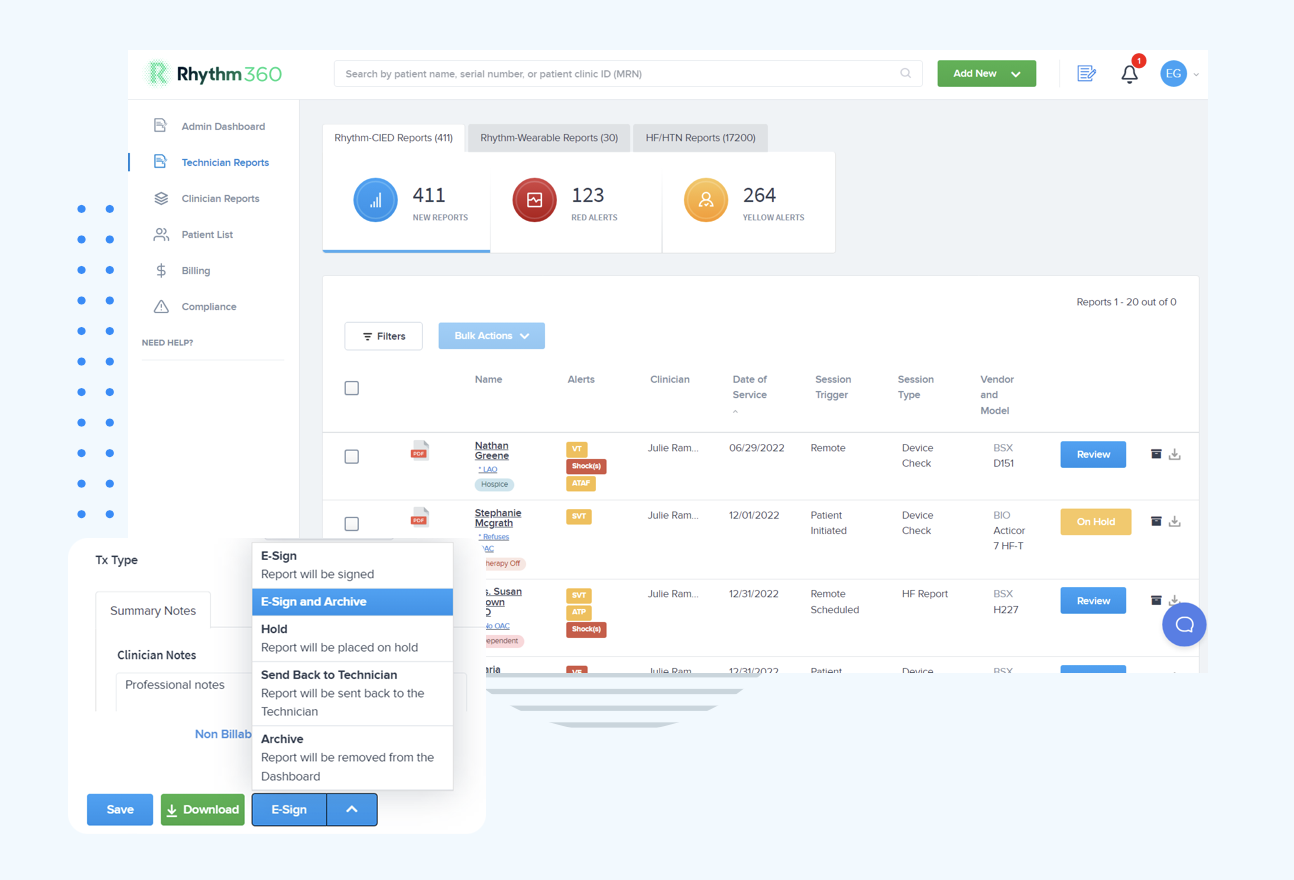
That was a big piece for us, to have an integrated review of data from trained personnel, the UCM team observed. Their comment highlights the value of eliminating fragmented OEM logins through centralized aggregation. UCM ultimately processed more than 73,000 reports annually through Rhythm360 in calendar year 2025, averaging more than 18,000 reports per quarter, which demonstrates the platform’s ability to scale in high-volume academic environments.
Alert fatigue now represents a documented patient safety risk in remote cardiac monitoring. False-positive alerts remain one of the biggest operational challenges in remote cardiac monitoring. Every episode flagged by an implantable cardiac monitor must be reviewed by a clinician, yet even devices equipped with manufacturer AI algorithms still generate a substantial number of non-actionable alerts.
The Heart Rhythm Society recently published its first AI framework for electrophysiology and provided guidance on how AI tools should be evaluated and implemented in clinical settings. This publication signals that AI triage now functions as a standard-of-care expectation rather than a differentiator.
Rhythm360’s AI triage engine filters non-actionable transmissions and prioritizes clinically significant events in near-real time. The AI-driven alert triage shortens response times for critical cardiac events by up to 80% while also reducing alert fatigue. The platform also offers optional 24/7/365 oversight by certified cardiac technicians (CCTs) supervised by physicians, so a critical Saturday-morning arrhythmia receives the same triage rigor as a Monday-morning scheduled review.
We are able to address these issues earlier; rather than waiting for a 3-month visit, we can call patients in for evaluation, the UCM clinical team noted. Their experience reflects how AI-assisted triage supports proactive rather than reactive care.
Bi-directional EHR integration for cardiac device alerts unlocks both clinical and financial value. Pulling patient demographics and device orders from the EHR while pushing finalized reports, encounter documentation, and billing charges back into the record removes manual transcription. This shift saves staff hours and reduces error risk.
Rhythm360 supports deep, bi-directional integration with Epic, Cerner, Athenahealth, eClinicalWorks, Greenway Health, and additional systems via HL7. Automation platforms normalize extracted data to standards including HL7 v2 segments (PID, IN1, OBX), FHIR resources (Patient, Encounter, Observation), and C-CDA documents to enable reliable insertion of clinical information such as diagnoses and procedures into any connected EHR for billing and alert purposes.
Rhythm360’s onboarding process, including EHR integration setup, typically takes from a few days to a few weeks. This timeline reflects pre-built connectors and a repeatable implementation methodology rather than a custom point-to-point build for each site.
Remote monitoring CPT codes create a meaningful and often underused revenue stream for cardiology practices. Codes 93298 and 93299 cover remote interrogation of implantable cardioverter-defibrillators and pacemakers. Code 99454 applies to remote physiological monitoring device supply and transmission. Manual tracking of these billable events across multiple OEM portals is error-prone and frequently results in missed charges.
Rhythm360 automates CPT code capture and documentation at the point of transmission review. Rhythm360’s automated CPT code documentation and billing for remote monitoring codes — including 93298, 93299, 99454, 99453, and 99457 — can increase remote monitoring revenue by up to 300% by reducing documentation gaps and improving compliance.
We have improved billing and accountability for our patients after the integration, the UCM team confirmed. Their experience reflects the impact of Rhythm360’s automated billing documentation layer.
Critical CIED alerts arrive at any hour, not just during clinic time. A clinician tethered to a specific workstation cannot act on a Saturday-morning ventricular fibrillation alert until Monday, which can increase the risk of stroke, syncope, or death. Rhythm360’s HIPAA-compliant mobile application allows clinicians to review transmissions, sign reports, and coordinate care from any location at any time.
For practices that need additional coverage depth, Rhythm360’s optional 24/7/365 CCT oversight layer provides certified human review of every urgent alert, supervised by physicians. This model ensures that no critical event goes unaddressed regardless of staffing availability and directly addresses technician turnover and weekend coverage gaps that device clinics consistently report.
| Evaluation Criterion | Rhythm360 Capability | Quantified Outcome |
|---|---|---|
| Multi-Vendor Data Aggregation | Vendor-neutral ingestion via API, HL7, XML, and computer vision OCR for PDFs, with redundant data feeds for OEM downtime | High data transmissibility rate described earlier |
| AI-Powered Alert Triage | Near-real-time AI filtering of non-actionable transmissions, with optional 24/7/365 CCT oversight supervised by physicians | Significant reduction in critical response times while reducing alert fatigue |
| Bi-Directional EHR Integration | Epic, Cerner, Athenahealth, eClinicalWorks, Greenway Health, and others via HL7, with data flowing in both directions | Implementation in days to weeks, with manual transcription removed |
| Automated CPT Billing Documentation | Automated capture of codes 93298, 93299, 99454, 99453, 99457 at point of transmission review | Substantial increase in remote monitoring revenue |
| Mobile Access and Oversight | HIPAA-compliant mobile app for transmission review, report signing, and care coordination, plus an available 24/7/365 CCT layer | Continuous coverage regardless of staffing availability or location |
| Real-World Volume Scalability | Cloud-based architecture that supports high-volume academic and health system environments | High-volume academic deployment at UCM |
Solo EP Practice. A single-physician EP practice implanting devices from two or three manufacturers faces an immediate portal fragmentation problem. Without a unified platform, the physician or a single device technician must log into each OEM system separately, manually compile reports, and track billable events in a spreadsheet. Rhythm360 consolidates all data into one dashboard, automates billing documentation for codes 93298 and 93299, and provides mobile access so the physician can review and sign reports from home during on-call hours.
Mid-Size Cardiology Group. A group practice with three to five electrophysiologists and a dedicated device clinic manages hundreds of active CIED patients. Alert volume often reaches a level where technician burnout becomes a retention risk. Rhythm360’s AI triage layer filters non-actionable transmissions before they reach the clinical queue, and the optional CCT oversight service provides weekend and holiday coverage without requiring the practice to hire additional staff.
Large Health System. UCM’s experience illustrates the scalability requirement at the enterprise level. UCM’s implementation of Rhythm360 enabled clinicians to review more transmissions daily and identify more abnormalities, while maintaining stable dismissal rates across a very high annual report volume. Bi-directional Epic integration ensured that finalized reports and billing documentation flowed directly into the health system’s existing revenue cycle infrastructure.
Rhythm360’s implementation process minimizes disruption to active clinical operations. The onboarding sequence covers platform configuration, OEM data feed activation, EHR integration setup, staff training, and go-live support. Practices typically complete this work within a few days to a few weeks, depending on practice size and integration complexity.
This compressed timeline compares favorably to general industry benchmarks. Comprehensive bidirectional multi-EHR integration with real-time data exchange typically requires 3–4 months for implementation when built from scratch. Rhythm360’s pre-built connectors and implementation methodology shorten that window significantly.
The total value of a workflow automation platform extends beyond direct revenue from improved CPT code capture. Practices that consolidate onto Rhythm360 report measurable reductions in the administrative burden that drives technician burnout. This burden carries a high cost when a specialized CCT leaves and must be replaced.
Removing redundant OEM logins eliminates a daily friction point for every staff member who touches the device clinic workflow. Centralizing patient data into a single source of truth reduces the risk of missing a critical event because it arrived in a portal that no one checked that day. The optional CCT oversight layer also supports continuity of care when the primary device technician is unavailable due to illness, vacation, or turnover.
The SaaS-based pricing model scales with clinic size and platform usage. Practices avoid the large upfront capital commitments that often accompany legacy on-premise systems.
The following framework helps practice administrators identify the Rhythm360 configuration that aligns with their operational profile:
AI triage reduces the volume of non-actionable transmissions that reach the clinical queue and frees staff to focus on events that require immediate action. In Rhythm360’s implementation, this filtering effect shortens response times for critical cardiac events by up to 80% while also reducing alert fatigue. The platform’s optional 24/7/365 CCT oversight layer adds a certified human review step for urgent alerts, so a critical arrhythmia flagged on a weekend receives the same triage rigor as one identified during business hours. The net effect is a shift from reactive, queue-based alert management to proactive, prioritized clinical intervention.
Workflow automation platforms designed for CIED remote monitoring typically target the following CPT codes for automated documentation and capture:
Rhythm360 automates the capture and documentation of all these codes at the point of transmission review and links billable events to compliant documentation before the report is finalized. This automation removes the manual tracking step that most often causes missed charges and rejected claims.
Integration timelines vary based on practice size, existing EHR configuration complexity, and the depth of bidirectional data exchange required. General industry benchmarks for building multi-EHR integrations from scratch range from several weeks for basic document processing to several months for comprehensive real-time bidirectional data exchange. Rhythm360’s implementation process, including EHR integration setup, typically completes within a few days to a few weeks and reflects the platform’s pre-built connectors for Epic, Cerner, Athenahealth, eClinicalWorks, and Greenway Health. The integration supports bidirectional data flows, with patient demographics, device orders, and scheduling information pulled from the EHR and finalized reports, encounter documentation, and billing charges pushed back automatically.
Rhythm360 is designed to eliminate the single-point-of-failure risk that arises when a practice relies on one or two specialized technicians for all device clinic operations. The platform centralizes all patient data, alert history, and communication logs in a single dashboard accessible to any authorized staff member and removes dependence on a specific individual’s institutional knowledge or portal credentials. For practices that need additional coverage depth, Rhythm360’s optional 24/7/365 CCT oversight service provides certified human review of urgent alerts supervised by physicians. This model ensures that critical events are triaged and acted upon whether the primary technician is on vacation, ill, or has left the practice.
The choice of a workflow automation platform for managing cardiac device alerts affects clinical outcomes, daily operations, and financial performance. Fragmented OEM portals create alert fatigue, missed critical events, staff burnout, and lost CPT revenue. Rhythm360 addresses the workflow as a unified, vendor-neutral system, with the transmissibility performance described earlier, AI-powered triage that accelerates responses, deep bi-directional EHR integration across Epic, Cerner, Athenahealth, and others, automated CPT billing documentation that has delivered large revenue increases, and HIPAA-compliant mobile access with optional 24/7/365 CCT oversight.
UCM’s experience, the high-volume academic deployment described earlier, shows how a fully implemented Rhythm360 environment improves billing accountability and supports earlier clinical interventions at scale. The same outcomes extend to solo EP practices, mid-size cardiology groups, and large health systems through a configuration and pricing model that scales with practice size.
Get started with Rhythm360 and start capturing the CPT revenue your practice is leaving on the table.




