

Last updated: September 18, 2026
Schedule a Demo With Rhythm360
Alarm committees should assess critical alert notification vendors against nine clear criteria before shortlisting.
A clear definition of “critical alert” drives vendor selection and resolves many alarm-fatigue disputes. Committees that lack agreement on which signals are critical cannot configure thresholds, write escalation rules, or measure program success.
Concrete examples of critical alerts in cardiac monitoring include new-onset atrial fibrillation, ventricular tachycardia, low battery indicators (ERI/RRT), lead malfunction, and significant weight gain in heart failure patients. Each carries a different urgency profile and a different downstream workflow. Some trigger anticoagulation initiation, others device reprogramming or urgent clinic contact.
A 2026 Scientific Reports cross-sectional study of 17,442 patient encounters measured 9.36 alarms per patient-hour in intermediate care and between 30.76 and 40.94 alarms per patient-hour in ICUs, with 88% of all bedside monitor alarms classified as technical rather than related to a change in patient condition. That ratio provides a quantitative case for threshold review and AI-powered triage and gives alarm committees data to present when requesting resources for a formal program.
Effective January 1, 2026, the Joint Commission’s clinical alarm requirement moved from NPSG.06.01.01 to NPG.01.05.01 under the hospital National Performance Goals chapter. The requirement directs hospitals to identify the most important alarm signals to manage based on internal data, including alarm frequency, patient-safety risk, and contribution to alarm fatigue. Any alarm-management policy that still cites NPSG.06.01.01 as current is out of date as of January 1, 2026.
Technical standards determine whether device data reaches the correct patient record and appears in the right flowsheet. Vendor marketing claims about “seamless integration” rarely survive contact with a real device fleet, so alarm committees should require vendors to name supported monitor manufacturers, EHRs, and integration standards.
A robust device-to-EHR integration captures real-time device output as HL7 v2 ORU R01 messages or FHIR Observations. It then matches the reading to the correct patient and encounter, maps vendor or IEEE 11073 terms to LOINC codes, validates units with UCUM, aligns timestamps to the institutional clock, and files the validated observation in the correct EHR flowsheet.
HL7 v2 ORU messages remain the workhorse for acute-care device data from major monitor manufacturers, with Mindray’s Patient Data Share protocol based on HL7 v2.3.1 sending ORU^R01 messages from bedside monitors, though some systems such as Philips monitors may use other protocols like RS232 for certain data. FHIR Observation and Device resources increasingly support newer and home-based equipment. Epic, Cerner, and Meditech each support HL7 v2 ORU inbound feeds, and Epic and Cerner expose FHIR R4 APIs for structured query and write-back.
Many bedside monitors have signals LOINC does not yet cover, so IEEE 11073 nomenclature codes fill that gap. LOINC identifies what the observation is, and UCUM specifies its unit precisely before data is filed into EHR flowsheets. The HL7 CardX-CIED implementation guide translates the historical Implantable Device Cardiac Observation profile into FHIR profiles so CIED device observations can be exchanged, queried, and reused across manufacturer platforms, middleware, and provider systems.
IHE Patient Care Device (PCD) profiles add the context needed to file device readings correctly in the EHR. Integration platforms should support HL7 v2.x messaging for the core observation flow, FHIR R4 Device and Observation resources for modern app and analytics layers, IEEE 11073 on the device side, and the IHE PCD-01 profile, which standardizes how device observations reach enterprise systems.
The escalation ladder is the single most operationally consequential design decision in a critical alert notification system. A well-designed ladder defines that the primary nurse receives the alert first. If the alert remains unacknowledged within a configurable interval, the charge nurse receives a secondary notification. If it still remains unacknowledged, a backup nurse or rapid response team is paged. Timing at each tier should be configurable by unit type and alarm priority class.
Closed-loop acknowledgment tracks whether a clinician has acknowledged and responded to an event, not just whether the alert was delivered to a device. The distinction matters for Joint Commission survey readiness. NPG.01.05.01 requires documented policies covering alarm monitoring and response, and guidance recommends that monitoring expectations define how quickly an alarm is answered, by whom, and what “answered” means, plus a way to audit against that expectation.
The Baxter NaviCare/Voalte Nurse Call recall (Recall Number Z-1306-2022) shows the risk when wireless integration call-cancellation behavior is not validated. Calls placed from push-button call devices were canceled on the nurse call system when answered at the wireless phone, regardless of call priority, affecting 283 installations. Alarm committees should require vendors to demonstrate escalation and acknowledgment behavior under simulated load before contract execution.
Downtime behavior matters as much as normal operations because outages create “digital darkness” for clinicians. ECRI’s 2026 Top 10 Health Technology Hazards ranks digital-darkness events as the No. 2 hazard and advises stronger disaster preparedness and recovery planning, including exercises and training to manage recovery in a live patient environment.
Nurse call and alarm systems must be on the essential electrical system (EES) per NFPA 99, with battery backup at the panel level to protect against brief power interruptions that could silence alarms. Annual wireless RF surveys should verify adequate Wi‑Fi coverage in all clinical areas, because areas with poor coverage will experience alarm delivery failures that undermine patient safety.
RFP language should require vendors to document four failure behaviors: primary Wi‑Fi loss, cellular fallback loss, integration engine or EHR outage, and the maximum data-loss window before redundant feeds restore continuity. Those requirements matter because many platforms cannot state a data-loss window at all. A vendor-neutral cardiac data layer with redundant feeds and AI-powered gap-filling, for example, maintains greater than 99.9% transmissibility even when an OEM’s server is down.
Joint Commission NPG.01.05.01, effective January 1, 2026, requires hospitals to identify the most important alarm signals to manage and to maintain documented policies covering alarm settings, who may change them, monitoring and response, and checking alarms for accuracy. A defensible clinical alarm management program includes an alarm inventory, risk-based prioritization, a default-settings policy, and a documented customization authority defining who can change or disable an alarm for an individual patient.
The ECRI 2026 hazard list also guides vendor evaluation. ECRI’s 2026 Top 10 Health Technology Hazards ranks misuse of AI chatbots as No. 1, cybersecurity risks from legacy medical devices as No. 8, and technologies implemented without careful regard for frontline staff workflows as No. 9. Each hazard maps to evaluation criteria such as AI transparency, device security posture, and implementation methodology.
FDA clearance distinctions shape RFP language. Nurse-call platforms fall under FDA Product Code ILQ (“System, communication, powered”), as confirmed by the NaviCare/Voalte Nurse Call recall record. Alarm-management middleware that receives, filters, escalates, or analyzes physiologic alarms falls under different product codes and regulations. The FDA recognizes IEC 60601-1-8 as a consensus standard relevant to medical device alarm systems. Committees should verify the specific product code and 510(k) status for any middleware platform before shortlisting.
Enterprise alarm-management platforms handle notification routing, escalation, and acknowledgment across the full device fleet. They typically do not provide normalized, AI-triaged cardiac device data such as CIED transmissions from Medtronic, Boston Scientific, Abbott, and Biotronik devices or physiologic data from CardioMEMS pulmonary artery sensors before that data enters the alarm stack.
Rhythm360 fills that cardiac data layer. It ingests and normalizes CIED and physiologic-monitor data from all major OEMs into a single vendor-neutral platform and applies AI-powered alert triage to filter non-actionable noise and surface clinically significant events. The platform delivers AI-driven alert triage through a HIPAA-compliant mobile app for clinicians, with audit trails built into a broader security foundation that includes NIST cybersecurity requirements, threat detection, and disaster recovery. Bi-directional EHR integration with Epic, Cerner, Athenahealth, eClinicalWorks, Greenway Health, and others via HL7 sends validated observations directly into the correct patient record without manual transcription.
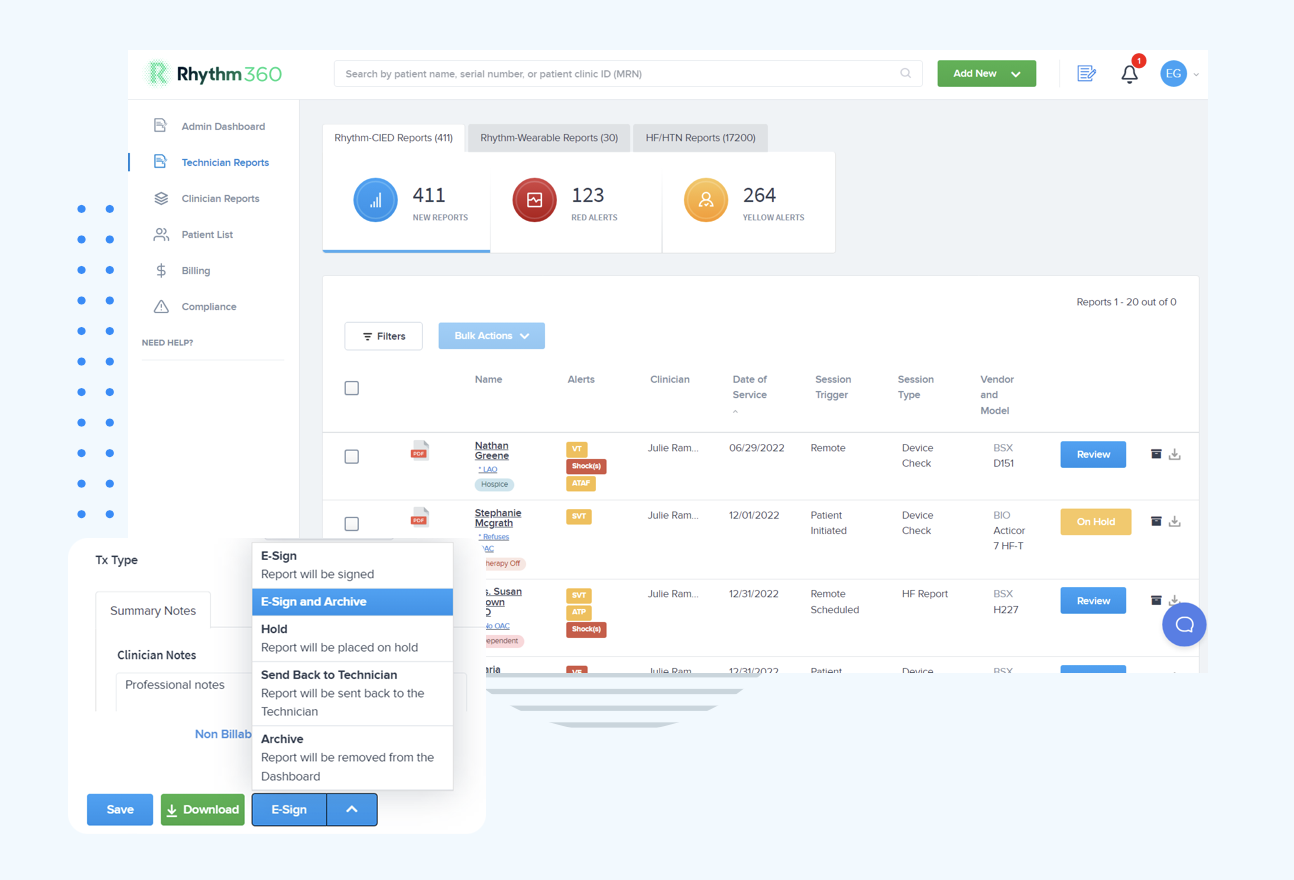
Redundant data feeds and AI-powered gap-filling via computer vision maintain greater than 99.9% transmissibility, including during OEM server outages. Optional 24/7/365 oversight by certified cardiac technicians (CCTs) supervised by physicians adds a human triage layer on top of the algorithmic one.
The clinical impact appears in everyday scenarios. A critical arrhythmia flagged on a Saturday morning, such as ventricular tachycardia on a remote CIED transmission or a significant pressure rise on a CardioMEMS sensor, reaches the on-call cardiologist’s mobile device within minutes. The patient can receive anticoagulants or device reprogramming that same day. Without a system that normalizes and triages that data before it reaches the clinician, the transmission may sit unreviewed until Monday. Rhythm360 shortens critical alert response times by up to 80% and can increase revenue capture by up to 300% through improved CPT code documentation, including 90-day cycle codes for pacemakers and ICDs (93294, 93295, 93296) and 30-day cycle codes for implantable cardiovascular physiologic monitors (93297) and subcutaneous cardiac rhythm monitors (93298).
Rhythm360 works alongside Ascom, Connexall, Vocera/Stryker, Rauland, and Critical Alert Systems as the cardiac-triage layer that feeds clean, normalized, prioritized data into the enterprise alarm-management stack those platforms provide.
See How Rhythm360 Fits Your Alarm Stack
Alarm committees can pair Rhythm360 with an enterprise alarm-management platform that matches local workflows. The vendors below are summarized with a “best for” description and a key limitation to support direct comparison.
Compare Rhythm360 With Your Current Platform
Most hospitals still rely on HL7 v2 ORU messages for acute-care device data into Epic and Cerner. An integration engine sits between the device or middleware layer and the EHR, capturing device output, matching it to the correct patient and encounter, mapping vendor-specific or IEEE 11073 codes to LOINC, validating units with UCUM, aligning timestamps, and filing the validated observation in the correct flowsheet. FHIR R4 Observation and Device resources support structured API exchange for newer equipment and analytics applications, so many organizations run HL7 v2 and FHIR in parallel. Rhythm360 offers bi-directional EHR integration with Epic, Cerner, Athenahealth, eClinicalWorks, Greenway Health, and others via HL7, with onboarding typically completed in days to a few weeks.
Closed-loop acknowledgment records whether a clinician both acknowledged and responded to an event, not just whether the alert reached a device. A system that logs delivery but not response cannot demonstrate that a critical alarm was acted upon, which Joint Commission NPG.01.05.01 expects through documented monitoring and response procedures with auditable records. The 2023 BMJ Open Quality study of 3,986 registered nurses found that 55% reported a situation where a patient needed urgent attention and no one responded to an alarm, a gap that closed-loop acknowledgment with escalation ladders is designed to address. Without a documented response record, an alarm committee cannot distinguish between an alarm that was assessed and one that was simply silenced.
Published alarm-reduction programs combine threshold review, redundancy elimination, false-positive reduction at the signal source, governance, and staff education. Case studies document alarm-volume reductions of 30 to 90 percent over 12 to 24 months, with no single intervention delivering the full reduction. The Boston Medical Center program reduced audible alarm volume in a telemetry unit by approximately 89 percent through threshold adjustment, redundancy elimination, improved electrode placement protocols, and a governance committee with authority over alarm changes while preserving detection of real clinical signals. AI-powered alert triage that filters non-actionable noise and prioritizes clinically significant events forms one part of this strategy. Rhythm360 applies this approach specifically to CIED and physiologic-monitor data before it reaches the broader alarm-management stack. Any reduction strategy must be validated against real clinical outcomes, not alarm volume alone.
Downtime planning should follow the same principles described in the downtime section. ECRI ranks digital-darkness events as a top hazard, and NFPA 99 requires essential electrical system protection for nurse call and alarm systems, supported by RF surveys to confirm wireless coverage. At the software layer, vendors should document specific behavior for each failure mode, including primary Wi‑Fi loss, cellular fallback loss, integration engine outage, and EHR unavailability. A vendor-neutral cardiac data layer with redundant data feeds and AI-powered gap-filling can maintain greater than 99.9% transmissibility even when an OEM’s server is down, so CIED transmissions and physiologic-monitor data are not silently lost during infrastructure outages.
Alarm fatigue, missed critical events, and Joint Commission scrutiny under NPG.01.05.01 call for a defensible evaluation framework organized around the alarm committee’s real decision sequence rather than a vendor feature list. The most effective architecture pairs an enterprise alarm-management platform with a vendor-neutral cardiac data and AI-triage layer that normalizes and prioritizes CIED and physiologic-monitor data before it enters the notification stack.
Rhythm360 serves as that cardiac-triage layer within the architecture. It delivers the response-time and revenue-capture gains described above, with the same bi-directional EHR integration and redundant-feed reliability, while working alongside Ascom, Connexall, Vocera/Stryker, Rauland, and Critical Alert Systems.
Schedule A Demo With Rhythm360 Today





