

Last updated: August 24, 2026
Vendor-neutral heart rhythm monitoring software is a cloud-based platform that ingests, normalizes, and displays CIED and remote physiologic monitoring data from all major device manufacturers, including Medtronic, Boston Scientific, Abbott, and Biotronik, within a single clinical workspace that operates independently of any one OEM portal or data format.
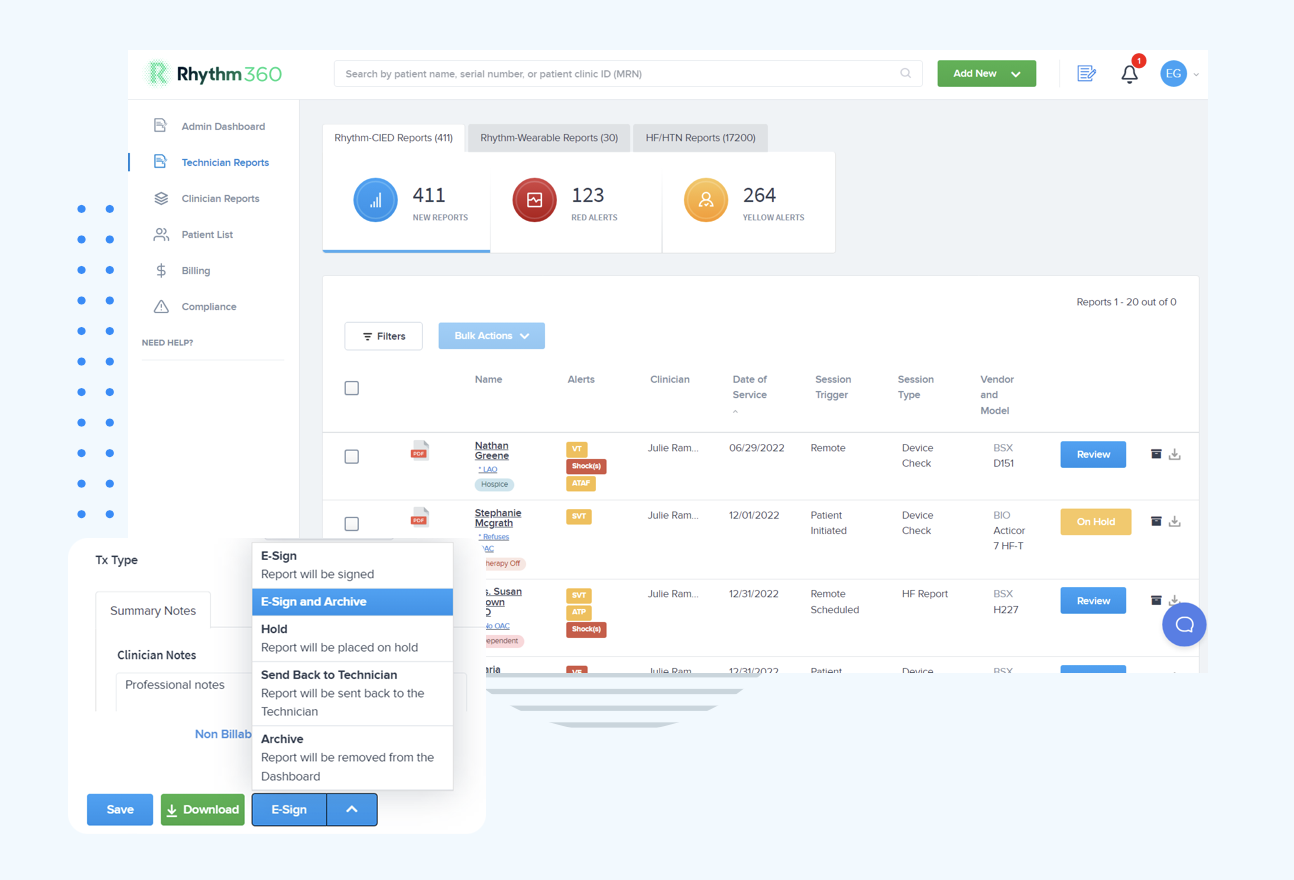
The risks of staying on fragmented OEM portals are measurable and growing. Practices that rely on passive monitoring and manual tracking across multiple portals often struggle with CPT 99454 compliance, which leaves a large share of billable cycles unclaimed. At the same time, the lack of interoperability standards between manufacturer platforms creates data silos that block comprehensive analysis and limit clinical value. Vendor-neutral software removes those silos at the infrastructure level.
Schedule a demo to see how Rhythm360 brings your entire CIED population into one dashboard.
The following table highlights five core capabilities that allow Rhythm360 to unify multi-OEM monitoring workflows while improving clinical outcomes and revenue capture.
| Capability | Rhythm360 by RhythmScience |
|---|---|
| Multi-OEM Data Normalization | Ingests API, HL7, XML, and unstructured PDFs via computer vision and AI, and achieves >99.9% data transmissibility through redundant OEM data feeds |
| AI Alert Triage | AI-powered alert prioritization filters non-actionable transmissions and surfaces clinically significant events, which reduces critical response times by up to 80% |
| Bi-Directional EHR Integration | Native bi-directional integration with Epic, Cerner, Athenahealth, eClinicalWorks, Greenway Health, and others via HL7, with implementation measured in days to weeks |
| CPT Billing Automation | Automated documentation and CPT code capture for codes including 93298, 93299, 99454, 99445, 99453, and 99457, with practices achieving up to 300% revenue improvement |
| Mobile Access | HIPAA-compliant mobile app that lets clinicians review transmissions, sign reports, and coordinate care from any location, at any time |
Each new device vendor input, including pacemakers, ICDs, loop recorders, MCTs, and FDA-approved wearables, requires its own login and process, and the administrative burden grows with every additional OEM. The manual workflow that follows is not a staffing problem. It is an architectural problem.
The consequences affect clinical care as well as operations. Staffing was always an issue for University of Chicago Medicine’s device clinic, like many other medical centers, because it struggled with technician turnover and timely weekend coverage. Fragmented portals intensify this challenge by making each technician’s knowledge non-transferable across systems. After Rhythm360 implementation, UCM reviewed more than 73,000 reports annually, averaging more than 18,000 per quarter, with stable dismissal rates that show scalable monitoring in a high-volume environment.
The 2026 regulatory environment increases the urgency. The OIG has highlighted oversight gaps following $536 million in Medicare RPM payments in 2024. A unified platform with timestamped, audit-ready documentation now functions as a requirement rather than a convenience.
Revenue leakage in cardiac monitoring often stays invisible, because it creates no denial, no alert, and no clear signal that revenue disappeared. For a cardiac monitoring program, the gap between CMS-allowed billing time and actual monitoring time can represent substantial uncollected revenue.
The 2026 CMS Physician Fee Schedule introduced new billing pathways that expand both opportunity and the risk of missing it:
Rhythm360 addresses these specific gaps with automated CPT code capture and documentation that tracks qualifying transmission days in real time across all OEM data feeds. The platform generates audit-ready records and surfaces patients at risk of missing billing thresholds before the cycle closes. Practices using Rhythm360 have achieved up to 300% improvement in revenue generation through more complete CPT code capture and better staff efficiency. As one UCM physician reported after implementation, “We have improved billing and accountability for our patients after the integration.”
Continuous remote monitoring significantly increases clinician workload because the high volume of incoming data requires organized review procedures, and poorly tuned alert systems can cause alert fatigue. When a practice monitors patients across four OEM portals, that fatigue multiplies across four separate alert queues with four different severity classifications and no shared triage logic.
AI-driven triage provides an evidence-based answer. A retrospective analysis of Assert-IQ insertable cardiac monitors showed that novel AI algorithms can reduce AF and pause electrogram data burden and transmission frequency. Rhythm360 applies similar AI-powered triage logic across all connected OEM data streams at once. The platform classifies alerts by clinical severity so that critical events such as ventricular fibrillation, complete lead failure, or ERI flagged within 30 days interrupt physician schedules immediately, while routine findings wait in a queue for scheduled review.
This approach delivers an 80% reduction in response times for critical patient alerts. A clinician at UCM described the operational shift by stating, “We are able to address these issues earlier; rather than waiting for a 3-month visit, we can call patients in for evaluation.”
Rhythm360 supports bi-directional integration with the following EHR systems:
Data moves in both directions. Transmission findings, signed reports, and CPT documentation push automatically into the patient record, and patient demographics and scheduling data pull from the EHR into Rhythm360. This workflow removes the manual transcription step that consumes physician and staff time and creates downstream administrative work for incorrect diagnoses and insurance mismatches.
Implementation speed directly affects clinical care and revenue, because a platform that takes months to deploy delays revenue recovery and keeps patients on fragmented workflows longer. Rhythm360’s onboarding process, including EHR integration setup, typically runs from a few days to a few weeks. The checklist below outlines the standard implementation sequence.
Schedule a demo to review an implementation timeline tailored to your practice’s EHR and device mix.
Device bundles, where a single OEM supplies both implanted hardware and monitoring software, create a structural conflict of interest because the monitoring platform favors that manufacturer’s devices rather than the practice’s full device mix. One of the advantages of having a single platform monitoring all devices is that even if you lose two people, the practice is not at the mercy of the two people that are leaving, which illustrates a level of resilience that OEM-bundled monitoring cannot match when staff trained on one portal depart.
Pure software becomes the appropriate choice when any of the following conditions apply, and the case strengthens as more conditions are present:
Device bundles may still fit single-OEM practices with low patient volume and no EHR integration needs. For practices that move beyond that narrow profile, the operational and financial cost of OEM-specific monitoring grows with every new device type added to the panel.
Rhythm360 serves a wide range of cardiology providers, from solo electrophysiology practices to large integrated health systems. The platform’s SaaS-based pricing scales with clinic size and platform usage, which keeps it accessible without the high setup fees tied to legacy on-premise systems. The strongest fit is a practice that monitors 50 or more CIED patients across two or more OEMs, uses an EHR with HL7 capability, and has identified revenue leakage or alert response delays as measurable operational problems. University of Chicago Medicine’s implementation shows the platform’s capacity at academic medical center scale, and Rhythm360’s flexible architecture also supports practices managing hundreds rather than tens of thousands of patients with similar workflow benefits.
EHR integration with Rhythm360 follows the implementation timeline described earlier, with duration varying based on the EHR system, the complexity of existing workflows, and the number of OEM data feeds connected at once. Rhythm360 supports bi-directional integration with Epic, Cerner, Athenahealth, eClinicalWorks, Greenway Health, and additional systems via HL7. The implementation process includes OEM portal credentialing, patient population import, EHR connection configuration and testing, alert threshold setup, and staff training. Practices go live with a parallel monitoring window to validate data flows before full cutover, and the RhythmScience implementation team manages the technical configuration to reduce the burden on internal IT staff.
Rhythm360’s automated documentation engine supports CPT code capture across both CIED remote monitoring and remote physiologic monitoring service lines. For CIED monitoring, supported codes include CPT 93296 for the remote technical component of pacemaker and ICD monitoring, 93298 for remote monitoring of implantable cardiovascular physiologic monitors, and 93299 for remote monitoring of implantable loop recorders. For remote physiologic monitoring programs that cover heart failure and hypertension patients, the platform supports CPT 99453 for patient onboarding, 99454 for device supply with 16 or more days of data transmission in a 30-day period, 99445 as the new 2026 code for 2 to 15 days of transmission, and 99457 for remote treatment management for the first 20 minutes.
The platform tracks qualifying transmission days in real time across all connected OEM and RPM data feeds, alerts staff when patients approach missed billing thresholds, and generates audit-ready documentation at the point of report signature. This automation addresses the main source of revenue leakage in cardiac monitoring programs, which occurs when billable events expire without entering the billing cycle because manual tracking across multiple portals failed to flag them in time.
Rhythm360 is a HIPAA-compliant platform built with audit-ready documentation as a core architectural requirement. The platform maintains timestamped transmission logs, signed report records, and CPT documentation trails for every billable event. This design directly supports OIG oversight of Medicare Remote Patient Monitoring Services that followed $536 million in Medicare RPM payments in 2024. Rhythm360’s automated documentation workflow captures the clinical evidence required to support each CPT claim at the time of the clinical action, which reduces reliance on retrospective reconstruction of billing records.
Rhythm360 supports both CIED monitoring and chronic disease management for heart failure and hypertension within a single platform. The Rhythm-CIED service line covers implantable device monitoring, and the chronic disease management service line covers remote physiologic monitoring for heart failure and hypertension. Both service lines operate in the same unified dashboard, so device technicians and clinicians can manage rhythm disorders, heart failure weight and fluid status, and hypertension blood pressure data without switching platforms.
Patient communications, including automated reminders and manual outreach, run through an integrated Twilio-powered messaging framework with a full audit trail. This multi-condition capability aligns with the 2027 CMS Ambulatory Specialty Model, which weights clinical quality metrics such as blood pressure control and guideline-directed medical therapy alongside RPM billing performance.
Fragmented OEM portals function as a structural barrier to clinical quality, billing compliance, and practice growth in 2026 and beyond. The global cardiac RPM market is projected to grow substantially, and differentiation is shifting toward integration depth, clinical actionability, and specialist workflow support. Practices that consolidate now gain the revenue, clinical outcomes, and operational resilience that fragmented workflows cannot match.
Rhythm360 by RhythmScience is a vendor-neutral, AI-powered platform built for multi-OEM cardiology practices that need a single source of truth across every device manufacturer, every CPT code category, and every EHR system they use. The alert response improvements described earlier, combined with the revenue gains documented in multi-practice implementations and implementation timelines measured in days to weeks rather than months, create a clear and immediate operational case for consolidation.
Schedule a demo and see how Rhythm360 consolidates your multi-OEM monitoring program into one unified, compliant, and revenue-focused platform.





