

Last updated: August 24, 2026
Cardiology practices in 2026 must manage remote monitoring across four proprietary OEM portals: Medtronic CareLink, Abbott Merlin.net, Boston Scientific Latitude, and Biotronik Home Monitoring. Each portal uses different alert formats, transmission schedules, and data export structures, which creates manual reconciliation work that does not scale. Many practices manage implants from multiple manufacturers, each requiring a separate portal login, so staff spend time navigating systems instead of caring for patients.
The financial exposure from this fragmentation is substantial. A cardiac monitoring program can lose significant revenue annually when billed monitoring time falls short of CMS-allowed thresholds. That shortfall stems directly from manual workflows. These manual processes cause billable events to go unbilled, often because staff miss billing periods or lack physician interpretation notes. Documentation compliance also challenges many remote cardiac monitoring providers. At the same time, the OIG's August 2025 report found that Medicare RPM payments totaled $536 million in 2024, so automated audit trails now function as a core risk-mitigation requirement rather than a nice-to-have feature.
The clinical risk compounds the financial risk. Remote monitoring generates large volumes of transmissions and alerts across broad patient cohorts. Staff without intelligent triage become overwhelmed by this volume, which drives alert fatigue and increases the chance that critical events go unnoticed. As Robert Kelly, Founder and CEO of Heart Rhythm International, states: "If the underlying data is fragmented, remote monitoring can easily add complexity rather than reduce it."
The solution to this fragmentation lies in platforms that consolidate data across all manufacturers and automate downstream workflows. The following four criteria describe how an enterprise platform should address these challenges and how Rhythm360 performs against each requirement.
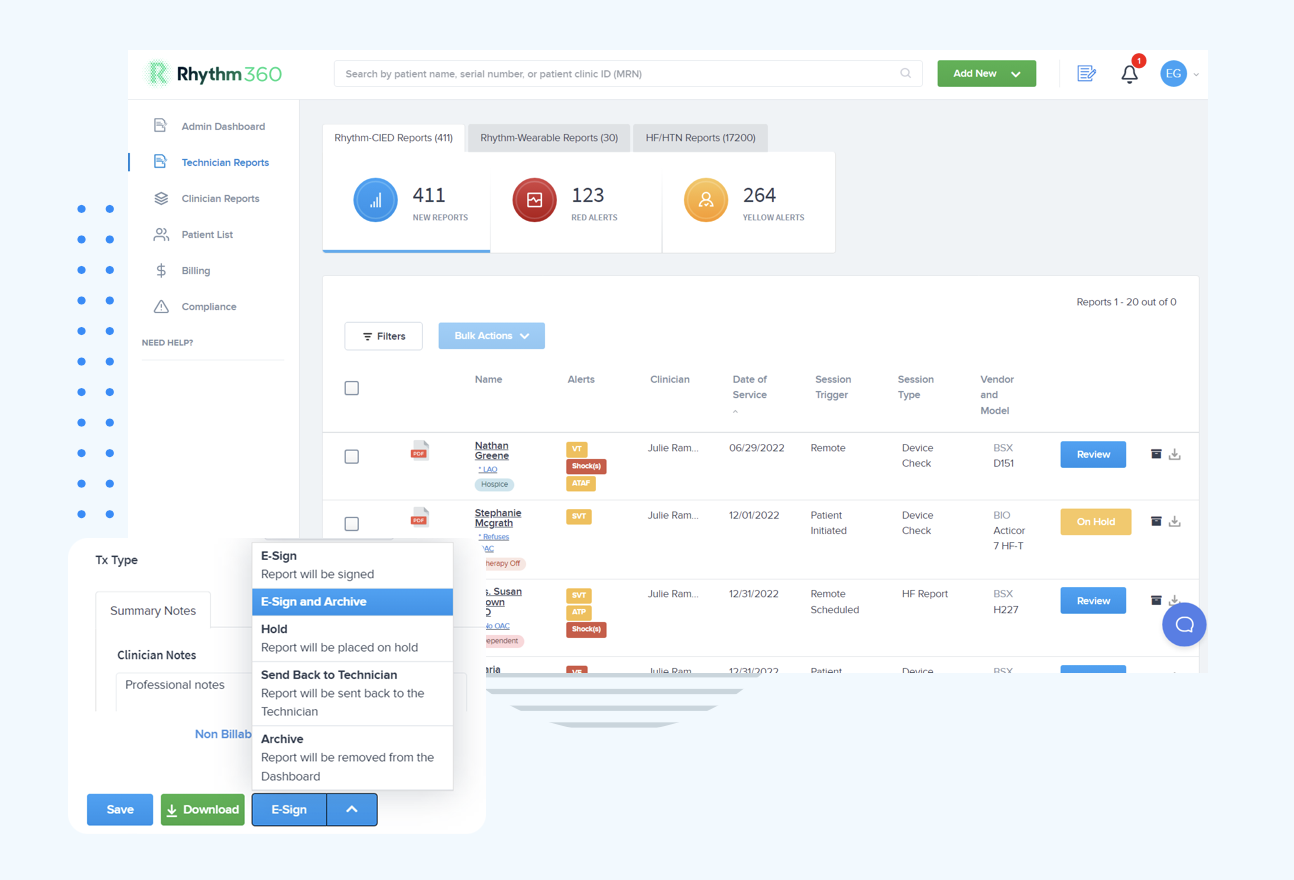
A true multi-OEM CIED monitoring platform ingests data from every major device manufacturer into a single normalized view, which removes redundant logins and manual transcription. Rhythm360 aggregates data from Medtronic, Abbott, Boston Scientific, and Biotronik into one dashboard using APIs, HL7, XML, and computer-vision PDF parsing. This approach achieves a data transmissibility rate that supports enterprise-scale operations.
| Rhythm360 Capability | How It Works | Measurable Outcome |
|---|---|---|
| Vendor-neutral data ingestion | APIs, HL7, XML, and computer-vision PDF parsing across all major OEMs | Single dashboard replaces 4+ portal logins |
| Redundant data feeds | AI gap-filling maintains data continuity during OEM server downtime | >99.9% data transmissibility |
| Unified patient population view | Normalized data across pacemakers, ICDs, ILRs, CRT, and CardioMEMS | Portal review time reduced from 2–3 hours to 30–45 minutes of exception handling |
| Enterprise scale | Cloud-based architecture with HIPAA-compliant infrastructure | University of Chicago Medicine processed more than 73,000 reports annually through Rhythm360 |
AI alert triage in cardiology separates clinically actionable events from non-actionable noise so staff see fewer alerts while still catching high-risk findings. Rhythm360's AI-driven alert triage reduces critical-alert response times by up to 80%. The broader evidence base for AI triage in cardiac monitoring supports this approach, as AI-based triage can reduce clinical decision-making time for chest-pain patients.
| Rhythm360 Capability | How It Works | Measurable Outcome |
|---|---|---|
| AI-powered alert prioritization | Machine learning filters non-actionable transmissions, and critical alerts are escalated immediately | Up to 80% reduction in critical-alert response times |
| Optional 24/7/365 CCT oversight | Certified cardiac technicians supervised by physicians provide human over-read | Proactive intervention on weekends and after hours |
| Mobile alert delivery | HIPAA-compliant mobile app pushes prioritized notifications to clinicians | Clinicians review and act on critical alerts from any location |
| Tunable alert thresholds | Configurable parameters per patient and device type | Aligns with 2023 HRS/EHRA/APHRS/LAHRS consensus target of approximately one alert per patient-year |
Andrew Beaser, MD, Associate Professor of Medicine at the University of Chicago Medicine, noted that Rhythm360 enabled clinicians to review more transmissions daily and identify more abnormalities. This improvement came directly from AI triage removing the noise that previously obscured signal.
Bi-directional EHR integration ensures that device data flows into the EHR automatically while structured clinical notes, billing fields, and physician signature prompts flow back to the monitoring platform. This approach removes dual data entry and supports OIG audit defense. Enterprise platforms must integrate with Epic, Athena, ModMed, and NextGen by pre-populating structured notes with device parameters, alert summaries, and physician signature fields. Rhythm360 provides bi-directional EHR integration with Epic, Cerner, Athenahealth, eClinicalWorks, Greenway Health, and GE Centricity via HL7 and Smart on FHIR APIs.
| Rhythm360 Capability | How It Works | Measurable Outcome |
|---|---|---|
| Bi-directional EHR sync | HL7 and Smart on FHIR APIs with Epic, Cerner, Athenahealth, eClinicalWorks, Greenway Health, and GE Centricity | Eliminates manual transcription and dual data entry |
| Auto-populated structured notes | Device parameters, alert summaries, and physician signature fields are pre-filled | Audit-ready documentation for every transmission |
| Integrated communication hub | Twilio-powered messaging with full audit trail in the patient record | Coordinated care with documented patient contact history |
| Rapid onboarding | Streamlined implementation process that includes EHR integration | Go-live in days to weeks depending on practice size and EHR complexity |
Remote monitoring CPT code automation tracks billable events, enforces 90-day and monthly billing windows, and generates compliant documentation without manual work. The financial stakes in 2026 are higher than ever. CMS increased the technical component RVU for CPT 93296 from 0.60 to 0.95 effective January 1, 2026, representing approximately 60% more reimbursement per service. Rhythm360 automates documentation and billing for CPT codes 93298, 93299, 99454, 99453, and 99457, with reported revenue increases of up to 300%.
| Rhythm360 Capability | How It Works | Measurable Outcome |
|---|---|---|
| Automated CPT tracking | Platform monitors 90-day CIED cycles and monthly RPM windows and flags approaching deadlines | Billing compliance above 90% at leading cardiology centers using interval-based workflows |
| Documentation auto-generation | Physician interpretation notes and transmission summaries are generated per claim | Closes billing gap from missed events and absent notes |
| Revenue dashboard | Real-time view of captured and potential revenue by CPT code and patient | Administrators identify leakage before billing cycles close |
| OIG audit trail | Every transmission links to physician signature, alert log, and communication record | With RPM payments exceeding $500 million in 2024 (per the OIG report cited earlier), this level of traceability supports audit readiness. |
With all four enterprise criteria established, the next sections address common questions practices ask when deciding whether to implement an enterprise monitoring platform.
Medicare RPM services grew substantially from 2019 to 2023, and Medicare and Medicare Advantage payments for remote patient monitoring exceeded $500 million in 2024, covering nearly one million beneficiaries. The core profitability question focuses on whether a practice's infrastructure captures that revenue reliably. A CIED monitoring program can generate additional annual revenue from the 2026 CPT 93296 RVU increase alone when billing is automated and properly documented. A program can gain additional revenue per year solely from correctly capturing the updated 2026 CPT 93296 rate. Rhythm360's administrative dashboard provides a real-time view of captured and potential revenue by CPT code, and the HIPAA-compliant mobile app allows physicians to sign reports and close billing cycles from anywhere, which removes the delayed signatures that commonly cause claims to lapse.
Loop recorders can represent a meaningful percentage of devices in a typical multi-manufacturer panel while producing a large share of all alerts. This pattern makes threshold configuration and intelligent triage the primary levers for managing alert volume. The 2023 international consensus statement on remote device clinics recommends customized alert programming to reduce alert frequency to roughly one per patient-year while making remaining alerts more actionable, with a written response clock requiring red-alert action within one business day.
Rhythm360 addresses alert fatigue through two complementary mechanisms. AI-powered triage filters non-actionable transmissions before they reach clinical staff, and optional 24/7/365 oversight by certified cardiac technicians adds a human over-read layer. Clinicians then receive prioritized, actionable notifications through the Rhythm360 mobile app instead of an undifferentiated queue. As UCM's experience demonstrates, earlier identification of abnormalities means clinicians can call patients in for evaluation rather than waiting for a 3-month visit. This shift moves the clinical model from reactive care to proactive intervention.
Hospitals evaluating cardiac monitoring platforms require EHR or EMR integration with systems such as Epic, Cerner, or Meditech, HL7 FHIR API support for data exchange, and single sign-on for clinical staff as baseline procurement requirements. The distinction between one-way and bi-directional integration has real operational impact. Bi-directional integrations add configuration complexity but are essential for pre-populating structured notes and returning completed reports with discrete measurements and diagnoses without dual data entry.
Rhythm360's bi-directional integrations with Epic, Cerner, Athenahealth, eClinicalWorks, Greenway Health, and GE Centricity via HL7 and Smart on FHIR APIs are managed on the vendor side, which reduces the burden on clinic IT resources. UCM reported improved billing and accountability for patients following Rhythm360 integration, a direct outcome of structured data flowing automatically into billing workflows instead of requiring manual entry.
| Practice Type | Days 1–10 | Days 11–20 | Days 21–30 |
|---|---|---|---|
| Solo EP Practice | OEM credential setup, patient panel import, EHR connection configured | Alert threshold configuration, staff training on dashboard and mobile app | First billing cycle reconciliation, go-live with full patient panel |
| 5–10 Physician Clinic | OEM credential setup, EHR integration kickoff, patient segmentation by CPT code family | Bi-directional EHR testing, alert triage rules configured, clinical staff trained | Billing workflow validation, non-transmission report review, full go-live |
| 20+ Physician Health System | IT and EHR team kickoff, data mapping and workflow alignment, phased patient cohort defined | Bi-directional EHR integration testing across departments, CCT oversight configured, admin dashboard deployed | Alert threshold tuning, median alert-to-action time measured, expansion to full patient population |
| CPT Code | Service Description | Incremental Revenue per 100 Additional Transmissions Captured | 2026 Context |
|---|---|---|---|
| 93298 | Remote monitoring of implantable cardiac device, physician analysis and report | Varies by RVU locality; closing a 20% billing gap on a 200-patient program recovers $12,000–$18,000 annually | Requires physician interpretation note per transmission; automated documentation closes the most common denial gap |
| 93299 | Remote monitoring of implantable cardiac device, technical component | ~$32 additional per service from 2026 RVU increase on CPT 93296 (technical component); 100-patient clinic gains ~$38,400/year | The 2026 RVU increase described above drives this revenue gain. |
| 99454 | Remote physiological monitoring device supply, 16+ days per 30-day period | ~$47 per missed claim; 200-patient program loses ~$38,000/year from one missed billing cycle per patient per quarter | Practices using manual tracking achieve 16-day compliance rates below 70%; automation closes this gap |
Remote patient monitoring is profitable when a practice has the infrastructure to capture every billable event within CMS-defined windows. As discussed earlier, Medicare RPM claims have grown substantially since 2019, reaching the $500 million threshold in 2024. The profitability gap appears between practices that rely on manual tracking, where some billable events go unbilled, and those using automated platforms that enforce 90-day CIED cycles and monthly RPM windows. Rhythm360's automated CPT capture and revenue dashboard are designed to close that gap, and practices report revenue increases of up to 300%.
Alert fatigue in device clinics decreases through a combination of AI-powered triage, tunable alert thresholds, and human over-read layers. Following the consensus guidance described earlier, Rhythm360 applies AI triage to filter non-actionable transmissions before they reach clinical staff, escalates red alerts immediately, and offers optional 24/7/365 oversight by certified cardiac technicians. Clinicians then interact only with prioritized, clinically significant events instead of an undifferentiated alert queue.
Bi-directional EHR integration functions as the standard for enterprise cardiac remote monitoring in 2026. One-way integrations push data into the EHR but require manual entry for billing fields and physician signatures, which recreates the documentation gaps that cause claim denials. Bi-directional integration pre-populates structured notes with device parameters, alert summaries, and signature prompts, then returns completed documentation to the monitoring platform for audit purposes. Rhythm360 supports bi-directional integration with Epic, Cerner, Athenahealth, eClinicalWorks, Greenway Health, and GE Centricity via HL7 and Smart on FHIR APIs.
Legacy OEM portals are manufacturer-specific, non-interoperable, and not designed for multi-OEM patient populations. A practice with devices from Medtronic, Abbott, Boston Scientific, and Biotronik must maintain four separate logins, reconcile four different alert formats, and manually transfer data into clinical and billing workflows. This fragmentation creates data silos, increases transcription error risk, and makes it structurally impossible to enforce consistent billing windows across a mixed-manufacturer panel. Fragmented workflows remain the most common root cause of denied claims, missed technical-component revenue, and compliance exposure in remote monitoring programs.
Rhythm360's implementation process, including EHR integration, typically takes from a few days to a few weeks depending on practice size and EHR complexity. Solo EP practices and smaller clinics with straightforward EHR environments can go live within days. Mid-sized clinics and large health systems with Epic or Cerner integrations require additional coordination for data mapping and workflow alignment, but Rhythm360 manages the technical build on the vendor side to reduce the burden on clinic IT resources. The phased onboarding approach, which covers OEM credential setup, EHR integration, alert threshold configuration, and billing workflow validation, is designed to minimize disruption to ongoing clinical operations.
The four procurement criteria for enterprise heart rhythm monitoring platforms in 2026, multi-OEM consolidation, AI alert triage, bi-directional EHR integration, and automated CPT capture, operate as interdependent requirements. Consolidation without triage produces alert overload. Triage without EHR integration produces documentation gaps. EHR integration without CPT automation produces revenue leakage. Rhythm360 addresses all four requirements simultaneously at the scale required by solo EP practices, 5–10 physician clinics, and 20+ physician health systems.
The University of Chicago Medicine's experience, more than 73,000 reports annually, improved billing accountability, and earlier clinical interventions, shows what enterprise-scale performance looks like in practice. Other platforms exist in the market, but Rhythm360 is designed to meet all four criteria within a single, vendor-neutral, HIPAA-compliant platform.





