Last updated: August 24, 2026
The table below consolidates the exact time thresholds, documentation rules, and billing frequencies for both the CIED and RPM code families effective in 2026, so you can see which billing windows apply to your current device mix and where mutual exclusivity rules create the highest risk of claim denials. Every figure is drawn from published CMS and payer guidance.
| CPT Code | Service Description | Time Threshold / Billing Window | 2026 Medicare National Average Rate |
|---|---|---|---|
| 93294 | Remote pacemaker interrogation with physician signed report | Once per 90-day period per device | Varies by payer; covered by Medicare, Aetna, BCBS, Cigna, UHC |
| 93295 | Remote ICD interrogation with physician signed report | Once per 90-day period per device | Varies by payer; duplicate billing triggers CO-18 denial |
| 93296 | Technical component of remote rhythm monitoring (pacemaker or ICD) | Once per 90-day period | Varies by payer; cannot be stacked with 99453/99454 |
| 93297 | Remote interrogation of implantable cardiovascular monitor (e.g., hemodynamic sensor) | Once per 30-day period | Varies by payer; mutually exclusive with 99454 for same period |
| 93298 | Remote interrogation of subcutaneous cardiac rhythm monitor / loop recorder | Once per 30-day period | Varies by payer; 99454 excluded under parentheticals |
| 93299 | Technical component for subcutaneous rhythm monitor remote interrogation | Once per 30-day period | Varies by payer |
| 99453 | RPM device setup and patient education (one-time per device) | One-time; minimum 2 days of monitoring required before billing | Carrier-determined (no national rate) |
| 99445 (new 2026) | RPM device supply with 2–15 days of transmitted data in a 30-day period | 2–15 days of data per 30-day period; mutually exclusive with 99454 | Varies by payer |
| 99454 | RPM device supply with 16–30 days of transmitted data in a 30-day period | 16–30 days of data per 30-day period; mutually exclusive with 99445 | $52.11 |
| 99470 (new 2026) | RPM treatment management, first 10–19 minutes in a calendar month | 10–19 minutes; not additive with 99457 in the same month | $26.05 |
| 99457 | RPM treatment management, first 20 minutes in a calendar month | 20+ minutes with interactive patient communication | Varies by payer |
| 99458 | RPM treatment management, each additional 20-minute increment | Each additional 20 minutes after 99457 threshold; unlimited increments | $41.42 |
Rhythm360 automates threshold tracking for every code in this table by ingesting data via API, HL7, XML, and PDF parsing, then mapping each transmission to the correct billing window. This automation prevents the most common billing error: duplicate claims within a single period. For example, billing 93295 more than once in a 90-day window triggers a duplicate denial, but Rhythm360 patient-by-patient calendars flag the approaching window boundary before the claim is submitted and stop the error at the source.
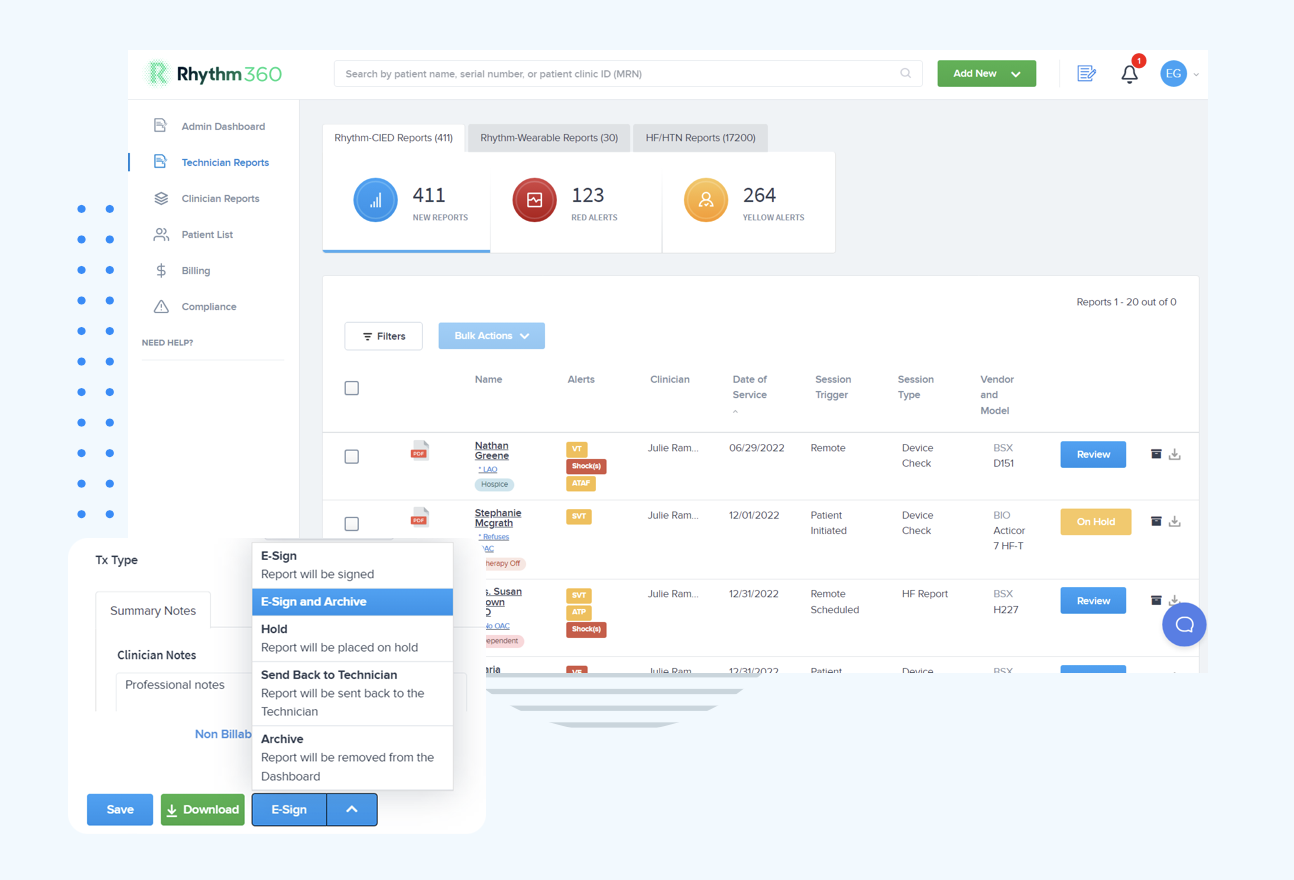
A reliable billing workflow for multi-OEM cardiology practices follows five sequential steps, and each step below maps directly to a Rhythm360 platform capability.
University of Chicago Medicine (UCM) implemented Rhythm360 to overhaul cardiovascular remote monitoring for CIED and heart failure patients. UCM reviewed more than 73,000 reports annually through Rhythm360 in calendar year 2025, averaging more than 18,000 reports per quarter. A UCM clinician noted directly: "We have improved billing and accountability for our patients after the integration."
The financial case is equally direct. RPM programs generate an estimated $120–$200 in monthly reimbursement per patient via CPT codes 99453–99458, with a 100-patient panel yielding $12,000–$20,000 monthly revenue. Practices using Rhythm360 have reported up to 300% revenue growth through more complete CPT code capture, improved staff efficiency, and the addition of RPM service lines for heart failure and hypertension patients. That revenue improvement stems directly from faster clinical response times that capture billable events within the correct billing windows.
One common scenario illustrates this link. A patient’s loop recorder transmits a new-onset AFib event at 7:00 a.m. on Saturday. Without a unified platform, that transmission sits in an OEM portal until Monday. With Rhythm360, the AI triage layer flags the event, routes it to the on-call clinician mobile app, and by Saturday afternoon the patient is on anticoagulants. That clinical outcome also generates a documented, billable 93298 transmission event. UCM clinicians noted they are able to address issues earlier; rather than waiting for a 3-month visit, they can call patients in for evaluation. Rhythm360 reduces critical-alert response times by up to 80% across its client base.
See your practice’s ROI projection based on your patient panel size and OEM mix.
EHR integration is a prerequisite for sustainable remote monitoring adoption because data that lives in a separate system and is not visible during clinical encounters pushes providers to reject monitoring programs. Data that lives in a separate system and is not visible during clinical encounters leads providers to reject monitoring programs. Rhythm360 completes bi-directional HL7 integration in days to weeks, not months.
The integration checklist for each major EHR system follows the same core architecture:
Structured cardiology-specific documentation workflows integrated into EHR records can reduce diagnostic data entry time per encounter and shorten the time from test completion to physician review. Rhythm360 integration delivers those same efficiency gains by eliminating the manual step of transcribing OEM portal data into the clinical record and writing structured data directly into the EHR flowsheet.
The revenue math for a practice that automates CPT billing through Rhythm360 stays straightforward. Using 2026 Medicare national average rates, a 100-patient RPM panel generates the following monthly reimbursement when all three billing components are captured:
Combined reimbursement across the RPM code set runs approximately $78–$245+ per patient per month under 2026 CMS rules. At $150 average per patient, a 100-patient panel produces $15,000 monthly, or $180,000 annually, before accounting for CIED codes. A modeled 100-patient deployment can generate substantial annual net profit after ongoing costs, with RPM programs delivering strong ROI.
The revenue leak in manual workflows comes from two sources: incomplete month capture and missed billable events. The new 2026 RPM codes CPT 99445 (device supply for 2–15 days) and 99470 (first 10 minutes of management) allow billing and revenue capture for shorter monitoring periods that previously fell below the 16-day and 20-minute thresholds and generated zero reimbursement. These gains occur only when the platform tracks transmission days accurately enough to assign the correct supply code. Rhythm360 automated day-count tracking handles that assignment in real time. Equally important, signed reports must land inside the correct billing window, even when events occur outside business hours.
For on-call clinicians, Rhythm360 HIPAA-compliant mobile app allows report review and digital signing from any location. A physician who can sign a completed 93298 report on a Saturday morning, rather than waiting until Monday, captures that billable event within the correct 30-day window. Across a population of hundreds of loop recorder patients, the revenue impact becomes material.
Request a custom profitability analysis for your patient panel and current CPT capture rate.
CMS introduced two new RPM codes effective January 1, 2026. CPT 99445 covers device supply when a patient transmits data for 2 to 15 days within a 30-day period. CPT 99470 covers the first 10 to 19 minutes of treatment management in a calendar month. These codes capture revenue from monitoring periods that previously generated zero reimbursement because they fell below the 16-day and 20-minute thresholds required for the existing codes. The full 2026 RPM code set now includes 99453 (one-time setup), 99445 (2–15 days device supply), 99454 (16–30 days device supply), 99470 (10–19 minutes management), 99457 (first 20 minutes management), and 99458 (each additional 20 minutes). CPT 99445 and 99454 are mutually exclusive, so only one device-supply code may be billed per patient per 30-day period based on the number of days data was transmitted.
Medicare covers remote cardiac monitoring under two distinct code families. CIED remote interrogation, covering pacemakers, ICDs, CRT devices, implantable cardiovascular monitors, and subcutaneous rhythm monitors, is billed under CPT codes 93294 through 93299, with reporting windows of either 30 or 90 days depending on device type. Remote physiologic monitoring for chronic conditions such as heart failure and hypertension is billed under CPT codes 99453 through 99458 plus the new 2026 codes on a calendar-month basis. Medicare requires that RPM devices be FDA-cleared medical-grade devices with automatic digital transmission; manually entered readings do not count toward billing thresholds. Patients must have a chronic or acute condition requiring monitoring and must transmit data at least 2 days in every 30-day period to qualify for device-supply reimbursement. CPT parentheticals prohibit reporting general RPM codes 99453 and 99454 alongside more specific CIED codes such as 93296, 93297, or 93298 for the same patient and period, a compliance detail that automated platforms track automatically.
Remote patient monitoring is profitable for cardiology practices that capture all three billing components, setup, device supply, and treatment management, consistently each month. Under 2026 CMS rules, practices can expect reimbursement in the range discussed in Section 5 when all billing components are captured consistently. A 100-patient panel at $150 average produces $180,000 annually. The payback period for launching an RPM program varies, with modeled deployments showing positive net profit after ongoing costs. Profitability depends on accurate day-count tracking to assign the correct supply code (99445 vs. 99454), documented clinical management time to support 99457 and 99458 claims, and clean separation from other care-management billing such as chronic care management. Practices that automate these tracking functions through a platform like Rhythm360 capture billable events that manual workflows routinely miss, which drives the up-to-300% revenue improvement reported by Rhythm360 clients.
The most important criteria for selecting a cardiology remote monitoring billing platform are vendor neutrality, data transmissibility, EHR integration depth, and CPT automation accuracy. Vendor neutrality means the platform ingests data from all OEM device manufacturers, including Medtronic, Boston Scientific, Abbott, Biotronik, and others, without requiring separate portal logins for each. Data transmissibility above 99.9% ensures that no billable transmission is lost due to OEM server downtime or data format inconsistencies. EHR integration should be bi-directional and complete within days to weeks, not months, and should support the major systems used in cardiology: Epic, Cerner, Athenahealth, and eClinicalWorks. CPT automation accuracy means the platform tracks 30-day and 90-day billing windows per patient per device, assigns the correct supply code based on actual transmission day counts, logs clinical management time against the correct calendar month, and generates audit-ready documentation without manual transcription. Compliance posture also matters: the CY 2027 Medicare Physician Fee Schedule proposed rule, open for comment through September 14, 2026, would restrict RPM billing to services performed by clinical staff directly employed by the billing practice, a regulatory shift that makes in-house workflow automation more important, not less.
Cardiology practices generating the strongest financial and clinical outcomes from remote monitoring in 2026 share one structural characteristic: they operate from a single, integrated platform rather than a collection of disconnected OEM portals and manual billing spreadsheets. Accurate CPT billing for CIED and RPM codes requires real-time threshold tracking, audit-ready documentation, and EHR-connected workflows that no manual process can sustain at scale.
Rhythm360 delivers vendor-neutral data ingestion from all major device manufacturers, AI-powered alert triage that reduces critical-event response times by up to 80%, automated CPT threshold tracking for the full 93294–93299 and 99453–99458 code families, and bi-directional EHR integration completed in days to weeks. University of Chicago Medicine experience, processing the volume described earlier, shows that the architecture scales from solo EP practices to academic medical centers.
Book your platform walkthrough to see the 2026 CPT automation workflow in action, review a profitability projection for your patient panel, and get an integration timeline for your EHR system.