Last updated: July 14, 2026
Cardiology is one of the highest-complexity billing specialties with denial rates of 15–25%, and industry benchmarks show net collection rates of 93–96%. Documentation failure caused by disconnected systems, not clinical error, drives much of this loss.
When a practice implants devices from Medtronic, Boston Scientific, Abbott, and Biotronik, staff must log into four separate, non-interoperable portals to retrieve transmission data. Each login adds a manual step where a CPT code can be missed, a monitoring period miscounted, or a billing window closed. CIED transmissions received but not billed within the 90-day cycle create permanent revenue loss, and RPM data that did not meet the prior 16-day minimum is now billable under new 2026 codes that many practices have not implemented.
Cardiac rehab, intensive cardiac rehab, CCM, and RPM remain underclaimed revenue streams for most cardiology practices. For a multi-cardiologist group, this often represents the single largest unrecognized revenue category. A platform architecture change, not more staff hours, fixes this structural problem.
See how Rhythm360 eliminates these revenue gaps in your practice.
The 2026 CPT update introduced significant changes to both CIED and RPM billing. Medicare eliminated the all-or-nothing 16-day rule, replacing it with a tiered system that requires practices to select the precise code, CPT 99445 for 2–15 days of data or CPT 99454 for 16 or more days, based on actual transmission volume in each 30-day period. This shift from a single threshold to continuous day counting makes manual tracking across hundreds of patients operationally unsustainable.
The active CIED-specific code set includes:
The 2026 RPM code set adds:
Automated platforms track transmission day counts in real time and assign the correct code before the billing window closes.
Rhythm360 ingests data from all major CIED manufacturers, including Medtronic, Boston Scientific, Abbott, and Biotronik, using API connections, HL7, XML, and AI-powered computer vision to parse unstructured PDFs. A redundant data feed architecture acts as a fail-safe when an OEM server is unavailable, which supports greater than 99.9% data transmissibility.
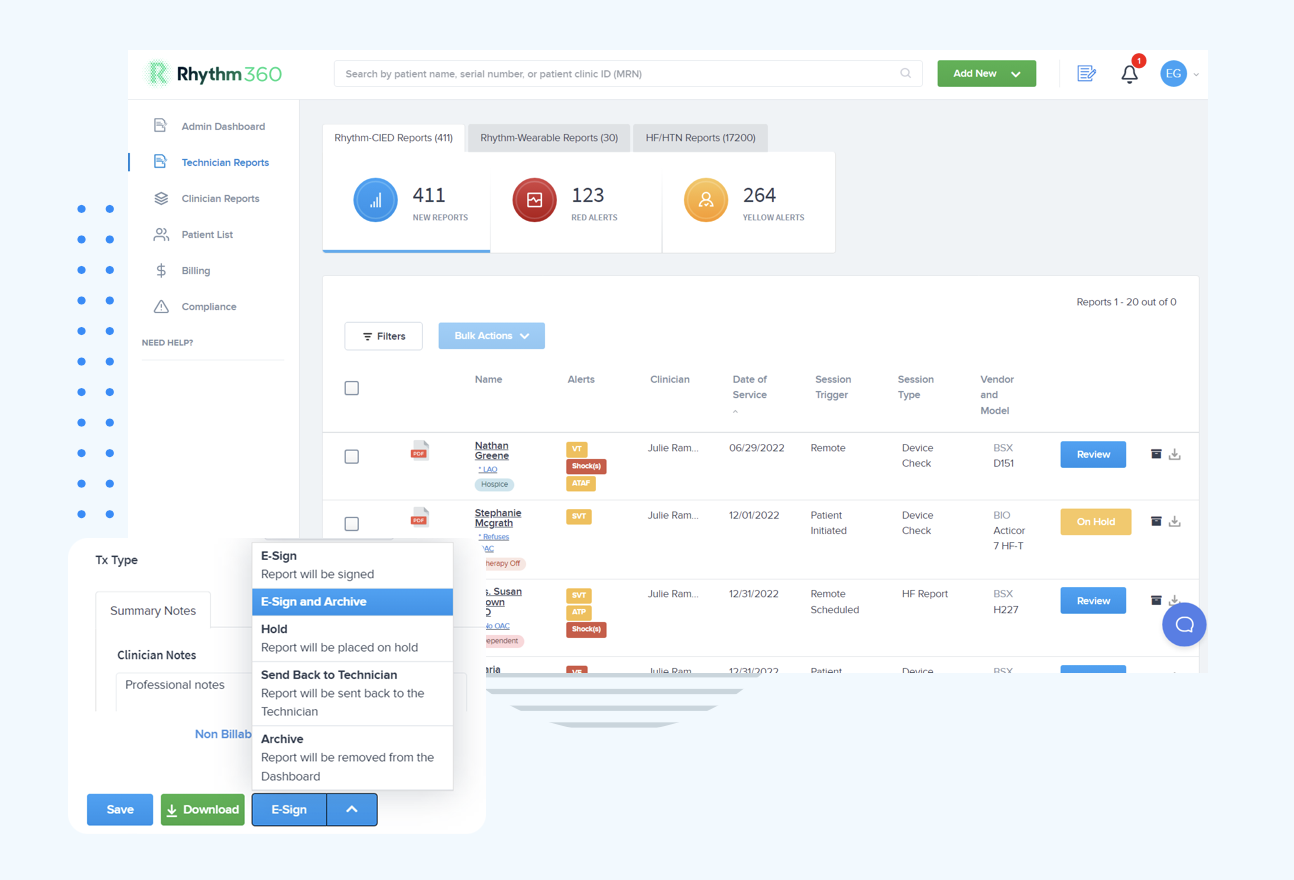
University of Chicago Medicine reviewed more than 73,000 reports annually through Rhythm360 in calendar year 2025, averaging more than 18,000 reports per quarter. That volume confirms the platform's scalability for high-load CIED environments. At that scale, a single percentage point of data loss translates directly into missed billing events and delayed clinical interventions.
At Lehigh Valley Health Center, AI implementation significantly reduced alert fatigue in cardiac remote monitoring. Alert fatigue creates both patient safety risk and billing compliance exposure. Clinicians who cannot separate signal from noise miss critical events and fail to generate the documentation required for CPT reimbursement.
Rhythm360's AI-driven alert triage filters non-actionable transmissions and prioritizes clinically significant events such as new-onset atrial fibrillation, ventricular tachycardia, and device malfunction. This workflow reduces critical response times by up to 80%. As data volumes grow, AI-assisted decision support becomes increasingly important. The platform also supports optional 24/7/365 oversight by certified cardiac technicians (CCTs) supervised by physicians for practices that need additional clinical coverage.
On-call clinicians use Rhythm360's HIPAA-compliant mobile application to review transmissions, sign reports, and coordinate care from any location. This mobile access removes the risk of a critical Saturday alert going unaddressed until Monday.
Automated billing and coding software in cardiology produces measurable financial gains. Rhythm360 practices have documented the following outcomes:
| Rhythm360 Feature | Outcome | 2026 Metric |
|---|---|---|
| Automated CPT code capture across all CIED and RPM code families | Revenue increase through optimized billing | Up to 300% increase in profitability |
| AI-powered alert triage and prioritization | Faster critical event response | Up to 80% reduction in response times |
| Greater than 99.9% data transmissibility via redundant feeds and AI extrapolation | Near-zero transmission data loss | >99.9% transmissibility rate |
| Bi-directional EHR integration (Epic, Cerner, Athenahealth, eClinicalWorks, and others) | Eliminated manual data re-entry and documentation gaps | Improved billing and accountability confirmed at UCM (2025) |
| Scalable SaaS pricing with implementation in days to weeks | Rapid time-to-value without capital expenditure | Onboarding in days to weeks |
Industry claim denial rates reached approximately 12.6% in 2026, with cardiology seeing rates between 9–14%. Automated pre-submission claim scrubbing and compliant documentation generation address the root cause of those denials before submission.
Remote monitoring data that sits outside the EHR creates clinical gaps and revenue leakage from unbilled CCM, RPM, and BHI services, as undocumented care management time increases claim denials.
Rhythm360 supports bi-directional integration with Epic, Cerner, Athenahealth, eClinicalWorks, Greenway Health, and other systems via HL7. Data flows directly into the clinical chart, and billing-ready documentation, including patient demographics, device type and manufacturer, monitoring period dates, and clinician interpretation notes, is generated automatically. CMS 2026 audit readiness requires contemporaneous documentation, clear attribution of work to eligible staff, and defensible linkage between data reviewed, interactions, and clinical decision-making. Rhythm360's automated documentation architecture aligns with these requirements.
Rhythm360 supports distinct but integrated service lines for CIED monitoring and RPM programs covering heart failure and hypertension. The platform automates the compliance documentation requirements that the 2026 CMS Physician Fee Schedule highlights for audit readiness, including:
Rhythm360 combines CIED monitoring, HF and HTN RPM, AI-powered billing automation, and bi-directional EHR integration within a single vendor-neutral platform purpose-built for cardiology compliance in 2026.
Request a walkthrough of Rhythm360's RPM compliance automation for your workflow.
AI implementation in EP remote monitoring produced major reductions in burnout among staff and physicians by removing the need to sift through massive volumes of transmitted data. Staff retention closely follows workflow design. Practices that rely on manual portal navigation and spreadsheet-based billing tracking experience higher turnover among specialized device technicians, which compounds cost over time.
Rhythm360's centralized administrative dashboard provides real-time visibility into patient compliance rates, critical alert status, and captured versus potential revenue by CPT code. Organizations that implement AI medical billing solutions often achieve 300% to 600% or greater ROI, with costs equivalent to one to two FTEs while delivering higher throughput and fewer errors. For a cardiology practice managing thousands of CIED patients, that operational leverage separates sustainable monitoring programs from those that erode margin with every transmission cycle.
The most frequently missed codes in CIED remote monitoring are CPT 93296, CPT 93298, and the RPM management codes CPT 99457 and 99470. These codes require precise documentation of monitoring period dates, transmission day counts, and clinical staff time that manual workflows rarely capture consistently. The 2026 CPT updates introduced CPT 99445 for 2–15 days of RPM data and CPT 99470 for 10–19 minutes of treatment management, and many practices have not yet incorporated these into their billing workflows. Rhythm360 automates tracking of these requirements and generates compliant documentation before the billing window closes.
AI in cardiology billing and coding software supports clinical staff and certified coders rather than replacing them. In CIED remote monitoring, AI automates transmission day counting, code selection between 99445 and 99454, alert triage, and documentation generation. Clinical staff retain full responsibility for interpreting device data, making care decisions, and signing reports. Certified coders retain responsibility for complex coding decisions and audit defense. Rhythm360's AI-powered platform handles data ingestion, normalization, and billing documentation so that clinical and coding staff focus on work that requires human judgment instead of portal navigation and spreadsheet reconciliation.
Rhythm360 supports bi-directional EHR integration with Epic, Cerner, Athenahealth, eClinicalWorks, Greenway Health, and other systems via HL7. Data flows in both directions. Device transmission data and clinical documentation push into the EHR chart, while patient demographics and order information pull from the EHR into Rhythm360. This eliminates manual data re-entry, ensures that billing-ready documentation attaches to the correct patient record, and satisfies the 2026 CMS requirement for contemporaneous, defensible documentation linkage between data reviewed and clinical decision-making. Implementation, including EHR integration setup, typically takes from a few days to a few weeks. The platform also integrates with Twilio-powered communication tools, maintaining a full audit trail of patient interactions within the patient record.
As shown in the outcomes table above, practices that implement Rhythm360 report substantial revenue increases through optimized CPT code capture, improved staff efficiency, and the addition of new RPM service lines for heart failure and hypertension management. The revenue impact comes from three main sources. Practices recover previously missed CIED billing events that fell outside the 90-day window. They capture newly billable RPM events under 2026 codes such as CPT 99445 and 99470 that many groups have not yet implemented. They also reduce claim denials through automated documentation that satisfies CMS audit requirements. A single Medicare patient fully enrolled in an RPM program can generate meaningful monthly reimbursement, and the cumulative impact across hundreds or thousands of patients becomes significant.
Fragmented OEM portals, manual transmission tracking, and disconnected EHR workflows create measurable revenue loss and compliance risk in 2026. New CPT codes, tighter CMS audit standards, and growing CIED patient populations make vendor-neutral billing and coding software with AI-powered automation a direct and quantifiable requirement.
Rhythm360 delivers greater than 99.9% data transmissibility, up to 80% faster critical alert response, bi-directional EHR integration, and documented revenue outcomes for cardiology practices that manage CIED and RPM programs at any scale.