Last updated: September 17, 2026
Device type drives most cardiac device denials. The device sets the code family, and the service selects the specific code. Work through this decision tree before choosing any code in the 93279–93298 range.
Codes in the 93279–93298 range are device-specific. A pacemaker code on an ICD patient, or a physiologic monitor code on a loop recorder patient, produces a device-mismatch denial that requires a corrected code, not more documentation.
CPT 93288 covers in-person interrogation of a pacemaker system without programming. It requires evaluation of programmed parameters, leads, battery, capture and sensing function, and heart rhythm, and is reported per patient encounter. CPT 93289 covers the same in-person interrogation service for an ICD system. CPT codes 93279–93284 cover in-person programming device evaluation with iterative adjustment of the device to test function and select permanent programmed values, differentiated by lead configuration.
According to Medtronic’s CIED reimbursement guidance, in-person interrogation and programming cannot be billed on the same date of service because interrogation is included in programming. That bundling logic appears in CMS policy as well. CMS Billing and Coding Article A56602 provides billing and coding guidance for LCD L34833, Cardiac Rhythm Device Evaluation, and NCD 20.8.1 supplies the national frequency guidelines referenced by that LCD. Billing 93288 with pacemaker programming codes 93279–93281 or peri-procedural code 93286 for the same device on the same date generates a CO-97 bundling denial.
The 93288 vs. 93289 split also follows device type. Use 93288 for pacemaker systems and 93289 for ICD systems. Applying 93288 to an ICD patient produces a device-mismatch denial similar to the remote monitoring errors described later.
Remote cardiac device monitoring uses different billing clocks by device. Pacemaker and ICD remote interrogation runs on a 90-day window. Subcutaneous rhythm monitors and implanted physiologic monitors run on 30-day windows. The table below summarizes the key distinctions.
| Code | Device Type | Component | Cycle Length |
|---|---|---|---|
| 93294 | Pacemaker (single, dual, multiple lead, or leadless) | Professional | Up to 90 days |
| 93295 | ICD / CRT-D | Professional | Up to 90 days |
| 93296 | Pacemaker, leadless pacemaker, or ICD / CRT-D | Technical | Up to 90 days |
| 93297 | Implantable cardiovascular physiologic monitor | Device-specific (global, -26, or -TC) | Up to 30 days |
| 93298 | Subcutaneous cardiac rhythm monitor / ILR / ICM | Device-specific (global, -26, or -TC) | Up to 30 days |
CPT 93294 covers the professional component of remote pacemaker interrogation, up to 90 days, for single, dual, multiple lead, or leadless pacemaker systems, with interim analysis, review, and report by a physician or other qualified health care professional. Bill it once per qualifying monitoring period of up to 90 days, no more than once every 90 days, and do not report it when the monitoring period is shorter than 30 days. The claim requires a documented, dated physician interpretation; a vendor printout alone does not meet this requirement.
CPT 93296 covers the technical component of remote interrogation for both pacemakers and ICDs, including data acquisition, receipt of transmissions, technician review, and distribution of results. It uses the same 90-day cycle as the professional components (93294 and 93295) and is reported once per monitoring period regardless of the number of transmissions. CPT 93296 may be billed only by the entity that furnishes the technical work, such as the practice, hospital, or IDTF that performs data acquisition and technician review. In a hospital setting, the hospital owns the technical claim and the physician bills only the professional work.
CPT 93294 reports the professional component for remote interrogation of pacemaker systems, while CPT 93295 reports the professional component for remote interrogation of ICD/CRT-D systems. Both use a 90-day cycle and require a documented physician interpretation. Device type is the only selection criterion. A pacemaker coded with 93295 or an ICD coded with 93294 produces a device-mismatch denial. Both codes pair with 93296 for the technical component when the clinic performs that work.
CPT 93297 and 93298 are device-specific codes assigned to different device categories. CPT 93297 applies to remote interrogation of an implantable cardiovascular physiologic monitor analyzing one or more recorded physiologic cardiovascular data elements from internal and external sensors over a period of up to 30 days. It does not apply to wireless pulmonary artery pressure sensors such as CardioMEMS when 93264 is the correct code. CPT 93298 applies to a subcutaneous cardiac rhythm monitor analyzing recorded heart rhythm data (ILR/ICM). Each code is billable once per 30-day period and can be billed global, with modifier -26, or with modifier -TC.
Talk to Us About 93297 Billing Workflows
CPT 93298 is reported once per completed 30-day monitoring period, not per transmission. CPT 93298 covers a remote interrogation device evaluation for a monitoring period of up to 30 days and must not be reported when the monitoring period runs under 10 days. Multiple transmissions or device alerts within a single 30-day period do not create a second billable unit.
Five documentation elements support a 93298 claim:
CPT 93295 and 93296 can appear together when the claim follows the professional and technical component rules. CPT 93295 reports the professional component for remote interrogation of ICD/CRT-D systems, and CPT 93296 reports the technical component for remote interrogation of pacemaker, leadless pacemaker, or implantable defibrillator systems, each for a monitoring period of up to 90 days. They can appear on the same claim when the same entity furnishes and documents both the professional interpretation and the technical work. They can also appear on separate claims when the practice bills the professional component and another entity bills the technical component. A physician practice can bill CPT 93296 only when it furnishes the technical workflow, such as by employing the technician who performs data acquisition, technician review, technical support, and distribution of results, and when the practice is enrolled to bill it.
Modifier rules follow the work performed. Modifier -26 applies when the physician bills only the interpretation and reporting, and modifier -TC applies when the clinic or monitoring vendor bills only the data acquisition, receipt of transmissions, and technician review. When one entity performs both the professional and technical components, report the global codes instead of adding modifiers. CPT 93294 and 93295 may be billed separately from the technical code 93296 because CMS deleted the CCI edits effective April 1, 2009. For 93297 and 93298, the same global/-26/-TC structure applies, with device type determining the correct code.
Same-day bundling rules limit stacking of in-person and remote services. In-person pacemaker or ICD interrogation generally cannot be billed together with remote monitoring technical support (93296) for the same 90-day period and device. A service center may report 93296 during a period in which a physician or QHP performs an in-person interrogation when the two entities are not billing the same work. In most cases, an in-person check during a remote cycle folds into the remote service rather than generating a separate billable interrogation. Before reporting both remote and in-person device evaluations during the same monitoring cycle, verify current CPT instructions, NCCI edits, and payer policies.
Billing CPT 93295 more than once in a 90-day monitoring period for the same patient triggers denials such as frequency edits, duplicate rejections, or medical review requests because CPT limits 93295 to one report per 90 days. Multiple transmissions within the cycle do not create multiple billable services.
For device-supply code CPT 99454, the monitoring period must fully elapse with at least 16 days of data within a 30-day period before billing, and CMS now allows billing for 2–15 day periods using new short-duration codes such as CPT 99445. For commercial payers with 90-day filing limits, claims filed near day 82 risk denial because the payer’s receipt date controls. Some payers, such as UHC and Aetna, measure corrected-claim deadlines from the rejection date, which can extend the window when the original claim was timely. Record the interval start date at device enrollment and schedule billing from that date.
For cardiac device monitoring codes (93293–93296), billing before the 30-day minimum monitoring window closes is the most common cause of a CO-151 frequency denial. Submitting CPT 93296 per transmission while the monitoring period is still open generates an OA-18 duplicate claim denial that usually resolves through a corrected claim rather than a formal appeal.
CMS NCD 20.8.1 leaves the timing judgment for remote cardiac device monitoring to the treating physician, and the transtelephonic monitoring frequency guidelines in NCD 20.8.1.1 serve as maximum frequencies for payment screening. Payers still enforce interval rules strictly on the claim, so internal scheduling must match the intended billing pattern.
Overlap drives several denial patterns. A patient billed under a cardiac monitoring code for a loop recorder or implanted pressure sensor in a given period generally cannot also generate a home physiologic monitoring device-supply claim such as 99454 for that same period. CMS LCD guidance states that tests cannot be billed during any period that overlaps with the billing timeframe of another device covered in the policy, even if the earlier test was discontinued and the patient was later reconnected.
The same overlap principle applies to staff time. A minute of staff time billed under a cardiac monitoring code cannot also count toward care management time in the same month. Time must be assigned once to a single service.
Each item below identifies a documentation element, the codes it supports, and the denial it helps prevent.
The remote monitoring rules above remain stable, but the surrounding code set changed in 2026. Several updates affect RPM codes referenced in this guide. All changes below took effect January 1, 2026, per the AMA CPT 2026 code set and the American College of Cardiology Coding Corner (December 4, 2025).
New RPM codes. CPT 99445 covers device supply with daily recording or transmission for 2–15 days within a 30-day period, lowering the prior 16-day minimum. CPT 99470 covers RPM treatment management services requiring at least one real-time interactive communication with the patient or caregiver and 10–19 minutes of cumulative professional or clinical staff time per calendar month, replacing the prior 20-minute threshold under CPT 99457. When total time reaches 20 minutes or more, CPT 99457 applies instead.
99453 and 99454 revisions. The 2026 descriptor for CPT 99453 removed the 16-day-or-more data requirement. That threshold now applies to device-supply code 99454. CPT 99453 remains a one-time setup and patient education code billed once per episode of care. For 2026, the CPT Editorial Panel refined CPT 99454 to specify 16 to 30 days of device supply and data transmission, clarifying the upper bound and distinguishing it from new short-duration code 99445, which covers 2 to 15 days.
2026 conversion factors. CMS finalized two 2026 Medicare Physician Fee Schedule conversion factors: $33.5675 for qualifying APM participants and $33.4009 for non-qualifying clinicians. The same cardiac monitoring code pays differently depending on APM participation status. MAC and LCD rules vary, so verify current CMS guidance and local billing articles before submitting claims.
The following codes were deleted effective January 1, 2026, per the ACC Coding Corner (December 4, 2025) and the AMA CPT 2026 code set:
No cardiology E/M or electrophysiology codes were deleted in the 2026 CPT update. The cardiac device evaluation family (93279–93298) remained intact; the 2026 cardiology deletions focused on PCI add-on codes, while 93299 had already been deleted effective January 1, 2020. Claims must use the code set in effect on the date of service, so the 2026 deletions do not affect services performed in 2025.
Use the following charge-sheet rows to capture every billable service at the point of care. Each row represents a distinct billable event, so keep rows separate even when they occur in the same encounter.
| Service | CPT Code(s) | Frequency | Documentation Trigger |
|---|---|---|---|
| In-person pacemaker interrogation (no programming) | 93288 | Per encounter | Device type, lead configuration, data reviewed, no parameter changes, physician signature |
| In-person ICD interrogation (no programming) | 93289 | Per encounter | Device type, lead configuration, data reviewed, no parameter changes, physician signature |
| In-person pacemaker programming | 93279 / 93280 / 93281 | Per encounter | Device type, lead configuration, parameters evaluated, settings changed, physician signature |
| In-person ICD programming | 93282 / 93283 / 93284 | Per encounter | Device type, lead configuration, parameters evaluated, settings changed, physician signature |
This simple grid gives front-desk and clinical staff a quick way to mark billable work in real time so encounters do not slip through without a claim.
Rhythm360 by RhythmScience is a vendor-neutral, HIPAA-compliant, cloud-based remote patient monitoring platform that consolidates data from all major device manufacturers, including Medtronic, Boston Scientific, Abbott, and Biotronik, into a single source of truth. Other platforms in this space include Murj, Implicity, Rhythm Management Group, and Octagos.
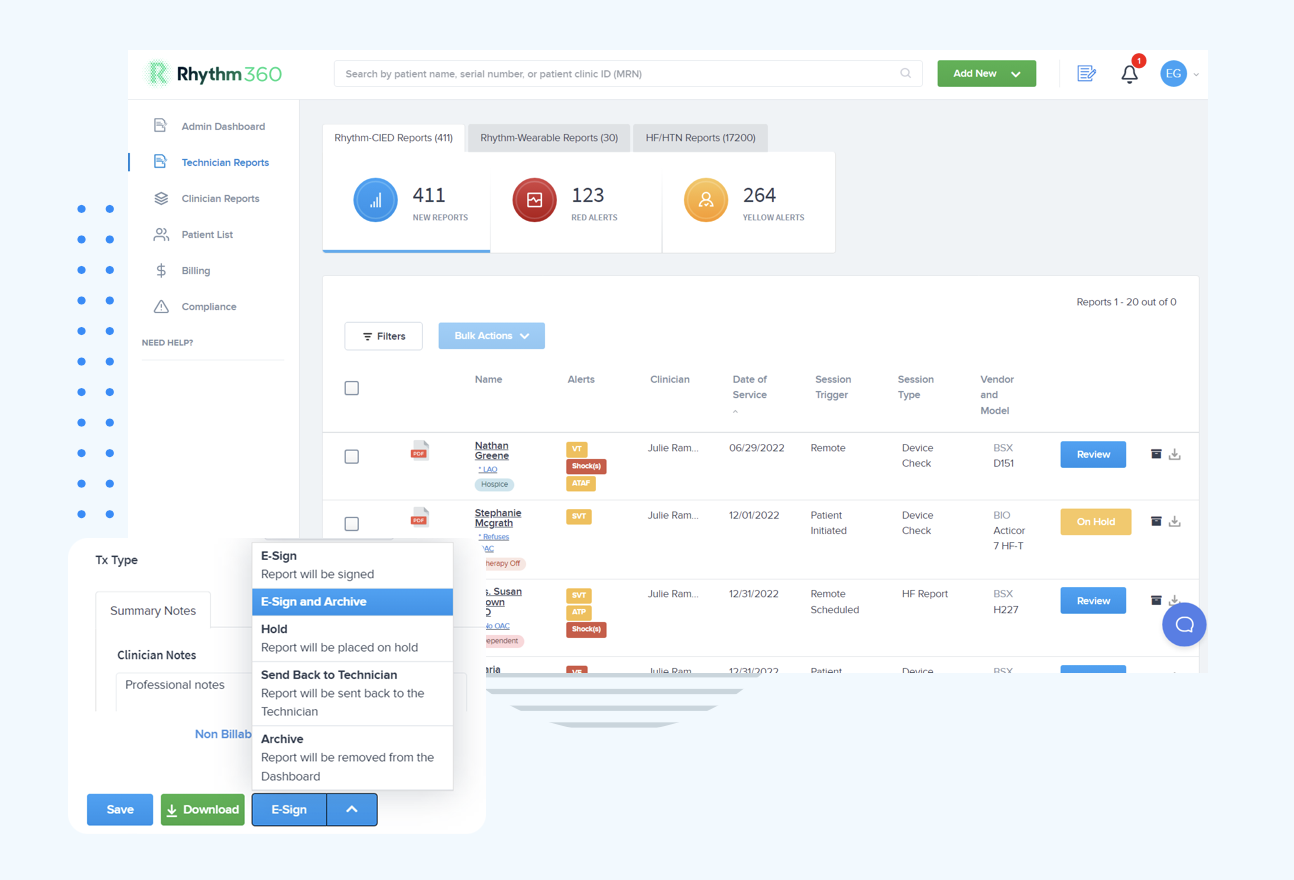
Rhythm360 applies the same rules described in this guide directly to your workflow. The platform tracks device-specific CPT pairings and cycle lengths, so a pacemaker never receives an ICD code and a 30-day device never receives a 90-day claim. That logic prevents the device-mismatch denials highlighted in the code-selection section. Rhythm360 also flags unsigned or undated interpretations and alerts staff when a monitoring period approaches its billing window, which addresses the missing-signature and frequency denials discussed in the remote monitoring and documentation sections. By surfacing these issues in real time, Rhythm360 keeps revenue capture aligned with the documentation and timing rules outlined above.