

See How Rhythm360 Unifies Your Monitoring Workflow
A functional chronic disease remote monitoring program follows a defined operational sequence. Each stage introduces specific workflow requirements and distinct failure points when systems are fragmented.
CMS defines remote patient monitoring as a patient collecting health data using a connected medical device that automatically transmits data to their provider for treatment or management. Medicare covers RPM for both chronic and acute conditions and requires a qualifying condition, an FDA-cleared connected device, and data transmission on at least two days every 30 days to support billing.
The following table summarizes the primary CPT codes used in cardiac remote monitoring programs, their applicable device types, billing cycles, and component structure:
| CPT Code | Device Type | Billing Cycle | Component Notes |
|---|---|---|---|
| 93294 | Pacemaker (single- or dual-chamber) | 90-day | Professional component; requires physician interpretation and documented clinical review |
| 93295 | ICD / CRT-D | 90-day | Professional component; mirrors 93294 documentation requirements |
| 93296 | Pacemaker and ICD / CRT-D (technical) | 90-day | Technical component for pacemakers and ICDs; covers data acquisition, technician review, and distribution of results; no physician work included; modifier -26 does not apply |
| 93297 | Implantable cardiovascular physiologic monitor (e.g., CardioMEMS) | 30-day | Device-specific global code; billable once per 30-day period; can be billed global, -26, or -TC |
| 93298 | Subcutaneous cardiac rhythm monitor / implantable loop recorder (ILR/ICM) | 30-day | Device-specific global code; billable once per 30-day period; can be billed global, -26, or -TC; not a technical partner to 93297 |
| 99453 | RPM (non-invasive physiologic monitoring) | One-time per episode | Initial device setup and patient education; billed once per device episode |
| 99454 | RPM (non-invasive physiologic monitoring) | 30-day | Device supply and data transmission; requires 16 or more days of data in a 30-day period |
| 99457 | RPM treatment management | Monthly | First 20 minutes of clinical monitoring and patient communication per calendar month |
Two important billing mechanics affect revenue capture across these code families. First, unbilled technical components represent direct revenue leakage, because a practice that bills 93294 or 93295 without also capturing 93296 leaves the technical service unreimbursed. Second, device-type mismatch, such as applying a pacemaker code to an ICD patient or using 93298 for a physiologic monitor patient who should be billed under 93297, is a common and preventable denial cause. Automated CPT tracking that maps each patient’s implanted device to the correct code family and billing cycle closes this revenue gap.
CMS’s CY 2027 proposed rule, published July 2026, would require RPM clinical monitoring services to be furnished by direct employees of the billing practice. Practices should monitor this proposal and review vendor agreements accordingly, because it does not restrict technology platforms, data infrastructure, or non-clinical support services. Those platforms matter because the billing gaps above often begin upstream in the fragmented data environment created by multiple device manufacturers.
Talk To Us About Closing Your Billing Gaps
Practices that implant devices from multiple manufacturers face a structural data problem. Each manufacturer operates a separate, proprietary remote monitoring portal. Staff must log into four distinct systems, including CareLink, LATITUDE, Merlin.net, and Home Monitoring, to retrieve, review, and reconcile transmission data. This manual process is time-consuming, error-prone, and scales poorly as patient volume grows.
The interoperability challenge grows as data formats diverge. Each OEM transmits data in proprietary formats such as structured APIs, HL7 messages, XML feeds, and unstructured PDF reports that do not map cleanly to one another or to EHR data models. The HL7 CardX CIED implementation guide provides a FHIR-based framework for normalizing CIED observations into computable, interoperable data structures. Production implementation still requires vendor-specific mapping work at each integration point.
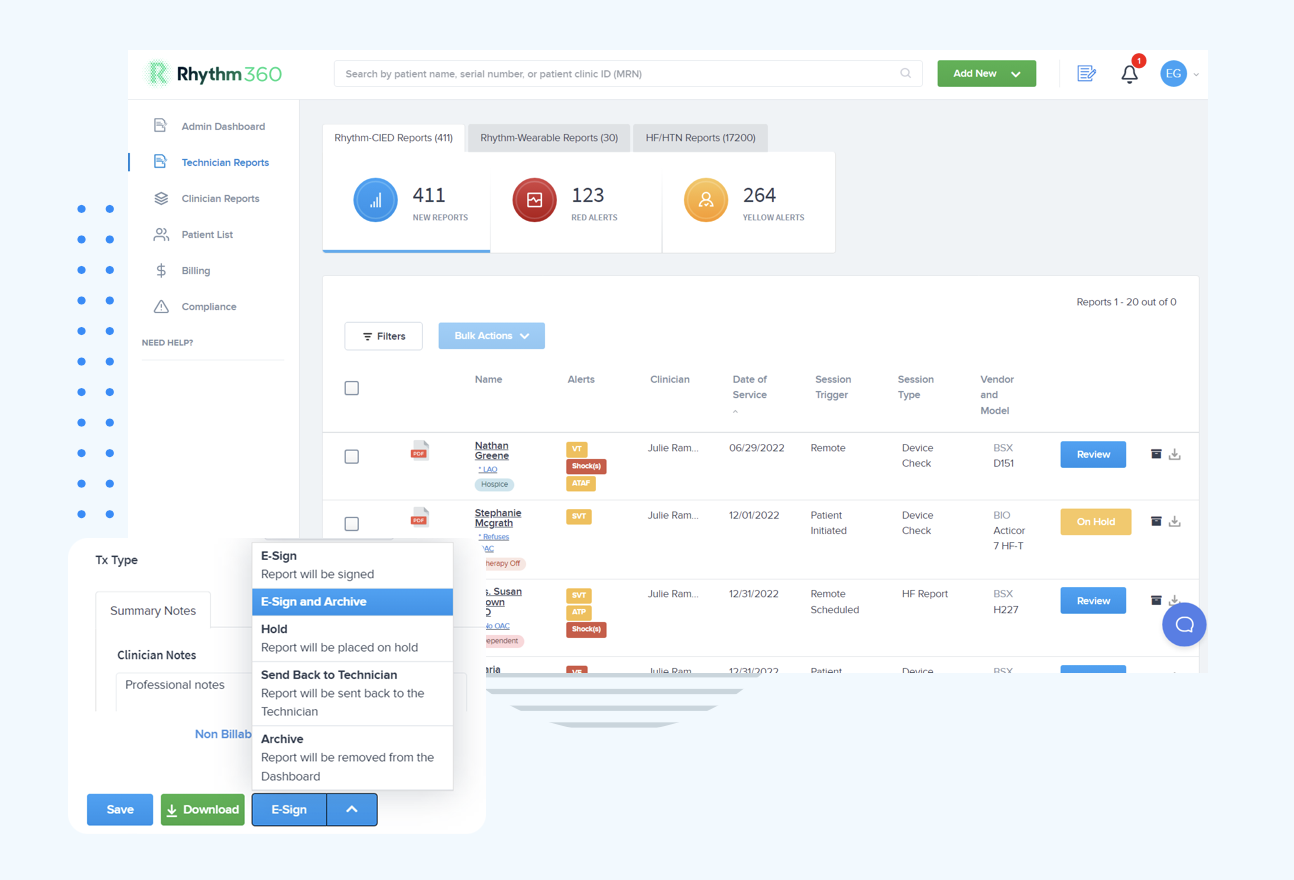
Vendor-neutral aggregation platforms address this by ingesting data via API, HL7, XML, and computer-vision parsing of PDF reports. They normalize disparate data streams into a single source of truth. The operational result is a unified transmission queue with one dashboard, one workflow, and one documentation trail, regardless of which manufacturer’s device a patient carries.
Rhythm360 by RhythmScience is built on this architecture. The platform achieves greater than 99.9% transmissibility through redundant data feeds, AI-powered extrapolation, and computer vision, and integrates bi-directionally with Epic, Cerner, Athenahealth, eClinicalWorks, and Greenway Health. The bottleneck in cardiac remote monitoring is data fragmentation and the billing gaps that follow from it, not the devices themselves.
That 13% figure comes from a study of 32,721 patients across 67 U.S. device clinics and shows how clinicians review enormous volumes of data for a small fraction of actionable information. In heart failure monitoring, this signal-to-noise problem is acute. Fluid status trends, weight gain, and heart rate variability generate frequent transmissions, and most do not require immediate intervention.
Because only a small fraction of transmissions are actionable, effective triage design must elevate four event categories above the rest:
Alert fatigue, the desensitization that occurs when notification volume exceeds a team's realistic review capacity, is a documented patient safety risk. Care teams exposed to unmanageable alert queues triage by volume rather than clinical significance, which creates conditions under which a meaningful alert gets missed. Mitigation requires four changes. Configure patient-specific thresholds and add confirmation logic that requires persistence before escalation. Deduplicate at the data ingestion layer. Finally, assign structured workflow ownership so notifications become assignable tasks with audit trails.
Additional operational challenges in remote monitoring programs include:
A functioning cardiac remote monitoring program requires four core roles regardless of program size: a supervising physician, a clinical monitor (RN or certified cardiac technician/CCT), an enrollment coordinator, and a billing specialist. In smaller practices, these functions may be combined across fewer staff members.
The clinical monitor role carries the operational weight of the program. This role manages transmission queues, conducts initial reviews, coordinates patient follow-up, and supports documentation. Device clinic nurses and IBHRE-certified technicians are specialized roles with long training and credentialing timelines, and most clinics now manage more device patients than three years ago with only modest growth in clinical teams.
Staffing models vary by program size and acuity. Small practices in early program phases can assign monitoring duties to existing staff on a part-time basis. As patient volume grows, dedicated clinical monitors become necessary to maintain alert response times and documentation completeness. The most common staffing failure is delaying dedicated hiring past 30–50 patients. That delay causes engagement drops, documentation gaps, and missed billing opportunities, particularly for time-based codes like CPT 99457 and 99458.
Revenue is most commonly lost at two points: unbilled technical components, where 93296 is not captured alongside 93294 or 93295, and incomplete time documentation that prevents billing for additional management time. Both losses trace back to billing steps that sit outside the monitoring workflow. Automated CPT tracking and workflow-integrated billing documentation close that gap by capturing the technical component and the time record as the clinical work happens. Gaurav A. Upadhyay, MD, at the University of Chicago Medicine, observed: "We have improved billing and accountability for our patients after the integration."
Practices evaluating their remote monitoring infrastructure face three broad options. They can continue with single-OEM portals and manual reconciliation, engage a service bureau that provides outsourced monitoring staff, or deploy a vendor-neutral platform that centralizes data, triage, documentation, and billing in one system.
Single-OEM portals are free to access but create the multi-login, data-silo problem described throughout this guide. They do not normalize data across manufacturers, do not automate CPT capture, and do not integrate with EHR workflows. As patient volume grows, the administrative burden scales linearly with headcount.
Service bureaus provide outsourced clinical monitoring staff but may not address the underlying data fragmentation or billing automation gaps. CMS’s proposed CY 2027 rule would restrict Medicare payment for RPM services furnished by contractor personnel, which affects outsourced monitoring arrangements and warrants legal review of any existing service bureau agreements.
Other vendor-neutral platforms in the market include Murj, Implicity, Rhythm Management Group, and Octagos. Practices evaluating these options should assess each against their specific EHR environment, device mix, and billing workflow requirements.
Rhythm360 by RhythmScience is a vendor-neutral, HIPAA-compliant, cloud-based platform. Its capabilities address each of the gaps above:
The University of Chicago Medicine reviewed more than 73,000 reports annually through Rhythm360 in calendar year 2025, averaging more than 18,000 reports per quarter. This volume demonstrates the platform’s scalability in a high-volume academic environment. Andrew Beaser, MD, Associate Professor of Medicine at UCM, has emphasized that decision support, including AI-assisted decision support, will become increasingly important as data volumes grow.
Compare Rhythm360 Against Your Current Setup
CMS guidelines for remote patient monitoring establish the following core requirements:
Remote monitoring in cardiology is the continuous or scheduled collection of cardiac rhythm, hemodynamic, and physiologic data from patients outside the clinical setting. Implanted or connected devices transmit data to care teams for review and intervention. Device classes include non-invasive wearables and connected peripherals, cardiac implantable electronic devices (CIEDs) such as pacemakers, ICDs, and implantable loop recorders, and hemodynamic monitors such as CardioMEMS pulmonary artery monitors. Remote monitoring differs from episodic in-person follow-up because it creates a continuous data stream. That stream enables detection of arrhythmias, device abnormalities, and heart failure decompensation between scheduled visits, often days to weeks earlier than conventional outpatient follow-up would allow. Clinical evidence from landmark trials including TRUST, CONNECT, EVOLVO, and IN-TIME consistently demonstrates that remote monitoring reduces time to clinical intervention, decreases inappropriate device therapy, and lowers hospitalization rates compared to standard in-person follow-up.
A chronic disease remote monitoring program requires four core roles. A supervising physician provides general oversight and signs interpretations. A clinical monitor, typically an RN or certified cardiac technician (CCT), manages the daily transmission queue, triages alerts, conducts patient outreach, and documents care activities. An enrollment coordinator identifies eligible patients, obtains consent, provisions devices, and manages onboarding. A billing specialist tracks CPT code eligibility, monitors billing intervals, and submits compliant claims. In small practices, these roles may overlap. As patient volume grows, dedicated staffing becomes necessary to maintain alert response times and documentation completeness. High-acuity panels, such as heart failure or multi-device patients, require RN-level clinical judgment for independent triage decisions. Stable single-condition panels may be managed by lower-credential monitors with escalation protocols to an RN or physician.
Fragmented OEM portals, manual triage, and device-type billing mismatches are three operational problems that cost cardiology practices revenue and put patients at risk. Staff who log into four separate manufacturer portals cannot scale their work effectively. Manual alert review without AI-assisted prioritization produces fatigue and missed events. Billing workflows that fail to match device type to CPT code and billing cycle generate denials and leave technical components uncaptured.
Rhythm360 by RhythmScience is built to solve each of these problems in a single, vendor-neutral, HIPAA-compliant platform. By ingesting and normalizing data from all major CIED manufacturers, integrating bi-directionally with leading EHR systems, automating CPT capture across 90-day and 30-day billing cycles, and applying AI-powered alert triage with optional 24/7/365 CCT oversight, Rhythm360 enables practices to scale patient volume without proportionally scaling headcount. Practices can capture up to 300% more revenue while reducing critical alert response times by up to 80%.
Andrew Beaser, MD, at the University of Chicago Medicine, summarized the clinical impact directly: "We are able to address these issues earlier; rather than waiting for a 3-month visit, we can call patients in for evaluation." That outcome reflects what a unified remote monitoring workflow delivers: earlier intervention, cleaner billing, and a program that operates at scale.
Start Scaling Your Program Without Scaling Headcount





