Last updated: September 22, 2026
Talk With Rhythm360 About Your RCM Quotes
Buyers need a shared vocabulary before they compare quotes. The following terms appear in every RCM software proposal and determine how costs compound over a contract term.
Per-claim pricing charges a fixed dollar amount for each claim submitted to a payer, regardless of whether the claim is paid. Usage-based SaaS scales on provider count, device census, and active service lines, typically combining a base platform fee with transactional add-ons. Percentage-of-collections charges a share of net revenue actually collected, which ties vendor compensation to practice performance. Total cost of ownership (TCO) is the all-in annual spend that includes subscription or service fees, implementation, integration, clearinghouse, migration, training, and any per-transaction charges. NCCI edits are the National Correct Coding Initiative bundling rules that govern which CPT code pairs can appear together on the same claim. CPT codes are the American Medical Association’s procedural terminology codes that define billable services, and in cardiology and EP the specific codes and their billing intervals directly determine claim volume and revenue throughput.
Four components determine whether an RCM software quote is defensible: the pricing model and its hidden variables, EP-specific cost drivers tied to CPT codes and billing cycles, one-time and recurring implementation fees, and the cost of inaction represented by revenue already leaving the practice through preventable denials and missed prior authorizations.
RCM software for large cardiology and EP practices is priced under three dominant models. Per-claim pricing is commonly quoted at roughly $4–$8 per submitted claim, with $5–$6 most common for general practices and $6–$8 for specialty or low-volume work. Usage-based SaaS scales on provider count, device census, and service lines. Percentage-of-collections pricing for enterprise and full-service RCM arrangements typically ranges from about 3%–9% of net collections, with full-BPO models commonly at 3%–7%. Each model shifts with claim volume, collection rate, and provider count. The table below summarizes the three models side by side so you can see why their headline rates cannot be compared directly.
| Pricing Model | Industry-Observed Range | Primary Cost Driver |
|---|---|---|
| Per-claim | $4–$8 per submitted claim ($5–$6 most common for general practices; $6–$8 for specialty or low-volume work) | Submitted claim volume and claim complexity |
| Usage-based SaaS | About $200–$1,500+ per provider per month, with full-featured and bundled mid-market specialty platforms reaching $500–$2,500 | Provider count, active device patient census, modules |
| Percentage-of-collections | About 3%–9% of net collections (enterprise/full-service), with full-BPO commonly at 3%–7% | Collected revenue and scope of services |
Pricing models only make sense when viewed inside the ecosystem they operate in. RCM software for large cardiology and EP practices sits between providers, device manufacturers, EHR systems, clearinghouses, and payers, and each connection adds cost or risk.
The ecosystem surrounding RCM software for large cardiology and EP practices spans providers, device manufacturers, EHR systems, clearinghouses, and payers. Device manufacturers such as Medtronic, Boston Scientific, Abbott, and Biotronik each operate proprietary remote monitoring portals that generate the transmission data underlying billable CIED interrogation claims. EHR systems including Epic, Cerner, athenahealth, eClinicalWorks, and Greenway Health serve as the documentation and charge-capture layer that must connect reliably to any RCM platform.
The space has shifted from manual, fragmented processes and on-premise databases toward integrated, cloud-based, AI-powered platforms that normalize data across OEMs. Legacy on-premise systems required staff to log into each manufacturer portal separately, reconcile data manually, and enter charges into the EHR by hand. That workflow scales poorly as device census grows. Common structural challenges include data fragmentation across OEM portals, administrative overload from manual transmission review, alert fatigue from high volumes of non-actionable notifications, and revenue leakage from missed or miscoded billable events.
Other platforms operating in this space include Murj, Implicity, Rhythm Management Group, and Octagos. Rhythm360 by RhythmScience is a vendor-neutral, HIPAA-compliant, cloud-based platform that ingests and normalizes data from all major device manufacturers, automates CPT code capture across CIED and remote physiologic monitoring service lines, and provides bi-directional EHR integration with Epic, Cerner, athenahealth, eClinicalWorks, Greenway Health, and others via HL7. Its SaaS-based pricing model scales based on clinic size and platform usage, and its streamlined implementation process, including EHR integration, takes only a few days to a few weeks.
See How Rhythm360 Normalizes Your Device Data
Per-claim pricing is commonly quoted at roughly $4–$8 per submitted claim, with $5–$6 most common for general practices and specialty or low-volume vendors quoting $6–$8 because they must cover fixed costs. The headline rate does not represent the all-in cost. Separate charges may apply for resubmissions ($2–$5 each), eligibility verification ($1–$3 each), and prior authorization ($15–$50 each). Because the vendor is paid on submission rather than collection, denial work remains unfunded unless the contract explicitly includes it, which matters acutely in EP billing where frequency-related denials on device interrogation codes are common.
Usage-based SaaS pricing often combines a base platform fee with transactional add-ons, so the effective per-claim cost depends on module scope and whether specialty workflows, automation, or support services are bundled. Full-featured RCM platforms cost $500–$2,500 per provider per month plus per-claim fees and setup fees. For large EP groups, the device patient census, not just provider count, becomes a key cost driver, because platforms that charge per monitored patient or per active device add a variable layer that grows with program enrollment.
Percentage-of-collections pricing for enterprise full-service RCM ranges from about 3%–9% of net collections, with full-BPO models typically at 3%–7%, and the vendor is paid only on dollars actually collected. This structure funds denial work and aged A/R follow-up, because a bad collection month reduces the vendor’s invoice alongside the practice’s revenue. However, hidden fees cluster around definitional ambiguity in “net collections,” charges on aged A/R recoveries from before the contract started, and implementation fees of $2,000–$15,000.
Converting any pricing model into a comparable annual TCO requires three inputs: annual claims volume, average collected revenue per claim, and provider count. The following worked example uses a 30-provider EP group submitting 60,000 claims annually with an average collected revenue of $180 per claim ($10.8M total collections).
Per-claim quote at $5.50: 60,000 × $5.50 = $330,000 base. Add estimated resubmissions at 8% denial rate: 4,800 × $3.50 = $16,800. Add prior authorization at 500 auths × $25 = $12,500. Subtotal: $359,300 before implementation.
Percentage-of-collections quote at 5%: $10,800,000 × 0.05 = $540,000. Verify whether the contract defines net or gross collections, because applying the percentage to charges before contractual adjustments inflates the base materially.
Usage-based SaaS at $800 per provider per month: 30 × $800 × 12 = $288,000 base. Add device census module at $15 per monitored patient per month for 600 patients: $15 × 600 × 12 = $108,000. Subtotal: $396,000 before implementation.
On this example, the usage-based SaaS quote ($396,000) and the per-claim quote ($359,300) land within 10% of each other, while the percentage-of-collections quote ($540,000) runs 35–50% higher, which remains invisible when you compare headline rates alone. Adding a realistic first-year implementation range of $25,000–$250,000 produces a normalized year-one TCO of roughly $384,000–$609,000 for per-claim, $421,000–$646,000 for usage-based SaaS, and $565,000–$790,000 for percentage-of-collections.
Large cardiology and EP groups face a build-versus-buy decision that consistently favors buying for undifferentiated workflows, because custom software costs three to five times what buying plus configuring costs over the life of a system and every payer rule change becomes an engineering ticket. The software-only versus managed versus hybrid RCM question turns on internal billing expertise and denial rate. In-house billing typically achieves an 85%–90% collection rate of allowable versus 93%–97% for outsourced billing services, which suggests that practices with denial rates above 8% or significant 90+ day A/R may benefit from a managed or hybrid model.
EP-specific complexity changes the math further. Ablation case volume generates high-dollar procedural claims with significant NCCI edit exposure. Modifier 25 was missing on 11% of same-day cardiology visit and diagnostic test claims in one audit of 61,400 claims, costing an average of $118 per claim. CIED interrogation billing cycles create periodic, batch-style claim generation rather than uniform monthly throughput, which changes how per-claim and percentage-of-collections contracts should be modeled and staffed.
EP billing runs on overlapping, device-specific billing clocks that most general RCM platforms do not track well. Pacemaker and ICD remote interrogation is billed under CPT codes 93294 (pacemaker professional), 93295 (ICD professional), and 93296 (technical) on 90-day cycles. Subcutaneous cardiac rhythm monitors, including implantable loop recorders, are billed under CPT 93298 once per 30-day period. Implantable cardiovascular physiologic monitors are billed under CPT 93297 on a 30-day interval. Both 93297 and 93298 can be billed global, with modifier -26 (professional component), or with modifier -TC (technical component).
A practice that incorrectly bills CPT 93298 on a 90-day cycle files only four claims per year instead of twelve. As noted in the Key Takeaways, billing CPT 93298 on a 90-day cycle instead of the payable 30-day interval costs roughly $825 per monitored patient per year, or approximately $495,000 per year across a 600-patient loop recorder census.
A single cardiology patient can sit on three different billing clocks simultaneously. One clock tracks the 90-day CIED interrogation window. A second clock tracks the 30-day subcutaneous rhythm monitor or physiologic monitor window. A third clock tracks the calendar-month management time window. Billing processes that assume one monthly cycle often miss at least one of these windows, which drops claims and leaves revenue unbilled. RCM contracts serving EP practices need pricing that accounts for this periodic, batch-style claim generation, and platforms need automated CPT code capture that distinguishes device type, billing interval, and modifier eligibility at the point of charge creation.
Rhythm360 automatically tracks device-specific CPT pairings, including the 90-day cycles for pacemakers and ICDs and the 30-day cycles for physiologic monitors and loop recorders, which prevents device-type mismatch denials and unbilled technical components. Practices using Rhythm360 have achieved up to a 300% increase in revenue capture and up to an 80% reduction in critical alert response times.
See Automated CPT Capture In Action
Organizational readiness for an RCM software deployment depends on stakeholder alignment, workflow maturity, data quality, integration needs, compliance processes, and training capacity. A phased rollout that starts with a defined workflow such as denial tracking, claims analytics, or eligibility automation reduces implementation risk and lets the practice validate data reliability and integration function before expanding scope.
Hidden and one-time costs are the most common source of TCO underestimation. Setup and implementation fees commonly add $2,000–$10,000+ to a practice’s first-year total cost, and almost no vendor advertises these fees upfront. Industry sources break these costs into five line items. Implementation and setup runs $500–$5,000. Data migration from a legacy system adds $1,000–$5,000. Training packages cost $150–$500 per session. Clearinghouse connectivity runs $75–$150 per month plus per-claim charges. EHR and lab integration fees add $500–$3,000 per interface. For broader custom or enterprise RCM deployments, a focused implementation may start around $40,000, a mid-scope solution covering claims management and EHR integrations typically lands in the $90,000–$250,000 range, and a complex enterprise program can move into the $250,000–$600,000+ range. Industry-observed EHR implementation costs for large specialty practices range from about $20,000–$50,000 for basic implementation at 11+ physician practices up to $400,000–$2,000,000 for 25+ physician practices, with multi-specialty clinics citing $250,000–$500,000. These costs are additive for a full deployment, so large EP groups should budget across all categories.
Rhythm360’s streamlined implementation process, including EHR integration, takes only a few days to a few weeks. Its SaaS-based pricing model scales based on clinic size and platform usage, which avoids rigid per-seat structures that inflate costs as device census grows.
RCM software procurement for large cardiology and EP practices often fails in four areas: fragmented workflows that survive the software transition, unclear ownership of denial follow-up, weak documentation at the point of charge capture, and misaligned success metrics that measure activity rather than revenue recovery.
The cost of inaction provides the ROI baseline that justifies software spend. A net collection rate below 90% means 10 cents of every collectible dollar is written off, denied without appeal, or left uncollected, which equates to $100,000 per year in preventable losses for a $1M annual revenue practice. For a 30-provider EP group collecting $10.8M annually, a 5% gap between actual and achievable net collection rate represents $540,000 per year in preventable revenue loss, which dwarfs the annual cost of most RCM platforms. Prior authorization was missing on 13% of advanced cardiac imaging claims in one audit of 61,400 cardiology claims, with an average denied charge of $612 per claim, and automated prior authorization tracking directly addresses this denial category.
Rhythm360’s automated CPT code capture and documentation automation addresses the upstream source of most EP billing errors: wrong device code, wrong billing interval, and missing modifier. These errors occur at charge capture rather than in the billing office, where staff can only catch them if the scrubber is configured to recognize device-type mismatches.
RCM software performance should be tracked across clinical, operational, financial, and compliance metrics. Key financial benchmarks include first-pass clean claim rate, days in A/R, denial rate, and net collection rate. MGMA reports the top-performer first-pass clean-claim rate at 95%+, while the industry median sits in the high 80s. HFMA best-in-class days in A/R holds under 30 days, while the industry median runs in the high 30s to low 40s. Cardiology-specific benchmarks for independent practices show 30–50 days in A/R, a 9–15% denial rate, and a 92–96% net collection rate, which reflects the complexity of procedural and device-monitoring claims.
Contract SLAs should tie to at minimum five KPIs with a right to renegotiate or terminate on failure. These KPIs include first-pass acceptance rate, overall denial rate, days in A/R, net collection rate, and aged A/R over 90 days as a share of total A/R. Revenue recovery guarantees and days in A/R improvement targets should appear as measurable commitments with defined measurement periods.
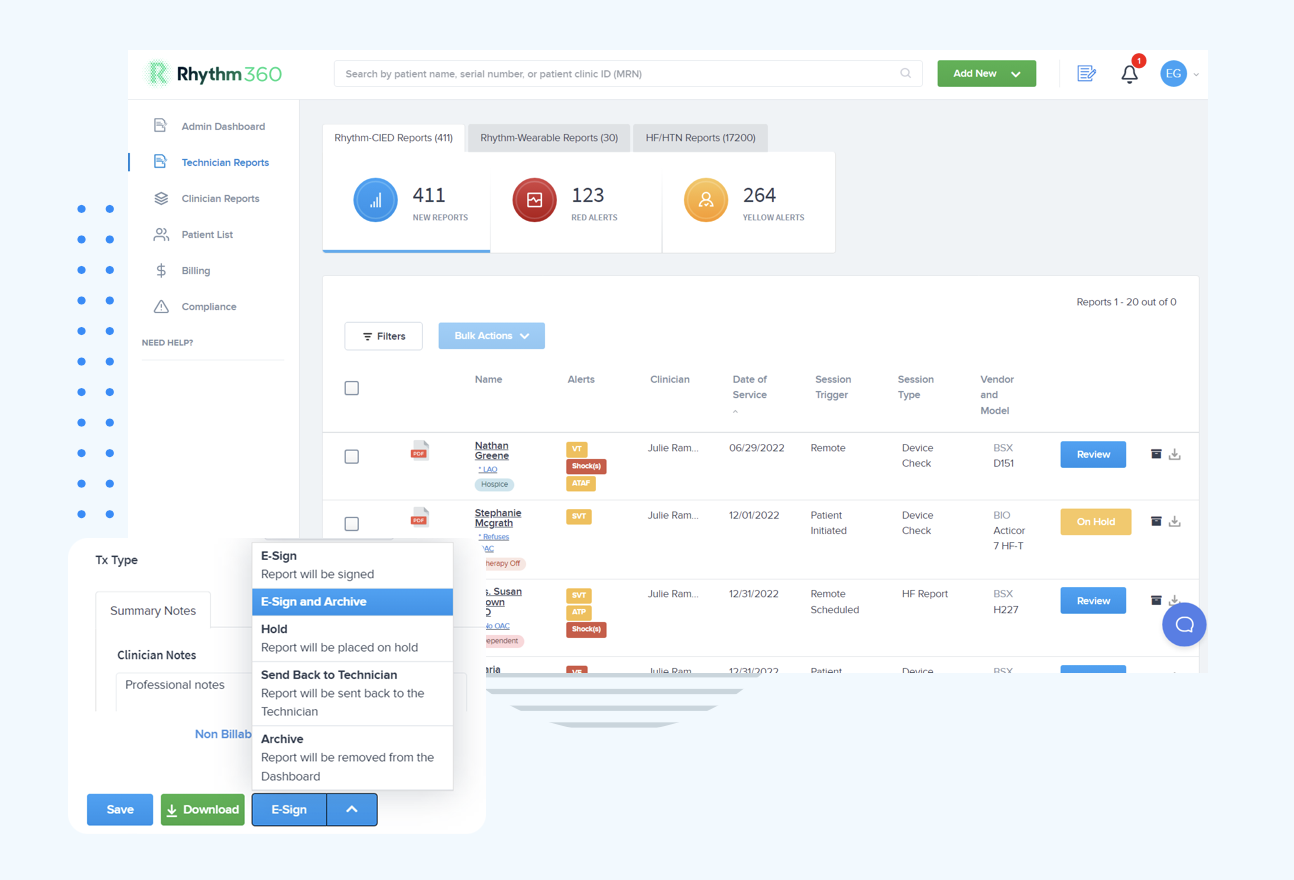
Rhythm360’s administrative dashboard provides a real-time, comprehensive overview of patient compliance, critical alerts, and captured and potential revenue based on CPT code requirements. This visibility gives practice administrators and CFOs the information they need to track performance against contracted SLAs and identify revenue gaps before they age into write-offs.
Explore The Rhythm360 Performance Dashboard
A 50-provider cardiology group should budget across three cost layers: the recurring platform fee, one-time implementation costs, and ongoing per-transaction or module charges. Under a usage-based SaaS model at $800 per provider per month, the base platform fee runs $480,000 annually before device census modules, integrations, or clearinghouse fees. Under a percentage-of-collections model at 5% on $18M in annual collections, the fee runs $900,000. Under per-claim pricing at $5.50 on 100,000 annual claims, the base is $550,000 before resubmission and prior authorization charges. A 50-provider practice typically invests $400,000–$800,000 for complete EHR implementation in year one, including software licensing, hardware, training, and professional services. The only defensible comparison is a normalized annual TCO that includes subscription, implementation, integration, and ongoing transaction fees applied to the same claim volume, collection rate, and provider count assumptions across every bid.
The cheaper model depends on average collected revenue per claim. The break-even point is calculated by dividing the per-claim fee by the percentage rate: at $6 per claim and 6%, the break-even is $100 of average collected revenue per billable claim. Above $100 average collected revenue, per-claim pricing is cheaper. Below $100, percentage-of-collections is cheaper. For EP practices with high-dollar procedural claims, median Medicare revenue per inpatient EP case was $20,520 (including $23,240 for DRG 273 and $19,460 for DRG 274 as of 2020), with commercial ablation reimbursements ranging from $51,512 to $55,825, which makes per-claim pricing structurally advantageous on the headline rate. However, per-claim contracts do not fund denial work unless explicitly contracted, so a practice with a 10–15% denial rate on device interrogation codes may find that the unfunded denial workload erases the per-claim savings. The correct comparison adds denial management cost to the per-claim TCO before you conclude which model is cheaper.
EP studies with ablation are among the highest-complexity, highest-dollar procedural claims in outpatient cardiology. A single ablation case generates multiple CPT codes for the diagnostic study, the ablation itself, and any associated imaging or mapping, and each code has its own global period, modifier rules, and NCCI edit exposure. This pattern creates periodic, high-dollar claim batches rather than uniform monthly throughput. Under a per-claim contract, ablation months generate disproportionately high invoices relative to collections if the vendor charges per submitted claim regardless of complexity. Under a percentage-of-collections contract, the vendor’s fee scales with the high collected revenue from ablation cases, which may or may not reflect the actual work involved. Practices with significant ablation volume should model their claim mix by separating procedural claims from device interrogation claims and apply each pricing model to the actual mix rather than an average claim value.
Hidden costs in RCM software contracts cluster around six categories that vendors rarely include in a headline quote. Implementation and setup fees run $500–$5,000 for smaller platforms and $15,000–$40,000 for enterprise EHR-integrated platforms. Data migration from a legacy system costs $1,000–$25,000 depending on volume and complexity. Staff training runs $150–$500 per session and is often billed separately after the initial onboarding. EHR and lab integration fees range from $500–$3,000 per interface. Clearinghouse connectivity costs $75–$150 per month plus per-claim charges. Early-termination or data export fees appear in many contracts and remain negotiable only before signing. For large cardiology and EP groups deploying a platform with multiple OEM data feeds, bi-directional EHR integration, and specialty-specific CPT modules, the realistic first-year implementation cost sits in the $25,000–$250,000 range. A fully itemized quote that covers every integration, every training session, and every transaction fee prevents surprise costs after contract execution.
The following questions are structured for extractability and should be submitted to every vendor in identical format so responses can be compared on the same basis.
Headline rates alone cause buyers to overpay for RCM software. Large cardiology and EP practices need a quote-normalization framework that converts per-claim, usage-based SaaS, and percentage-of-collections proposals into a single annual TCO figure that uses the same claim volume, collection rate, and provider count assumptions across every bid. Layer EP-specific cost drivers tied to 90-day CIED interrogation cycles and 30-day physiologic monitor and loop recorder cycles into that framework. Consolidate hidden implementation and integration fees. Anchor the analysis in the cost of inaction. Together these steps produce a budget line that reflects actual financial exposure.
The RFP question bank above is designed to surface real cost before signature. Practices that use it consistently will find that the vendor willing to answer every question in writing on pricing, SLAs, data export, and escalation caps is also the vendor most likely to perform against those commitments after go-live.
Rhythm360 by RhythmScience is built for the billing complexity that defines large cardiology and EP practices. The platform provides vendor-neutral data ingestion across all major device manufacturers, automated CPT code capture across 90-day and 30-day device monitoring cycles, bi-directional EHR integration, and an administrative dashboard that delivers real-time visibility into captured and potential revenue. Practices have achieved up to an 80% reduction in critical alert response times and up to a 300% increase in revenue capture using the platform.
Get A Rhythm360 TCO Walkthrough