

Last updated: October 7, 2026
See How Rhythm360 Reduces 99454 Denials
Every denied CPT 99454 claim represents a compounding loss. The direct hit is approximately $52 per patient per period, though some denials can be rebilled under CPT 99445 or recovered on appeal. The indirect cost is larger, because staff must pull transmission logs, draft appeals, and resubmit. When that rework volume exceeds capacity, appeal deadlines slip. Missed deadlines then create denial patterns that attract payer scrutiny and audit exposure.
Recurring CPT 99454 denials usually trace back to workflow failures rather than coding errors. The CPT code is correct. The patient is eligible. The device transmitted data. The claim denies for one of three reasons: a transmission log was not verified before submission, consent was not documented before monitoring began, or the billing period was calculated from the wrong start date. Each failure has a specific fix.
Denial-prevention workflows create clean claims, faster payment, and documentation that survives audit. For practices managing large RPM populations, eliminating preventable denials produces significant revenue lift. Rhythm360's automated CPT capture and documentation helps practices recover previously lost revenue, increasing profitability by as much as 300%.
See How Rhythm360 Prevents 99454 Write-Offs
CPT 99454 payment depends on meeting a small set of strict requirements. Core requirements appear in the First Coast Service Options Medicare RPM checklist and the CMS CY 2026 Physician Fee Schedule Final Rule (CMS-1832-F). Each item below is a documentation element an auditor will look for, so a single missing element can sink an otherwise valid claim:
CPT 99454 is not time-based. Unlike CPT 99457 and 99458, there is no minimum number of clinician minutes required for 99454 to be billable. Practices that treat these codes as a single family often misalign documentation and trigger denials. For a deeper look at billing 99453 and 99454 together, see CPT Codes 99453 and 99454 Billed Together in 2026.
Rhythm360 automatically tracks device-specific CPT pairings and blocks device-type mismatch denials before a claim is submitted.
The 16-day rule remains the most contested requirement in RPM billing and a major source of confusion in 2026. Per the CMS CY 2026 Physician Fee Schedule Final Rule, CPT 99454 still requires at least 16 days of device readings within a 30-day period. A vendor claim that the 16-day requirement would be removed in January 2026 proved false. CMS instead created CPT 99445 for shorter monitoring spans. Many coding references still cite 16 days as the universal RPM minimum, but that is now only partially accurate. Sixteen days remains the lower bound for CPT 99454, yet it is no longer the minimum for every device-supply code.
Effective January 1, 2026, CPT 99445 covers 2–15 days of data transmission per 30-day period, while CPT 99454 covers 16–30 days. The two codes are mutually exclusive and cannot be billed in the same month for the same patient. The documented number of transmission days determines which code applies. Practices should verify requirements per payer and per date of service, because MAC-specific policies may differ.
Rhythm360 tracks transmission days and alerts staff when a patient is trending below the 16-day threshold. Teams can then perform outreach before the billing period closes rather than reacting after a denial posts. For a complete breakdown of billing frequency rules, see How Often Can Cardiology Practices Bill CPT 99454? Guide.
The First Coast Service Options RPM checklist requires automatic transmission of data, not manual uploads. Patient-entered readings, staff transcription from a manual device, and any data that does not originate from the device's own transmission mechanism do not count toward the 16-day threshold.
Qualifying devices for CPT 99454 include FDA-cleared blood pressure monitors, glucometers, pulse oximeters, digital weight scales, cardiac implantable electronic devices (CIEDs such as pacemakers, ICDs, and CRT devices), and respiratory flow rate monitors. Consumer wearables, fitness trackers, and smartwatches do not qualify.
Auditors expect proof of automatic transmission in the chart. The record must contain the device ID and a timestamp for every recording on each qualifying day, not just a summary count. A documented clinical review authored by a qualified healthcare professional that references what was reviewed and any resulting action is also required, rather than a simple login event.
Rhythm360 ingests data from every major device manufacturer, including Medtronic, Boston Scientific, Abbott, Biotronik, and others, and turns that data into auditable transmission logs without manual compilation. For a full list of qualifying devices, see CPT 99454 Devices: Complete Guide for Cardiology RPM.
Five denial codes account for most rejected CPT 99454 claims. Each entry below follows the same structure so you can scan quickly: cause, documentation requirement, and corrective action.
Rhythm360's automated CPT code capture flags these issues before a claim reaches the payer, so teams prevent denials instead of chasing appeals.
CPT 99445 is the most operationally significant RPM billing change of 2026 and remains underrepresented in many billing guides. Before 2026, a patient who transmitted only 15 days of readings in a monitoring period generated zero device-supply revenue. CMS created CPT 99445 to close that gap.
CMS set CPT 99445's reimbursement equal to CPT 99454's, approximately $52.11 nationally, because the practice expense remains the same. The decision between the two codes is therefore clinical. Teams count the transmission days and bill the code that matches.
The operational rule is straightforward. CPT 99445 and 99454 are not both payable for the same 30-day episode, so a provider must choose one code. Billing both in the same period triggers a denial. Similarly, CPT 99470 cannot be billed with CPT 99457 for the same month.
Rhythm360 tracks transmission days per patient and surfaces the correct device-supply code for each billing period. This prevents missed revenue on short-transmission months and duplicate-billing denials.
Documentation failures create fast paths to both denial and recoupment. The following elements must be present before CPT 99454 is billed:
Record retention minimums for CPT 99454 claims vary by payer: 6 years for Traditional Medicare fee-for-service, 7 years for Medicare billing and ordering records, and 10 years for Medicare Advantage. State law may require longer. A simple policy for a mixed panel is to retain everything for 10 years.
Rhythm360's auditable documentation and bi-directional EHR integration with Epic, Cerner, Athenahealth, eClinicalWorks, Greenway Health, and other systems via HL7 ensures all required elements are captured, timestamped, and retained in an audit-ready format. For a complete requirements reference, see CPT Code 99454 Requirements: Complete RPM Billing Guide.
Medicare Advantage and commercial plans may set their own RPM policies rather than automatically following Original Medicare rules. Coverage and billing requirements therefore need to be confirmed separately with each payer. A service that is billable under Medicare fee-for-service rules may still be denied or limited under a commercial plan if the contract sets different utilization or documentation standards.
Different MAC jurisdictions can apply different local coverage and payment rules through local coverage determinations. These jurisdiction-specific expectations can differ from another MAC's policy for a comparable service. Before billing, teams should look up the CPT code on the relevant MAC's LCD database to confirm covered diagnosis codes and any modifier requirements.
Most RPM claim denials trace to a wrong Place of Service, a missing modifier, or a documentation gap rather than the CPT code itself. Staff should verify Place of Service, required modifiers, patient consent, and complete documentation before submission for every payer.
Rhythm360's automated CPT capture and documentation supports payer-specific billing requirements and generates the auditable record needed to defend claims across Medicare fee-for-service, Medicare Advantage, and commercial payers. For a complete provider eligibility guide, see Who Can Bill CPT 99454: Complete Provider Guide.
Review Your Payer Rules With Rhythm360
CPT 99454 denials follow predictable patterns tied to documentation and workflow. Rhythm360 is a vendor-neutral, HIPAA-compliant remote patient monitoring platform built to remove those failure points before a claim is submitted.
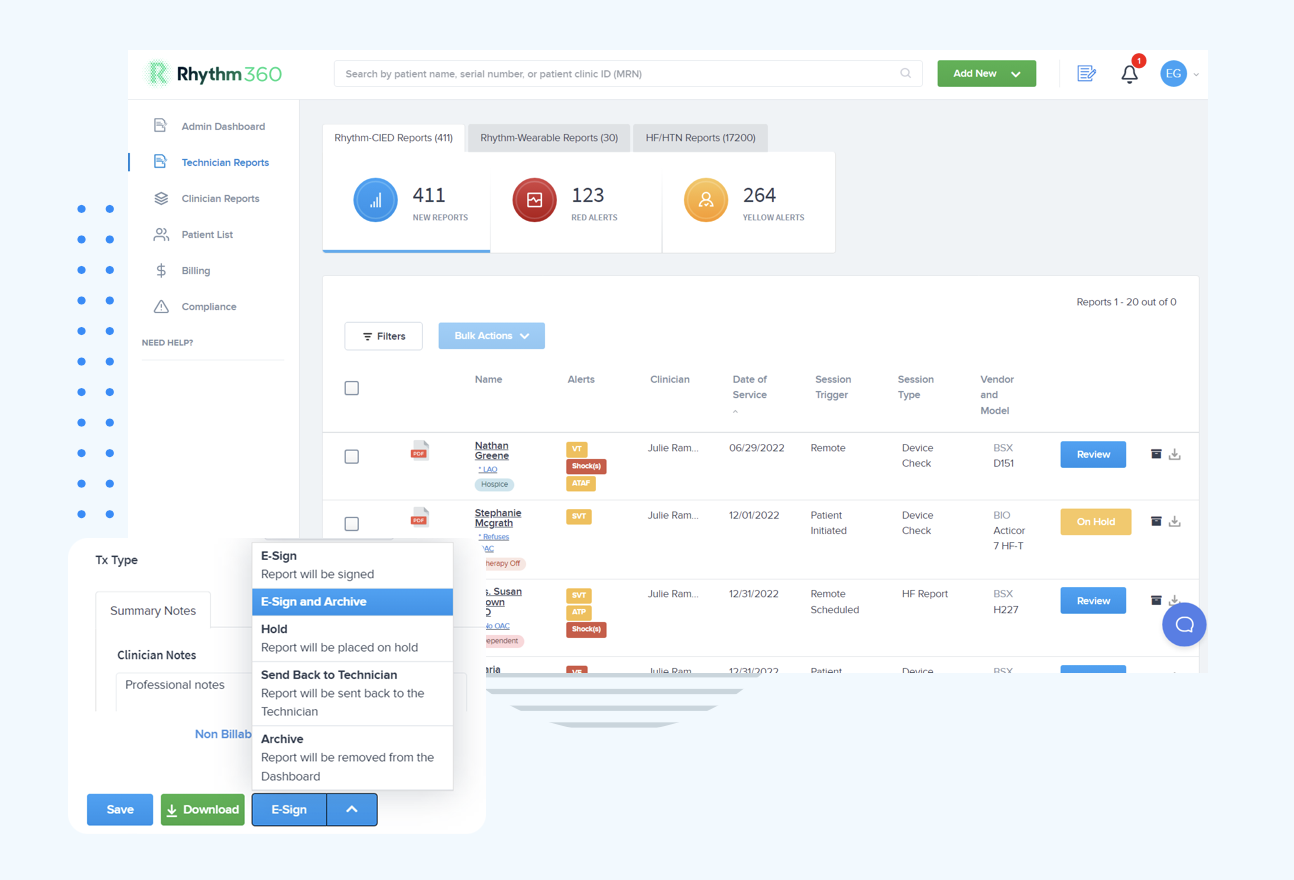
Key capabilities work together as a single workflow:
Rhythm360 tracks device-specific CPT pairings and prevents device-type mismatch denials and unbilled technical components. Practices using Rhythm360 have reported revenue capture increases of up to 300%.
Other platforms in the remote monitoring space include Murj, Implicity, Rhythm Management Group, and Octagos. Rhythm360 focuses specifically on the documentation, transmission tracking, and billing compliance requirements that drive CPT 99454 denials in cardiology and electrophysiology practices.
For a complete billing workflow reference, see How To Bill CPT 99454: RPM Billing Guide For Cardiology and How To Correctly Bill CPT 99454 RPM: Complete Guide.
Walk Through A Rhythm360 Billing Workflow
CPT 99454 requires an FDA-cleared device capable of automatic data transmission, the 16-day transmission threshold covered above, an established patient relationship with the billing practitioner, documented patient consent obtained before or at the start of service, and a clinical order in the record before billing. The code is not time-based, so there is no minimum clinician time requirement. Only one practitioner may bill CPT 99454 per patient per 30-day period, regardless of how many devices the patient uses. Rhythm360 automates transmission tracking, consent documentation, and CPT code capture so every required element is in place before submission.
The CY 2026 Physician Fee Schedule Final Rule introduced two new RPM codes effective January 1, 2026. CPT 99445 covers device supply and data transmission for 2–15 days of transmission within a 30-day period, reimbursed at approximately $52.11 nationally, the same rate as CPT 99454. CPT 99470 covers the first 10–19 minutes of RPM treatment management per calendar month, reimbursed at approximately $26.05 nationally, and requires at least one real-time interactive communication with the patient or caregiver. CPT 99445 and CPT 99454 are mutually exclusive, and CPT 99470 and CPT 99457 are mutually exclusive. Rhythm360 identifies the correct code for each patient's transmission-day count and management time to prevent missed revenue and duplicate-billing denials.
CPT 99454 is the device supply and data transmission code. It is earned when the device meets the 16-day transmission threshold and is not time-based. CPT 99457 is the treatment management code covering the first 20 minutes of clinical staff, physician, or qualified healthcare professional time per calendar month spent managing RPM services, and it requires at least one interactive communication with the patient or caregiver. The two codes run on different clocks. CPT 99454 follows a rolling 30-day period starting from the date monitoring begins, while CPT 99457 follows a calendar month. Treating them as synchronized often misaligns claims. Rhythm360 tracks both clocks independently and generates documentation that supports each code without overlap.
Bill CPT 99454 when the patient has transmitted device data on 16 or more days within the 30-day billing period. Bill CPT 99445 when the patient has transmitted data on 2–15 days within the same period. The two codes are mutually exclusive, so billing both for the same patient in the same 30-day period triggers a denial. If the patient transmitted data on 0 or 1 days, neither code is billable for that period. Both codes reimburse at approximately $52.11 nationally under the 2026 CMS Physician Fee Schedule, so the decision remains clinical. Rhythm360 surfaces the correct code automatically based on verified transmission-day counts and removes manual calculation errors.
CPT 99454 denials cost cardiology and electrophysiology practices revenue they already earned and create audit exposure that compounds over time. The root causes are specific and fixable, including unverified transmission-day counts, consent documented after monitoring begins, billing periods calculated from the wrong start date, device-type mismatches, and incorrect use of the 2026 CPT 99445 framework.
Rhythm360 addresses these problems at the source through vendor-neutral data ingestion, automated CPT code capture, auditable documentation, and bi-directional EHR integration. Practices that implement Rhythm360 stop losing revenue to preventable denials and build a billing workflow that remains defensible at audit. For a complete cardiology RPM billing reference, see CPT 99454 Billing Guidelines: Complete Cardiology RPM Guide.
Talk With Rhythm360 About Your 99454 Denials





