See How Rhythm360 Supports RPM Compliance
The CMS CY 2026 Physician Fee Schedule final rule (CMS-1832-F), effective January 1, 2026, introduced two new RPM CPT codes, 99445 and 99470. These codes create billable pathways for shorter data-transmission and treatment-management periods that previously fell below reporting thresholds. They close a gap that left partial-adherence monitoring months entirely unbillable under the prior framework.
The 2026 code set also clarifies a central compliance point. The 16-day requirement applies to device-supply codes only (99445 and 99454) and does not apply to treatment-management codes (99457, 99458, and 99470). Practices that apply a universal 16-day rule across all RPM codes misapply the standard and create audit exposure on every treatment-management claim they submit.
The CY 2027 Medicare Physician Fee Schedule Proposed Rule, published July 16, 2026, signals further structural changes. One proposal would require that RPM clinical staff be direct employees of the billing practitioner rather than third-party contractors. Practices can treat this proposal as a forward-looking compliance signal.
Review Your RPM Code Mix With Rhythm360
The 2026 Medicare RPM code set consists of six principal codes plus one legacy code. The table below maps each code to its purpose and its single most important compliance condition, so you can see at a glance why a universal threshold does not work.
| Code | Purpose | Key Compliance Condition |
|---|---|---|
| 99453 | Initial device setup and patient education | Billed once per episode of care, not repeatable for the same patient |
| 99445 (new 2026) | Device supply and data transmission for 2–15 days in a 30-day period | Mutually exclusive with 99454, bill when transmission days reach 2–15 but not 16 |
| 99454 | Device supply and data transmission for 16–30 days in a 30-day period | Requires 16 qualifying transmission days in the 30-day monitoring period, mutually exclusive with 99445 |
| 99470 (new 2026) | Treatment management, first 10–19 minutes per calendar month | Mutually exclusive with 99457, requires at least one real-time interactive communication, bill when monthly management time reaches 10–19 minutes |
| 99457 | Treatment management, first 20+ minutes per calendar month | Requires at least 20 minutes of cumulative time and at least one real-time interactive communication, mutually exclusive with 99470 |
| 99458 | Treatment management, each additional 20-minute increment | Add-on to 99457 only, cannot be billed on top of 99470 |
| 99091 | Physician/QHP collection and interpretation of physiologic data | A legacy, distinct service billed per 30-day period. CPT 99091 and 99457 cannot both be billed for the same time period for the same patient, but CMS has determined that both codes may be billed within a 30-day period if the same time is not counted for both codes. It compensates physician personal time for data interpretation, not clinical staff management time. |
The most common compliance error in RPM billing is applying the 16-day transmission threshold to treatment-management codes. As established above, the 16-day rule governs device-supply codes only.
Precise condition statements for each code family:
The device-supply period, a 30-day rolling window, and the treatment-management period, a calendar month, do not always align. Each component’s requirements are evaluated independently.
An RPM claim is only as defensible as the transmission log and time record behind it. The code entered on the claim form does not make it defensible. A complete, audit-ready RPM record contains the following elements:
See An Audit-Ready RPM Record In Rhythm360
Concurrent billing with CCM and E/M: RPM may be billed concurrently with Chronic Care Management and Transitional Care Management when each service’s requirements are independently met, provided the same staff time is not counted toward more than one billed service. Separate, non-overlapping time logs are required for each program. Overlapping time logs across CCM and RPM are a frequent audit target.
RPM vs. RTM: RPM and remote therapeutic monitoring (RTM) cannot be billed for the same patient in the same period for the same clinical parameter. Practices must select the code family that matches what the device measures. RPM covers physiologic data, while RTM covers non-physiologic therapeutic data.
NCCI edits: Under CMS NCCI Column 1/Column 2 edits, the Column 1 code is eligible for reimbursement while the Column 2 component code is not reimbursed when filed on the same date of service by the same provider. Modifier indicator “0” means the edit cannot be bypassed. Indicator “1” means an appropriate modifier may apply with supporting documentation.
Medicare vs. commercial payers: Medicare covers RPM for acute or chronic conditions when medically necessary, but commercial payers diverge significantly. Aetna’s February 2026 commercial RPM policy, for example, limits coverage to heart failure, hypertension, and diabetes and lists the new 2026 codes 99445 and 99470 as not covered. Cigna goes further, limiting reimbursement to five conditions: COPD, diabetes mellitus, gestational diabetes, heart failure, and hypertensive disorders of pregnancy. Because Medicare Advantage plans must cover what Medicare covers, the practical takeaway is to verify payer policy before enrolling any non-Medicare patient in RPM.
Does Medicare pay for remote therapeutic monitoring? Medicare established RTM as a separately covered service in 2022. RTM and RPM are distinct code families and cannot be billed together for the same clinical parameter in the same period. RTM does not require an established patient relationship under current Medicare rules, though the CY 2027 proposed rule would extend that requirement to RTM as well.
Cardiology and EP practices that bill both CIED monitoring and physiologic RPM operate under two distinct code families with different billing cycles and device-pairing logic. Mismatching device type to code is the primary denial driver in this setting.
Pacemakers and ICDs: 90-Day Cycle
Physiologic Monitors And Loop Recorders: 30-Day Cycle
93297 is a device-specific code for implantable cardiovascular physiologic monitors. 93298 is a device-specific code for subcutaneous cardiac rhythm monitors and implantable loop recorders. Neither is a professional or technical component of the other. Applying 93297 to a loop recorder, or 93298 to a physiologic monitor, produces a device-type mismatch denial. Each code is billable independently once per 30 days, and each can be split into professional and technical components using the -26 and -TC modifiers.
The most common RPM and CIED monitoring denial patterns, and the documentation a reviewer will request for each, include the following:
An audit-ready framework produces, on demand, the patient consent record with date, the ordering-provider documentation, the device transmission log with qualifying calendar dates, the contemporaneous time log with staff identity and activity, and the interactive communication record with date, method, and clinical outcome.
An audit-ready framework requires consistent production of consent records, ordering documentation, transmission logs, time logs, and interactive communication notes. Producing all of that manually is where most practices fall short, which is the gap Rhythm360 is built to close.
Rhythm360 by RhythmScience is a vendor-neutral, HIPAA-compliant platform that makes this compliance program executable inside an existing cardiology or EP workflow. The platform automatically tracks device-specific CPT pairings. Pacemakers and ICDs follow 90-day cycles (93294, 93295, 93296), while physiologic monitors and loop recorders follow 30-day cycles (93297 for implantable cardiovascular physiologic monitors, 93298 for subcutaneous cardiac rhythm monitors and implantable loop recorders). That pairing logic helps prevent device-type mismatch denials and unbilled technical components.
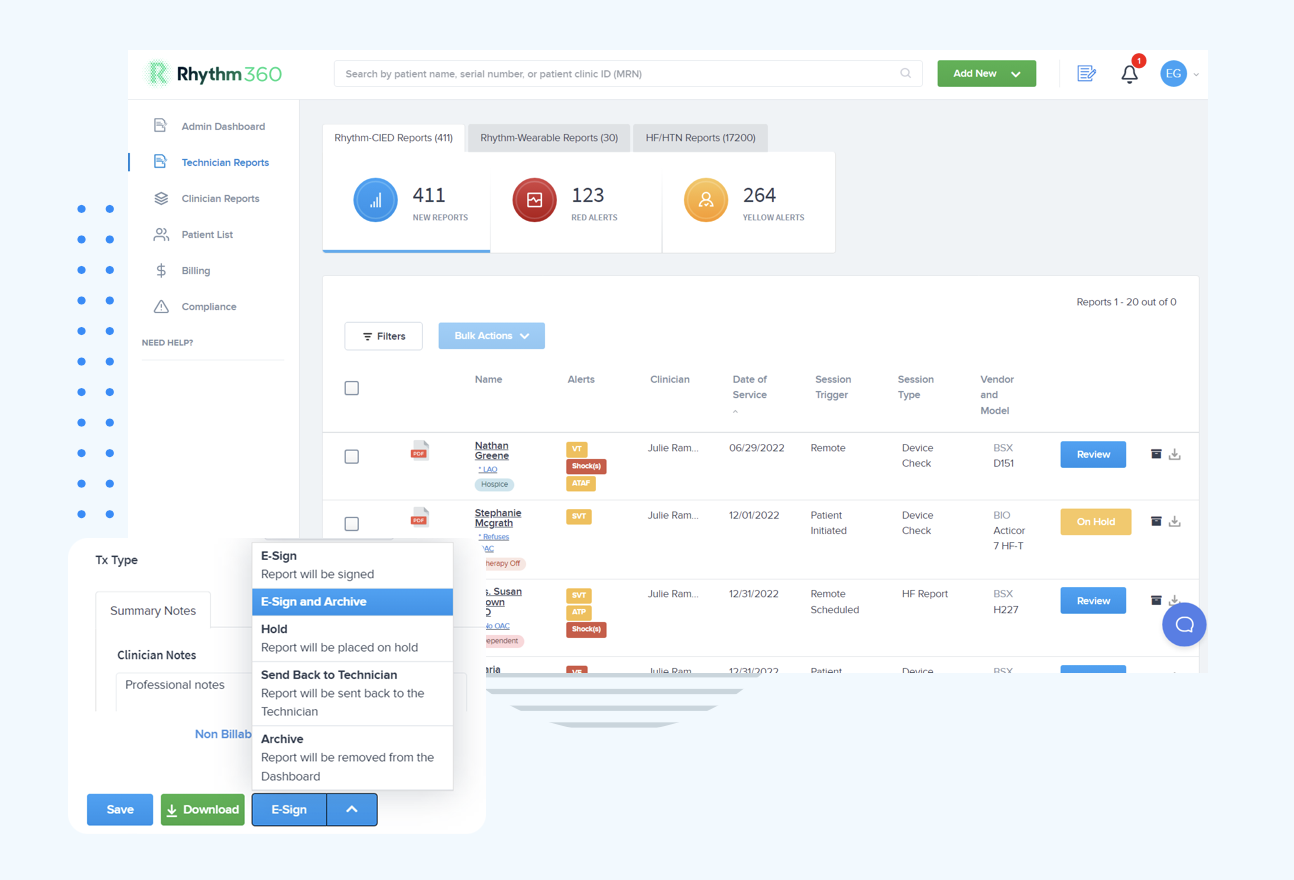
Rhythm360 automates data ingestion, report generation, and billing documentation, consolidating data from all OEM portals, including Medtronic, Boston Scientific, Abbott, Biotronik, and others, into a single source of truth. This consolidation removes manual portal-switching that creates documentation gaps and audit exposure.
Practices using Rhythm360 have achieved measurable improvements in billing accountability and monitoring scale. University of Chicago Medicine reviewed more than 73,000 reports annually through Rhythm360 in calendar year 2025, averaging more than 18,000 reports per quarter. Rhythm360 focuses on a unified, audit-ready documentation infrastructure that connects device data, CPT code logic, and billing documentation in a single workflow.
See How Rhythm360 Tracks Every Code Threshold
The following answers address the code and documentation questions practices raise most often when preparing for an RPM audit.
RPM documentation follows the same retention rules as other Medicare medical records. Most practices retain records for at least seven years to cover typical audit lookback periods. State law, payer contracts, and institutional policy may require longer retention, so compliance teams should confirm the strictest applicable standard and apply it consistently to RPM logs, transmission records, and consent documentation.
CPT 99091 covers the collection and interpretation of physiologic data that has been digitally stored and transmitted by the patient or caregiver to the physician or other qualified healthcare professional. It requires a minimum of 30 minutes of time, each 30 days. It is a legacy code billed per 30-day period and is distinct from the RPM management codes 99457 and 99470. Unlike 99457 and 99470, which compensate clinical staff management time, 99091 compensates physician or QHP personal time for data interpretation. As noted in the code table, 99091 and 99457 cannot be billed for the same time period, though CMS allows both within a 30-day period if time is not double-counted.
Yes. Medicare established RTM as a separately covered service in 2022 under its own CPT code family, the 98975 series. RTM monitors non-physiologic data, including musculoskeletal status, respiratory status, therapy adherence, and treatment response, and can be self-reported by the patient through a software application. RPM requires an FDA-defined device that transmits physiologic data automatically. RTM and RPM are mutually exclusive for the same clinical parameter in the same period. Under current Medicare rules, RTM does not require an established patient relationship, though the CY 2027 proposed rule would extend that requirement to RTM. Commercial payers vary significantly in their RTM coverage, and many major commercial plans do not currently reimburse RTM codes.
CMS finalized two new RPM CPT codes in the CY 2026 Physician Fee Schedule final rule (CMS-1832-F), effective January 1, 2026. CPT 99445 is a device-supply code covering 2 to 15 days of physiologic data transmission within a 30-day monitoring period, a billing pathway that did not exist before 2026. It is reimbursed at approximately the same national rate as 99454, about $52 per 30-day period, because CMS determined the practice expense of supplying the device does not change based on transmission-day count. CPT 99470 covers the first 10 to 19 minutes of RPM treatment-management time in a calendar month, below the 20-minute threshold required by 99457. It reimburses approximately $26 nationally. CPT 99470 requires at least one real-time interactive communication, while CPT 99445 is a device-supply code governed by the 2–15 day transmission threshold rather than an interactive-communication requirement. Both new codes are mutually exclusive with their higher-threshold counterparts, 99454 and 99457, in the same billing period.
CMS guidelines for RPM require an established patient relationship before billing begins, documented patient consent prior to initiating services, and an FDA-defined connected medical device that transmits physiologic data automatically. Self-reported data does not qualify. RPM must be medically necessary and tied to an acute or chronic condition, and each billed code must meet its specific threshold. Device-supply codes 99445 and 99454 are governed by transmission-day counts within a 30-day rolling period. Treatment-management codes 99470, 99457, and 99458 are governed by cumulative clinical time within a calendar month and require at least one real-time interactive communication. Only one practitioner may bill RPM for a given patient in a given period. RPM may be billed concurrently with CCM and TCM when each program’s requirements are independently met and time is not double-counted. Commercial payer guidelines vary and must be verified separately before enrolling non-Medicare patients.
The 2026 RPM code set changed compliance rules in two fundamental ways. It introduced new codes, 99445 and 99470, that require practices to select the correct code based on actual transmission days and actual management minutes. It also made explicit that the 16-day threshold governs device-supply codes only. Practices that apply a single universal threshold across all RPM codes generate denials and audit exposure on every treatment-management claim they submit.
The evaluation lens for any RPM compliance program in 2026 is straightforward. The program must track each code’s threshold independently, produce contemporaneous documentation that survives a reviewer’s request, and pair each device type to the correct code at the point of billing. A code-by-code, documentation-first, audit-ready program determines whether revenue is captured or recouped.
Talk With Rhythm360 About Audit-Ready RPM