Last updated: September 28, 2026
Before you compare vendors, keep these points in mind. They define a true care coordination platform instead of a single-function monitoring tool.
Talk to a cardiology workflow specialist
Three distinct product categories serve overlapping patient populations. Buyers frequently conflate them for two reasons: OEM marketing blurs monitoring with coordination, and the same patient often carries both an implanted device and a chronic HF diagnosis.
HF RPM platforms focus on physiologic data collected from external or wearable devices such as weight scales, blood pressure cuffs, and pulse oximeters. They support chronic disease management billing under codes such as 99453, 99454, and 99457. These platforms excel at population enrollment and CCM workflow, and HF RPM platforms typically ingest transmissions from cardiac implantable electronic devices (pacemakers, ICDs, and CRTs), usually via home-based receivers or smartphone apps.
CIED remote monitoring platforms aggregate transmissions from pacemakers, ICDs, CRT devices, and implantable loop recorders. The Japanese Heart Rhythm Society Expert Consensus Statement on Remote Monitoring of Cardiac Implantable Electronic Devices notes that third-party software can centrally manage data from multiple device manufacturers and incorporate it into electronic medical records, reducing staff workload. CIED remote monitoring platforms are strong on device-specific CPT documentation, but CardioMEMS data flows through Abbott's separate Merlin.net PCN HF Portal rather than CIED platforms, and wearable RPM remains largely unintegrated.
EHR-native tools within Epic or Oracle Health/Cerner offer tight workflow integration. They depend on vendor-specific data feeds and mappings that are inconsistent across manufacturers. Peer-reviewed research quantitating real-world EHR interoperability found overall interoperability was relatively poor (maximum 0.68), with same-vendor implementations more interoperable than different-vendor ones, though vendor choice alone does not ensure reliable interoperability. These tools also may not provide the alert triage logic or CPT audit trails that a specialized platform delivers.
The operational gap appears where all three categories meet. A patient with an ICD, a CardioMEMS sensor, and a concurrent HF/HTN RPM program sits in that gap. No single OEM portal and no EHR module was designed for that convergence.
Vendor-neutral normalization pulls structurally different data streams into one consistent view. That includes feeds from Medtronic, Boston Scientific, Abbott, and Biotronik, alongside CardioMEMS pulmonary artery pressure readings. Each manufacturer transmits data in proprietary formats: APIs, HL7 messages, XML files, and unstructured PDF reports. Each OEM server also has its own availability window. Medtronic explicitly notes that CareLink Network availability may be unavailable at times due to maintenance, updates, or coverage gaps, a risk that applies across all OEM platforms.
Rhythm360 addresses this through redundant data feeds. When an OEM server is unavailable, a secondary ingestion path, including computer vision parsing of PDF transmissions, maintains data continuity. This approach sustains the platform's greater than 99.9% transmissibility rate. AI-powered data mapping uses the same layer to fill gaps and flag connectivity issues before they become missed alerts.
An ACC expert analysis on digital cardiovascular care warns that without interoperability, the expanding ecosystem of digital health technologies risks fragmenting care into siloed data streams while increasing administrative burden on clinicians. A unified workspace counters that fragmentation and centralizes action.
Rhythm360 serves as the single source of truth, unifying implantable and wearable cardiac device data into one AI-powered, vendor-neutral platform. Its service lines for Rhythm-CIED and HF/HTN remote physiological monitoring stay distinct but integrated. University of Chicago Medicine reviewed more than 73,000 reports annually through Rhythm360 in calendar year 2025, averaging more than 18,000 reports per quarter. That volume demonstrates real-world scalability across a high-volume academic CIED and HF program.
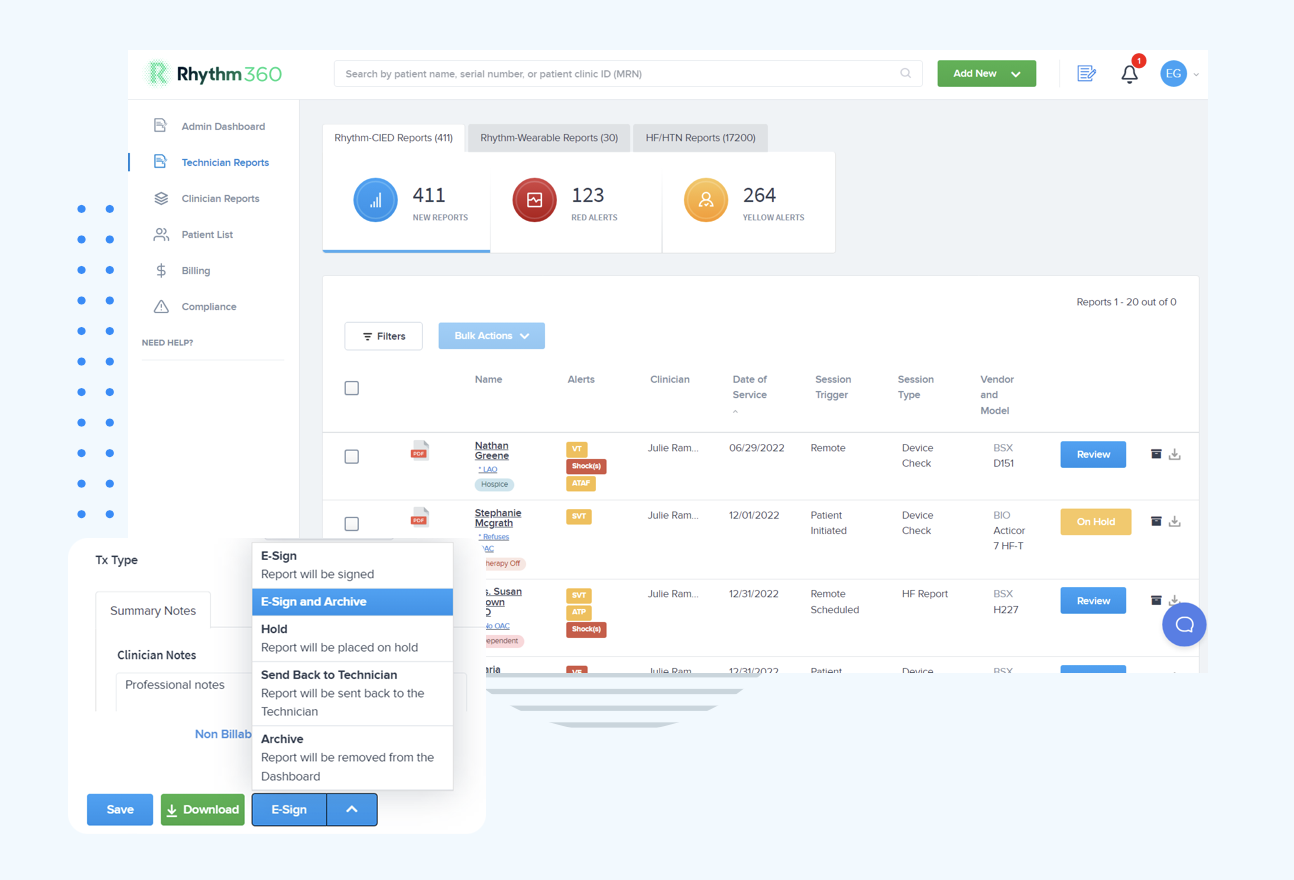
See the unified workspace in action
Heart failure patients frequently qualify for both RPM and CCM billing in the same month, provided the services are distinct and the same clinical staff minutes are not counted toward both programs.
For RPM, three foundational codes stack across the enrollment and monitoring lifecycle, each with its own documentation trigger.
For implantable cardiac devices, the billing structure separates by device type and cycle length. Pacemakers and ICDs operate on a 90-day cycle. Code 93294 is the professional component for pacemakers, and 93295 is the professional component for ICDs. Code 93296 is the technical component for both device families, covering remote data acquisition, technician review, and distribution of results. A device clinic that owns the monitoring platform and employs the reading physician bills two codes, the professional and the technical.
Physiologic monitors and loop recorders operate on a 30-day cycle with device-specific codes. Code 93297 covers implantable cardiovascular physiologic monitors such as CardioMEMS. Code 93298 covers subcutaneous cardiac rhythm monitors and implantable loop recorders. Each is billable once per 30 days and can be billed global, -26, or -TC depending on the practice's ownership of the professional and technical components.
Revenue cycle outcomes in device and HF programs tie directly to documentation accuracy. University of Chicago Medicine reported improved billing and accountability for patients following Rhythm360 integration. Rhythm360's automated CPT capture and documentation supports practices in recovering previously undocumented billable events. Clients have achieved up to an 80% reduction in critical alert response times and up to a 300% increase in revenue capture and profitability.
Capturing the billing codes above depends on something less visible. Someone must respond to the alert that triggers the documentation. Alert ownership is the operational question that no academic guideline fully answers. In a multi-OEM, multi-condition program, an alert can arrive from a Medtronic ICD, a CardioMEMS sensor, or an RPM weight scale at any hour, on any day. Without a defined escalation protocol, the alert sits unacknowledged.
A functional alert ownership model assigns each alert type to a specific role with a documented response timeline. AI triage makes that model workable. Because high dismissal rates in CIED monitoring are structural features of safety-first remote monitoring, most OEM-generated alerts are nonactionable across the 73,000-report UCM program described earlier. This pattern makes AI-powered triage a clinical necessity rather than a convenience.
Rhythm360 supports optional 24/7/365 oversight by certified cardiac technicians (CCTs) supervised by physicians. This coverage keeps escalation paths staffed outside business hours. A concrete scenario illustrates the stakes. A new-onset AFib alert arrives on a Saturday morning. The AI triage layer classifies it as clinically significant and routes it to the on-call CCT, who escalates to the supervising cardiologist. By Saturday afternoon, the patient is on anticoagulation. Remote monitoring studies have shown that this approach can detect AF episodes 1 to 5 months earlier than conventional follow-up, with approximately 90% of AF episodes detected through remote monitoring being asymptomatic.
Multidisciplinary roles such as electrophysiologist, HF cardiologist, NP, RN, CCT, and medical assistant each carry defined responsibilities within the escalation path. The HIPAA-compliant Rhythm360 mobile app ensures that the on-call clinician can review the transmission, sign the report, and initiate a care decision from anywhere.
See how alert ownership works in practice
Bi-directional EHR integration means data flows in both directions. Device and RPM data write into the EHR patient record. Patient demographics, problem lists, and medication data pull from the EHR into the monitoring platform. A one-directional feed, where staff must manually transcribe findings into the EHR, simply creates a second workflow.
Contractually, bi-directional integration should specify the message standard, such as HL7 v2, HL7 FHIR R4, or SMART on FHIR for app-layer access. It should also define the data elements exchanged in each direction, the latency expectation, and the escalation path when a feed fails. Rhythm360 supports bi-directional integration with Epic and Cerner, as well as Athenahealth, eClinicalWorks, and Greenway Health via HL7.
The ACC expert analysis on digital cardiovascular care cites the EXTEND randomized trial, in which device-based monitoring transmitted data directly into an EHR dashboard to enable seamless data exchange and clinician engagement. That trial sets a practical standard for what contractual integration commitments should deliver.
Onboarding, including integration configuration, typically takes a few days to a few weeks with Rhythm360. This timeline contrasts with the quarters-long implementation cycles associated with enterprise EHR module deployments.
Use a consistent three-part framework with every vendor. Start with clinical capability, then evaluate operational ownership, and finish with financial durability.
Other platforms in this space include Murj, Implicity, Rhythm Management Group, and Octagos. Applying this checklist consistently across all of them will surface the operational and financial differences that matter at the point of deployment.
A realistic onboarding sequence for a digital heart failure management care coordination platform moves through four phases: integration and configuration, patient enrollment, staff training, and steady-state operation. Integration and configuration come first. EHR connections are established, OEM data feeds are activated, and alert thresholds are configured to match the practice's clinical protocols. Patient enrollment follows, using onboarding checklists that capture consent documentation, device enrollment confirmation, and ICD-10 diagnosis codes supporting medical necessity for each billing program.
Staff training covers the administrative dashboard, alert triage workflows, mobile app use, and CPT documentation review. The dashboard provides a real-time view of patient compliance, critical alerts, and captured versus potential revenue based on CPT code requirements. This visibility gives practice administrators the population-level insight needed to manage a growing program without adding headcount.
Steady-state operation begins when the team is reviewing transmissions, responding to alerts within defined timelines, and generating billing documentation without manual transcription. Andrew Beaser, MD, Associate Professor of Medicine at University of Chicago Medicine, noted that Rhythm360 enabled clinicians to review more transmissions daily and identify more abnormalities. This outcome reflects the shift from reactive to proactive patient management that a well-implemented platform enables.
With the evaluation framework and onboarding sequence in hand, two practical questions remain for most teams.
Program costs vary by practice size, the number of patients enrolled, the device types monitored, and the platform's pricing model. Most remote patient monitoring companies use a flat fee per patient, per month (PPPM) pricing model, though some may charge extra for devices or offer fully managed services at different price points. Practices should evaluate total cost of ownership across three dimensions: platform licensing, implementation and integration costs, and staffing requirements for alert triage and documentation. On the revenue side, a well-implemented program generates recurring reimbursement through the RPM and device-specific codes outlined above. The net financial impact depends on patient panel size, payer mix, and documentation accuracy. Rhythm360 clients have achieved the same revenue gains described above through optimized CPT code documentation and the addition of RPM service lines for HF and HTN patients.
The CardioMEMS HF System is a wireless, battery-free pulmonary artery pressure sensor, so it has no battery depletion timeline in the conventional sense. The CardioMEMS sensor is externally powered by radiofrequency (RF) energy from the antenna of the Patient Electronics System during each reading session. Device longevity is therefore not limited by an internal power source the way a pacemaker or ICD is. Abbott, the manufacturer, provides device-specific durability data in its product labeling and post-approval study documentation. The FDA required a post-approval study to collect additional evidence of continued safety and effectiveness in the NYHA Class III population for which the device is indicated. Clinicians managing CardioMEMS patients should consult current Abbott labeling and their institutional CardioMEMS program protocols for the most current device performance specifications.
Cost and device longevity matter, but they do not decide between platforms in late-stage evaluation. The category confusion between HF RPM platforms, CIED remote monitoring platforms, and EHR-native tools is an operational problem, not a marketing one. Practices that select a platform optimized for only one of these functions will rebuild the fragmented workflow they set out to eliminate. Late-stage evaluation turns on operational questions: who owns the Saturday morning alert, how 93297 and 93298 documentation survives a payer audit, what bi-directional EHR integration contractually requires, and how quickly a practice can reach steady-state operation.
Rhythm360 is built for cardiology teams that need vendor-neutral CIED and CardioMEMS integration, AI-driven alert triage, automated CPT documentation across the full device and RPM code set, and bi-directional connectivity with Epic and Cerner. These capabilities deploy in days to weeks rather than quarters.
Schedule a strategy session with Rhythm360