Last updated: August 24, 2026
Heart failure programs face a compounding operational crisis that directly affects adherence and readmissions. A 2026 study by Bessette LG et al. in JAMA Internal Medicine, analyzing 6,111 hospitalized heart failure patients, found that 54% of new GDMT prescriptions went unfilled within seven days of discharge, and at six months, only 42% of patients remained adherent to all heart failure medications. High rates of primary nonadherence appeared for beta-blockers and RAS inhibitors, drug classes that require active monitoring and timely titration to deliver mortality benefit.
Disconnected workflows drive much of this gap. When device data from Medtronic, Boston Scientific, Abbott, and Biotronik lives in separate, non-interoperable OEM portals, clinical staff spend hours on manual data retrieval instead of acting on findings. A 2024 retrospective study at Zayed Military Hospital in the UAE found that cardiology-led inpatient care, characterized by structured follow-up and coordinated workflows, was associated with shorter lengths of stay than under internal medicine services, which shows how care coordination directly affects outcomes.
The financial consequences are equally severe. Practices without centralized billing documentation miss billable RPM events, generate rejected claims on CPT codes 99453, 99454, 99457, and 93298, and lose revenue that a properly integrated platform would capture automatically. Staff burnout from alert fatigue and redundant data entry accelerates turnover of specialized device technicians, which compounds the operational burden.
See how Rhythm360 consolidates OEM data streams and closes these workflow gaps in a live demonstration.
The solution to these fragmentation and adherence challenges is a structured, EHR-integrated workflow that embeds device monitoring, GDMT management, and billing documentation into a single system. The following seven-step process shows how Rhythm360 operationalizes this integration from discharge through ongoing home monitoring.
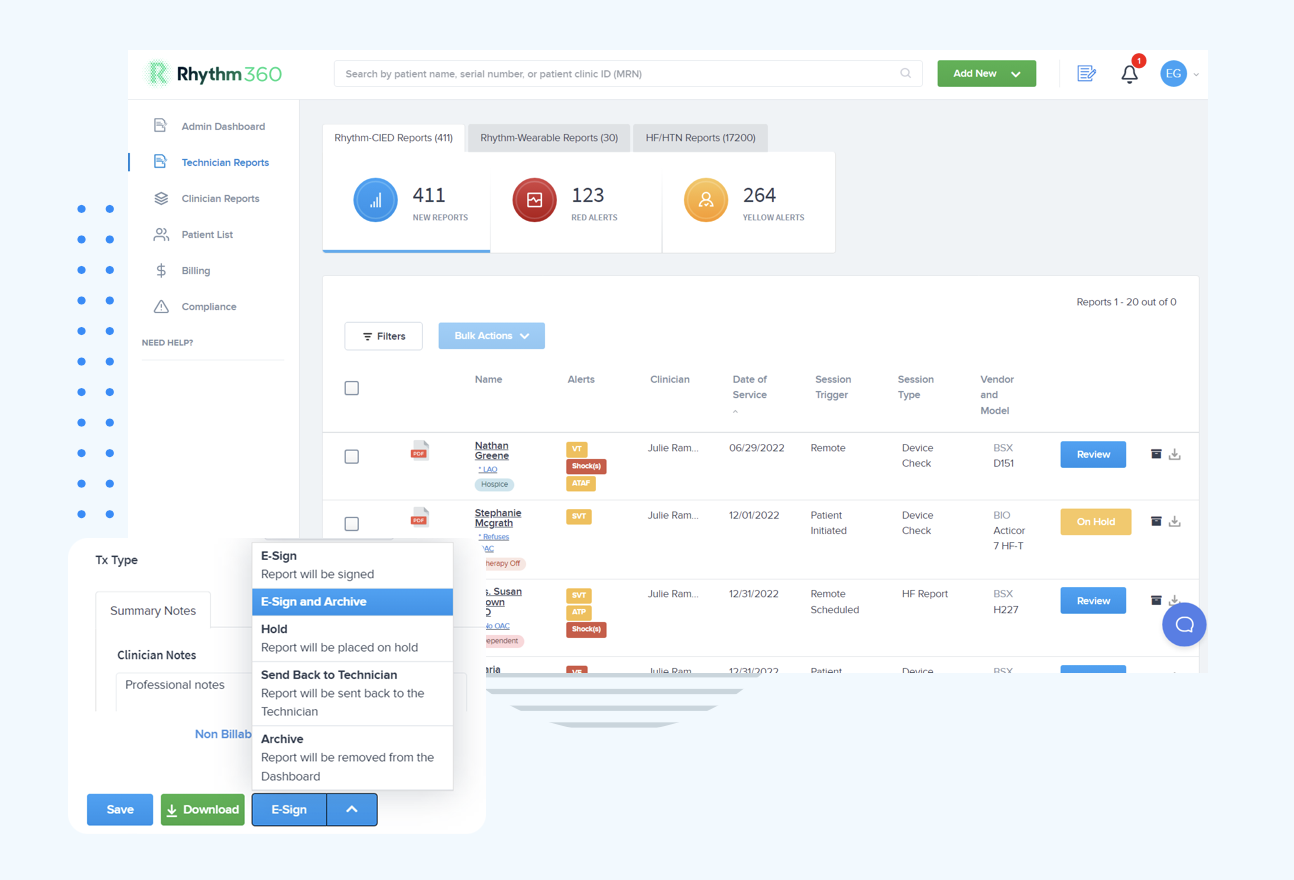
This discharge-to-home workflow eliminates portal fragmentation and documentation gaps by embedding device data, GDMT alerts, and billing capture directly into your Epic or Cerner environment.
A functional HF registry starts with structured admission and discharge data mapped to consistent problem-list codes. Rhythm360 ingests patient demographics, device identifiers, and diagnosis codes at enrollment and creates a longitudinal record that persists across care settings. Practices using a unified registry can stratify patients by HF phenotype, including HFrEF, HFmrEF, and HFpEF, and then apply condition-specific monitoring protocols from day one.
The FHIR specification uses the Device resource to represent a specific monitored device instance identified by UDI or serial number, while each remote monitoring measurement such as weight or blood pressure is recorded as an Observation resource linked to the Patient via Observation.subject and to the Device instance via Observation.device. DeviceAssociation records the time-bounded relationship between a patient and a home monitoring device such as a weight scale or blood pressure cuff. DeviceMetric describes each measurable channel of a communicating RPM device and is referenced by Observation resources for clinical measurements.
Effective CDS alerts for GDMT fire at the moment a clinician can act, such as order entry, visit documentation, or medication reconciliation, rather than as background notifications. Early initiation of foundational GDMT classes with structured up-titration and close follow-up can improve therapy, and this cadence requires EHR-embedded prompts to scale across a population.
The 2026 VITAL-HF multicenter randomized controlled trial of 178 adults with HFrEF across seven US sites evaluated a remote digital intervention versus usual care. These results support the idea that remote monitoring platforms that trigger actionable medication titration opportunities within supervised workflows can produce measurable improvements in GDMT optimization.
Rhythm360 applies this standards architecture across all supported OEM data streams. The platform ingests APIs, HL7 v2 messages, XML feeds, and unstructured PDFs via computer vision and AI-powered normalization and achieves greater than 99.9% data transmissibility through redundant data feeds that remain active even when an OEM server is unavailable. For bi-directional RPM integration, remote configuration commands such as changing daily reporting frequency on home weight scales are represented using ServiceRequest, with the outcome recorded as an Observation referencing the original ServiceRequest via Observation.basedOn.
Scaling AI-enabled remote monitoring in heart failure requires tight integration with electronic health records and prescribing systems. Rhythm360 satisfies this requirement through native bi-directional connections with Epic, Cerner, Athenahealth, eClinicalWorks, and Greenway Health.
A 2024 systematic review and meta-analysis by Felisberto and colleagues found that physicians override an average of 90% of drug-drug interaction alerts generated by clinical decision support systems, a rate that makes undifferentiated alerting systems clinically counterproductive. Research shows that only 10–20% of clinical alarms in hospital settings require any clinical intervention, with ICUs generating hundreds of alarms per day that condition staff to treat most alerts as background noise.
Rhythm360's AI triage layer addresses this problem directly. The system evaluates repeated measurements, recent patient baseline, measurement quality, active conditions, current medications, recent hospitalization, device type, and prior acknowledged alerts before generating an escalation. By filtering out alerts that fall within expected variation or duplicate recent notifications, the AI ensures that only contextually significant events reach the care team. This approach reduces critical alert response times by up to 80% because clinicians can act immediately on a smaller volume of high-priority notifications instead of sorting through hundreds of low-value alerts.
The 2026 Cardiology Journal experts' viewpoint confirms that AI-driven systems triage alerts according to clinical context rather than static thresholds, thereby reducing alert fatigue and focusing human review on events most likely to benefit from intervention. Rhythm360 supplements automated triage with optional 24/7/365 oversight by certified cardiac technicians (CCTs) supervised by physicians, which provides a human governance layer that catches edge cases the algorithm flags for escalation.
Alert governance within Rhythm360 follows a structured taxonomy that separates urgent alerts, routine exceptions, trend reviews, technical issues, and adherence problems and routes each category to the appropriate clinical role.
Rhythm360's outcomes dashboard gives teams a real-time view of patient compliance, critical alert status, GDMT adherence gaps, and captured versus potential revenue based on CPT code requirements. Practices using the platform have documented up to a 300% increase in revenue through improved CPT code capture and better staff efficiency.
The platform automates documentation for the following RPM billing codes:
The University of Chicago Medicine's implementation of Rhythm360 shows this impact at scale. UCM reviewed more than 73,000 reports annually through Rhythm360 in calendar year 2025, averaging more than 18,000 reports per quarter, with Andrew Beaser, MD, Associate Professor of Medicine at UCM, noting that clinicians were able to review more transmissions daily and identify more abnormalities. UCM reported: "We have improved billing and accountability for our patients after the integration," and "We are able to address these issues earlier; rather than waiting for a 3-month visit, we can call patients in for evaluation."
Rhythm360's implementation process follows a phased rollout that minimizes disruption to active clinical operations while moving quickly to live monitoring.
As UCM's experience demonstrates, decision support including AI-assisted decision support will become increasingly important as data volumes grow, which makes the governance and tuning steps in weeks three and four as critical as the technical integration itself. Other platforms in the remote cardiac monitoring space exist, but Rhythm360's vendor-neutral architecture and bi-directional EHR integration are designed to serve the full discharge-to-home continuum without requiring separate portal access for each OEM.
Walk through the Epic or Cerner integration timeline specific to your health system's configuration with the Rhythm360 implementation team.
Bi-directional EHR integration means that data flows in both directions between the remote monitoring platform and the EHR. Device readings, alert events, and RPM documentation push automatically into the patient's chart in Epic or Cerner, while the platform pulls current medications, visit notes, and problem-list data to provide clinical context during alert triage. This approach eliminates manual data entry, reduces transcription errors, and ensures that the clinician reviewing an alert sees the patient's full clinical picture, not just a raw device reading, before deciding on a response.
The primary CPT codes for remote physiological monitoring in heart failure are 99453 for initial setup and patient education, 99454 for device supply with daily recording or programmed alert transmission per 30 days, and 99457 for treatment management, first 20 minutes of clinical staff time per calendar month. For patients with cardiac implantable electronic devices, 93298 applies to remote interrogation device evaluation with physician analysis and report. Rhythm360 automates the documentation required for each of these codes, tracks time, transmission counts, and clinical interactions, and generates audit-ready records that support compliant claim submission. Practices using the platform have achieved up to a 300% increase in revenue through stronger CPT code capture.
Rhythm360 uses an AI-powered triage layer that evaluates each incoming alert against the patient's recent baseline, active conditions, current medications, recent hospitalization history, device type, and prior acknowledged alerts before generating a clinician notification. Alerts are classified into a structured taxonomy of urgent, routine exception, trend review, technical issue, or adherence problem and are routed to the appropriate clinical role rather than broadcast to the entire care team. Optional 24/7/365 oversight by certified cardiac technicians provides an additional human governance layer. The result is an 80% reduction in critical alert response times and a significant decrease in the volume of non-actionable notifications reaching physicians and nurses.
The core FHIR resources for RPM data in heart failure are Device, which represents the specific monitored device instance identified by UDI or serial number, Observation, which records each measurement such as weight or blood pressure and links to the patient via Observation.subject and to the device via Observation.device, DeviceMetric, which describes each measurable channel of a communicating device, and DeviceAssociation, which records the time-bounded relationship between a patient and a home monitoring device. For bi-directional configuration, ServiceRequest represents remote commands such as changing reporting frequency, with outcomes recorded as Observations referencing the original ServiceRequest. HL7 v2 PCD-01 messages map to these FHIR resources using IEEE 11073-10101 nomenclature and LOINC codes for vital signs observations.
The full implementation process, including HL7 interface activation, OEM portal connections, patient registry import, CDS alert configuration, CPT billing template setup, and staff training, typically takes from a few days to a few weeks depending on the size of the practice and the complexity of the existing EHR configuration. Rhythm360's implementation team works directly with Epic and Cerner IT contacts to complete credential exchange and sandbox validation in the first three days, with live monitoring beginning in week two or three. This phased approach minimizes disruption to active clinical operations and ensures that alert thresholds and governance frameworks are tuned before full patient volume is onboarded.
Fragmented OEM portals, disconnected EHR workflows, and undifferentiated alert systems create patient safety risks and revenue liabilities. With adherence rates remaining below 50% at six months post-discharge, as the Bessette study demonstrated, and readmission rates persistently high, the clinical and financial case for integrated, AI-powered monitoring is no longer theoretical. The 2026 VITAL-HF trial, the iCARDIO Alliance guidelines, and UCM's real-world experience with Rhythm360 all point to the same conclusion: structured, EHR-integrated remote monitoring with intelligent alert triage produces measurable improvements in GDMT adherence, readmission rates, and billing capture.
Rhythm360 delivers vendor-neutral bi-directional integration with Epic, Cerner, and other major EHR systems, AI-powered alert triage that reduces critical response times by up to 80%, automated CPT documentation for compliant RPM revenue, and greater than 99.9% data transmissibility across all major device manufacturers, in a platform that goes live in days to weeks, not months.
Explore how Rhythm360 can transform your heart failure program by improving clinical outcomes and revenue performance.