Heart Failure Patient Monitoring Devices: A Practice Guide
Rhythm360 unifies implantables, CIEDs & RPM data in one platform. Streamline HF monitoring workflows, billing & alerts. See how it works.

Key Takeaways For Heart Failure Monitoring Programs
- Heart failure monitoring devices fall into three categories: implantable hemodynamic monitors, CIED-based diagnostics, and non-invasive RPM tools. Each category carries distinct clinical, billing, and workflow requirements.
- Implantable sensors such as CardioMEMS and Cordella deliver direct PA pressure data and have demonstrated meaningful reductions in HF hospitalizations. Emerging options like V-LAP and FIRE1 broaden the hemodynamic monitoring landscape.
- CIEDs and non-invasive RPM tools generate most daily transmissions. Fragmented manufacturer portals add operational complexity that can cause missed alerts and billing gaps.
- CPT billing rules vary by device type and cycle length. Incorrect code selection and undocumented clinician time are leading causes of claim denials in cardiac monitoring programs.
- Rhythm360 unifies data from all major device manufacturers, automates alert triage and CPT documentation, and connects with leading EHRs so practices can scale heart failure monitoring efficiently.
See How Rhythm360 Unifies Device Data
Implantable Hemodynamic Monitors For Heart Failure
Implantable hemodynamic monitors measure intracardiac or vascular pressures directly and provide objective physiologic data that symptom-based assessment alone cannot reliably capture.
CardioMEMS HF System (Abbott)
The CardioMEMS HF System (PMA P100045) received initial FDA premarket approval in 2014 and expanded approval in 2022 for NYHA Class II–III patients with at least one prior heart failure hospitalization and/or elevated natriuretic peptides. The device consists of an implantable pulmonary artery pressure sensor placed in the distal PA via right heart catheterization. The procedure is typically performed through internal jugular or femoral venous access using a 12-French sheath and takes approximately 30 to 45 minutes.
Once implanted, the sensor transmits daily PA pressure readings wirelessly to a home electronics unit, commonly called the CardioMEMS pillow, which the patient rests against during each transmission session. Those readings upload to a secure database for clinician review. The pivotal CHAMPION trial reported a 28% reduction in heart failure hospitalizations compared with usual care. A 2025 pooled analysis of over 4,000 patients found that each 1 mmHg reduction in PA pressure during the first six months was associated with approximately a 3% improvement in survival at two years.
Cordella Pulmonary Artery Sensor (Endotronix)
The Cordella PA Sensor System received FDA approval through the premarket approval (PMA) process in 2024. It is indicated for NYHA Class III heart failure patients at home on diuretics and guideline-directed medical therapy.
The system includes an implantable PA sensor placed in the right PA, a catheter delivery system, a handheld patient reader with a dock, and a data analysis platform that transmits PA pressure measurements to a secure database. The pivotal PROACTIVE-HF trial met its primary endpoint with a 6-month event rate of 0.15 events per patient and demonstrated 99.2% freedom from device complications at six months. The FDA is requiring a post-approval study to collect additional evidence of safety and effectiveness.
V-LAP
V-LAP is a left atrial pressure sensor identified within the emerging category of implantable hemodynamic sensors for heart failure. It measures left atrial pressure directly and offers a different hemodynamic window than PA-based sensors. V-LAP does not yet have published FDA PMA clearance data equivalent to CardioMEMS or Cordella and remains an emerging technology.
FIRE1
FIRE1 (also referenced as FIRE1/NORM) is an inferior vena cava sensor placed within the broader implantable hemodynamic monitoring landscape for heart failure. It measures IVC area and collapsibility over time as a surrogate for intravascular volume status, rather than IVC pressure. Like V-LAP, FIRE1 is an emerging technology without the same regulatory and clinical trial record as CardioMEMS or Cordella.
Explore Hemodynamic Monitoring Integration
CIED-Based Monitoring For Heart Failure Management
Cardiac implantable electronic devices, including pacemakers, implantable cardioverter-defibrillators (ICDs), and cardiac resynchronization therapy (CRT) devices, contain built-in sensors and diagnostics that support heart failure management. Intrathoracic impedance trends, arrhythmia burden, heart rate variability, and device therapy logs all provide clinical signals relevant to HF status and decompensation risk.
The four major CIED manufacturers, Medtronic, Boston Scientific, Abbott, and Biotronik, each operate proprietary remote monitoring networks. Each network has its own interface, alert logic, and report format. A practice managing patients with devices from more than one manufacturer must log into multiple non-interoperable portals to retrieve data, which creates structural fragmentation that worsens as patient panels grow.
A 2024 real-world analysis found that a single network of 26 centers reviewed over 70,000 remote transmissions in 2023, compared to just 6,600 in-office interrogations. This ratio confirms that remote monitoring has become the primary device clinic workflow and no longer functions as a supplement to in-person care.
Non-Invasive Heart Failure Monitoring Tools In Daily Practice
Non-invasive remote monitoring tools for heart failure include cellular-connected weight scales, blood pressure cuffs, pulse oximeters, and remote dielectric sensing (ReDS) vests. These devices generate most RPM data for HF and hypertension patients and often serve as the entry point for practices launching a new RPM service line.
Their precision limits compared with implantable hemodynamic monitors affect clinical decision-making. CardioMEMS measures pulmonary artery pressure directly, whereas ReDS estimates pulmonary fluid content non-invasively. ReDS has demonstrated diagnostic validity and potential prognostic value, but external validation remains limited and evidence that ReDS-guided management improves clinical outcomes is still preliminary.
Cellular scales and BP cuffs provide trend data that is clinically useful for identifying decompensation patterns. However, home measurement technique is uncontrolled: cuff size, posture, and timing all affect blood pressure readings. Clinical reliance should therefore be based on validation status for the specific measurement and population.
Non-invasive tools do not replace implantable hemodynamic monitoring in high-risk NYHA Class III patients. They instead support broader population health management and chronic disease monitoring programs.
Launch Your RPM Program With Rhythm360
CPT Billing For Heart Failure Monitoring Devices
Heart failure remote monitoring relies on two main CPT families with different cycle lengths, device-type requirements, and claim structures. Applying the wrong code to a device type frequently triggers claim denials in cardiac monitoring programs.
Pacemakers and ICDs, 90-Day Cycle:
- 93294, remote monitoring of a pacemaker (professional component).
- 93295, remote monitoring of an ICD (professional component).
- 93296, remote monitoring technical component for pacemakers and ICDs.
Physiologic Monitors and Loop Recorders, 30-Day Cycle:
- 93297, remote monitoring of an implantable cardiovascular physiologic monitor (e.g., CardioMEMS). This is a device-specific code, not a professional component. It is billable once per 30 days and can be billed global, with modifier -26, or with modifier -TC.
- 93298, remote monitoring of a subcutaneous cardiac rhythm monitor or implantable loop recorder (ILR/ICM). This is also a device-specific code, not a technical component. It is billable once per 30 days and can be billed global, -26, or -TC.
93297 and 93298 are not a professional/technical pair. Each code corresponds to a different device type. Applying 93297 to a loop recorder or 93298 to a physiologic monitor will generate a device-type mismatch denial.
RPM Codes For Non-Invasive Devices:
- 99453, remote physiologic monitoring setup and patient education; billed once per episode of care.
- 99454, device supply with daily recordings or programmed alert transmissions; billed per 30-day period, requiring at least 16 days of transmitted data in that period.
- 99457, first 20 minutes of RPM treatment management per calendar month, requiring a live interactive communication with the patient.
The 30-day cycle for 93297 and 93298 and the 90-day cycle for 93294–93296 create different documentation and scheduling requirements, and those differences are where billing errors often cluster. The most commonly dropped billable event in cardiac remote monitoring is clinician interpretation and treatment-management time: staff review alerts and contact patients, but the time is never logged, so 99457 never generates a claim.
Managing Data From Multiple Heart Failure Monitoring Devices
A practice running CardioMEMS alongside CIEDs from Medtronic, Boston Scientific, Abbott, and Biotronik, plus a non-invasive RPM program, operates across at least five non-interoperable data environments at once. Each manufacturer portal has its own login, alert logic, and report format. No universal data standard exists across these networks.
Fragmented platforms and poor alert prioritization are documented practical barriers to effective monitoring in multidevice programs. The operational consequences include manual transcription burden, inconsistent documentation, delayed billing cycles, and elevated risk of missed critical events. Data arriving in a portal nobody monitors produces liability without benefit, and that risk scales directly with the number of disconnected systems a practice manages.
University of Chicago Medicine addressed this problem directly by implementing Rhythm360. UCM reviewed more than 73,000 reports annually through Rhythm360 in calendar year 2025, averaging more than 18,000 reports per quarter, a volume that would be operationally unsustainable across fragmented OEM portals. As Andrew D. Beaser, MD, an Associate Professor of Medicine at the University of Chicago Medicine (UCM), a role he has held since July 2020, noted: "We have improved billing and accountability for our patients after the integration."
Alert Triage And Patient Compliance In Mixed-Device HF Programs
Alert fatigue is the dominant operational failure mode in remote monitoring programs. A 2023 study published in Pacing and Clinical Electrophysiology found that most CIED alerts (73%) and scheduled transmissions (90%) were nonactionable, with only 7% of alerts leading to in-office follow-up. When alert volume exceeds clinical capacity, the response to genuine physiologic signals degrades.
Patient compliance compounds the problem. When patients disconnect devices, lose connectivity, or stop transmitting, care teams must troubleshoot in person, which undermines the efficiency that makes remote monitoring worthwhile. Because adherence tends to decline over time, programs need re-engagement strategies and realistic expectations about patient attrition.
Rhythm360 addresses both problems through AI-powered alert triage that filters non-actionable transmissions and prioritizes clinically significant events, reducing critical alert response times by up to 80%. The platform's integrated communication hub, powered by Twilio, enables automated and manual patient messaging with a full audit trail within the patient record. Care teams can document re-engagement attempts and avoid redundant outreach. As UCM's implementation demonstrated: "We are able to address these issues earlier; rather than waiting for a 3-month visit, we can call patients in for evaluation."
What Is Next In Heart Failure Monitoring
The next wave of implantable hemodynamic sensors is expanding beyond the pulmonary artery. V-LAP is an implantable hemodynamic sensor that targets left atrial pressure, while FIRE1/NORM targets inferior vena cava area. Both measure hemodynamic windows that PA-based sensors do not directly capture.
As device options expand, the operational complexity of managing a mixed-device program increases proportionally. Each new device category introduces a new data stream, a new billing code family, and often a new OEM portal. "Decision support, including AI-assisted decision support, will become increasingly important as data volumes grow."
Practices building or expanding HF monitoring programs in 2026 should account for this trajectory when evaluating their data infrastructure. Platform decisions made today will determine whether the program can absorb new device categories without adding headcount.
Why A Vendor-Neutral Platform Changes Heart Failure Economics
Rhythm360 by RhythmScience is a vendor-neutral, HIPAA-compliant, cloud-based platform. It ingests and normalizes data from all major CIED manufacturers, including Medtronic, Boston Scientific, Abbott, and Biotronik, as well as specialized sensors such as CardioMEMS. This approach provides a single source of truth for mixed-device HF monitoring programs.
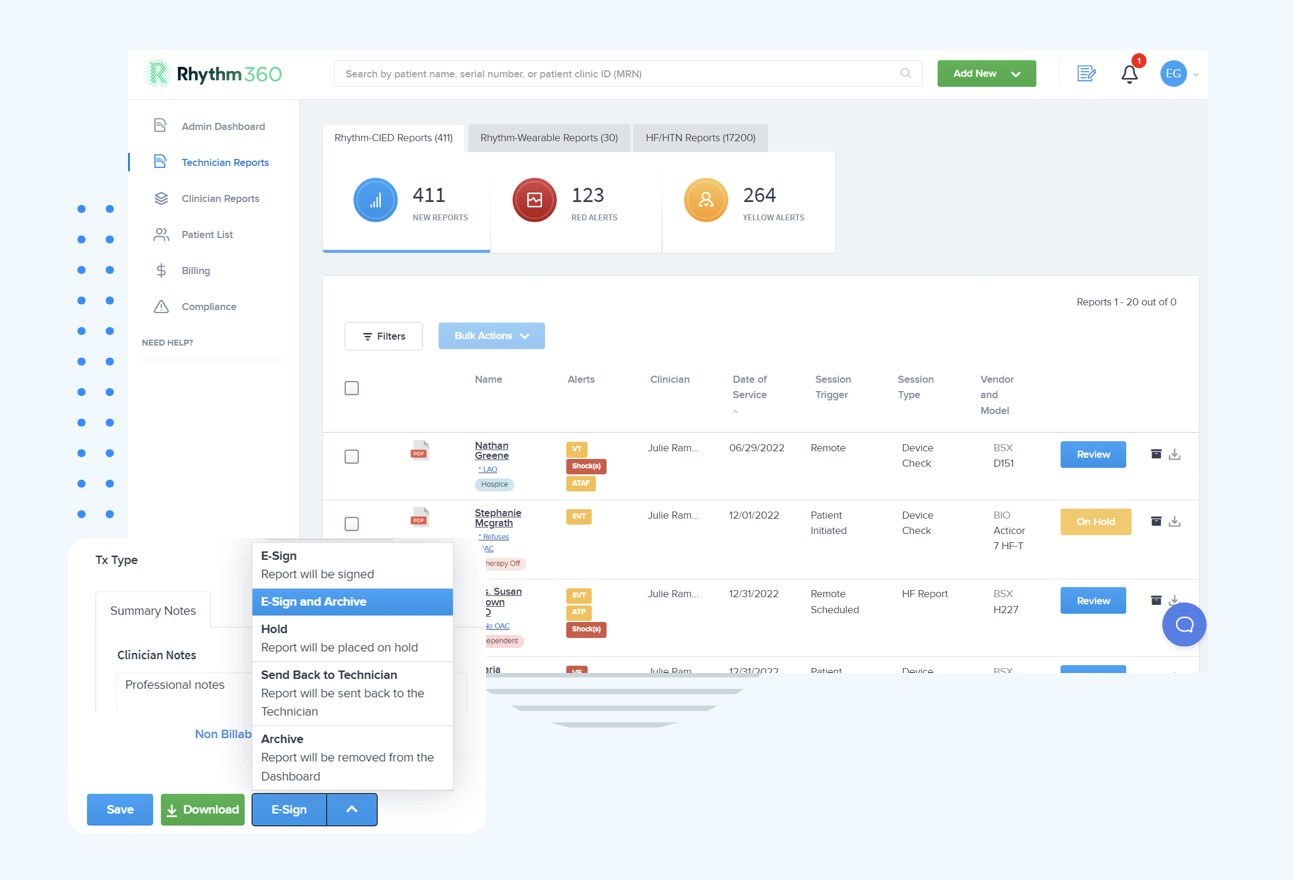
Data ingestion spans APIs, HL7, XML, and unstructured PDFs processed via computer vision and AI, achieving greater than 99.9% data transmissibility through redundant data feeds. The platform offers bi-directional EHR integration with Epic, Cerner, Athenahealth, eClinicalWorks, and Greenway Health. It pushes finalized reports directly into the patient chart while pulling discrete EHR data to provide clinical context at the time of transmission review.
Optional 24/7/365 oversight by certified cardiac technicians (CCTs) supervised by physicians is available for practices that need extended coverage without adding internal headcount. A secure, HIPAA-compliant mobile app allows clinicians to review transmissions, sign reports, and coordinate care from anywhere. As noted earlier, practices using Rhythm360 have seen up to an 80% reduction in critical alert response times, and they have also achieved up to a 300% increase in revenue capture and profitability through optimized CPT documentation and billing support.
Other platforms in the cardiac remote monitoring space exist, including Murj, Implicity, Rhythm Management Group, and Octagos. Practices evaluating platforms should assess data normalization depth, EHR integration scope, billing automation capability, and alert triage methodology against their specific patient population and device mix.
For a detailed look at how to build the operational foundation for a program like this, see the Heart Failure Remote Monitoring: 10-Step Roadmap and the Best Remote Patient Monitoring Platforms for Heart Failure guide.
Frequently Asked Questions
What Are The Main Types Of Heart Failure Patient Monitoring Devices?
Heart failure patient monitoring devices fall into three primary categories. Implantable hemodynamic monitors, including CardioMEMS, Cordella, V-LAP, and FIRE1, measure intracardiac or vascular pressures directly from inside the body. CIED-based diagnostics include pacemakers, ICDs, and CRT devices that transmit device diagnostics, arrhythmia burden, intrathoracic impedance, and therapy records remotely. Non-invasive RPM tools include cellular-connected weight scales, blood pressure cuffs, pulse oximeters, and ReDS vests that collect physiologic data at home without surgical implantation. Each category serves a different clinical purpose and generates a distinct data stream that requires specific billing codes and workflow infrastructure.
What Is The Difference Between Implantable Hemodynamic Monitors And Non-Invasive RPM Tools?
Implantable hemodynamic monitors measure pressure or fluid status directly from within the cardiovascular system. For example, CardioMEMS measures pulmonary artery pressure continuously from a sensor placed in the distal PA. Non-invasive RPM tools estimate physiologic parameters externally: a cellular scale measures body weight as a proxy for fluid retention, a BP cuff measures peripheral arterial pressure, and a ReDS vest estimates pulmonary fluid content using radiofrequency signals.
Implantable monitors provide more direct and continuous hemodynamic data but require a procedural implantation and are indicated for specific patient populations, typically NYHA Class II–III with prior HF hospitalization. Non-invasive tools are easier to deploy at scale, require no procedure, and usually serve as the starting point for practices launching an RPM service line, but they carry greater measurement variability and depend heavily on patient adherence and technique.
How Is CardioMEMS Implanted?
CardioMEMS is implanted via a standard right heart catheterization procedure performed through internal jugular or femoral venous access. Access is typically obtained using a 12-French sheath. The sensor, approximately 10 mm in width, is delivered to the distal pulmonary artery using a transvenous catheter delivery system and anchored in place.
The procedure generally takes 30 to 45 minutes from start to finish. Once implanted, the sensor requires no battery and transmits daily PA pressure readings wirelessly to a home electronics unit, the CardioMEMS pillow, that the patient rests against during each transmission session. The readings upload to a secure database for clinician review. Patients must be on stable guideline-directed medical therapy and meet the labeled indication, NYHA Class II–III with at least one prior HF hospitalization and/or elevated natriuretic peptides, before implantation.
What CPT Codes Apply To Heart Failure Remote Monitoring?
The applicable CPT codes depend on the device type being monitored.
- Implantable cardiovascular physiologic monitors (e.g., CardioMEMS): CPT 93297, billable once per 30-day period; can be billed global, with modifier -26, or with modifier -TC.
- Subcutaneous cardiac rhythm monitors and implantable loop recorders: CPT 93298, same 30-day cycle and modifier structure.
- Pacemakers and ICDs: 93294 (pacemaker professional), 93295 (ICD professional), and 93296 (pacemaker/ICD technical), all on a 90-day billing cycle.
- Non-invasive RPM programs: 99453 (setup and education, once per episode of care), 99454 (device supply, per 30-day period with at least 16 days of transmitted data), and 99457 (first 20 minutes of treatment management per calendar month, requiring live interactive communication).
93297 and 93298 function as device-specific codes rather than a professional and technical pair, and applying them to the wrong device type generates a mismatch denial.
How Do Practices Manage Data From Multiple Device Manufacturers?
Without a unified platform, practices must log into each manufacturer's proprietary portal separately, CareLink for Medtronic, LATITUDE for Boston Scientific, Merlin.net for Abbott, and Home Monitoring for Biotronik, plus any additional platforms for hemodynamic monitors and RPM devices. This structure creates data silos, manual transcription burden, inconsistent documentation, and elevated risk of missed critical events.
The operational solution is a vendor-neutral platform that ingests and normalizes data from all OEM sources into a single dashboard, automates CPT documentation, and integrates bi-directionally with the practice's EHR. Rhythm360 provides this infrastructure and supports practices from solo EP clinics to large integrated health systems managing thousands of patients across multiple device categories and manufacturers.
Talk To A Cardiac Monitoring Specialist
Conclusion: Workflow Turns Devices Into A Program
Selecting heart failure patient monitoring devices marks the starting point for a program. The clinical value of CardioMEMS, Cordella, CIEDs, and non-invasive RPM tools depends entirely on the operational infrastructure behind them. That means how data is aggregated, how alerts are triaged, how CPT codes are documented, and how the program scales without overwhelming staff.
Practices that treat device selection and workflow design as separate decisions consistently encounter the same problems: fragmented portals, billing gaps, alert fatigue, and patient attrition. A vendor-neutral platform that unifies all device data, automates documentation, and integrates with the EHR converts a collection of monitoring devices into a functioning, scalable program. For a comprehensive look at the device landscape before building out the operational layer, see the Best Remote Heart Failure Monitoring Devices 2026 Guide.
Build Your Scalable HF Monitoring Program