

Last updated: August 24, 2026
CMS reimburses RPM services through three distinct billing components: device setup, device supply, and treatment management. The 2026 Physician Fee Schedule introduced two new short-cycle codes that allow practices to bill for heart failure patients who transmit data fewer than 16 days per month, a population that previously generated no RPM reimbursement.
| CPT Code | Description | Transmission / Time Requirement | HF Use-Case Example |
|---|---|---|---|
| 99453 | Initial device setup and patient education | Billed once per episode of care | Onboarding a CHF patient to a cellular weight scale and BP cuff |
| 99454 | Device supply — standard transmission tier | 16+ days of transmitted data in a 30-day period | Daily weight and SpO2 readings from an adherent HF patient |
| 99445 | Device supply — short-duration transmission tier | 2–15 days of transmitted data in a 30-day period | Lower-engagement HF patient who transmits intermittently |
| 99457 | Treatment management — first 20 minutes | 20+ minutes; requires live interactive communication | NP reviews weight-gain trend and calls patient to adjust diuretic |
| 99470 | Treatment management — first 10 minutes | 10–19 minutes; lighter-touch engagement tier | Brief clinical review of a stable HF patient’s BP readings |
| 99458 | Treatment management — each additional 20-minute add-on | Each additional 20-minute increment beyond 99457 | Extended care coordination for a decompensating HF patient |
| 99091 | Physician collection and interpretation of physiologic data | 30+ minutes of physician time per 30-day period | Cardiologist interprets 30 days of CardioMEMS PA pressure data |
CPT 99454 and 99445 are mutually exclusive, so only one device-supply code may be billed per patient per 30-day period. The same mutual-exclusivity rule applies to 99457 and 99470 within the same calendar month.
Medicare requires a physician order for RPM services, and only one practitioner may bill RPM services for a given patient in any 30-day period, regardless of the number of devices used. Single-NPI enforcement ranks among the most frequently cited denial triggers, and manual multi-portal workflows make consistent enforcement difficult.
| Evaluation Criterion | Traditional Multi-Portal Workflow | Rhythm360 |
|---|---|---|
| Single-NPI enforcement | Manual cross-reference across OEM portals, with high risk of duplicate billing | Automated single-NPI enforcement per 30-day period at the platform level |
| Eligibility verification | Staff checks payer rules individually per patient at enrollment | Automated eligibility checks mapped to payer-specific coverage rules |
| Billing-tier determination | Manual review of standard (16+ days) vs. short-duration (2–15 days) tier before submission | Automated threshold tracking assigns the correct code tier before claim generation |
| Consent documentation | Paper or disconnected digital consent, with common audit gaps | Consent captured and stored within the patient record with a full audit trail |
Medicare covers RPM for patients with chronic or acute conditions requiring monitoring, including heart failure. Coverage requires the device to meet the FDA definition of a medical device, transmit data digitally and automatically, and collect readings on at least 16 days per 30-day period. Medicare Part B applies 20% patient cost-sharing to RPM services.
Medicare may deny RPM claims when the device does not meet the FDA definition under section 201(h) of the Federal Food, Drug, and Cosmetic Act, when ICD-10 codes fail to demonstrate medical necessity, or when minimum daily reading thresholds are not met. The table below contrasts the documentation risk profile of manual workflows with Rhythm360’s automated approach.
| Documentation Requirement | Manual Workflow Risk | Rhythm360 Automated Approach |
|---|---|---|
| FDA-cleared device validation | Staff manually confirms device status with no systematic check | Automated medical-device validation at enrollment |
| Transmission day count | Multiple readings on the same day count as one, and manual tracking is error-prone | Day-count engine tracks unique transmission days and flags patients at risk of missing the threshold mid-month |
| Time-stamped clinical notes | Time must be contemporaneous, and reconstructed logs are flagged in audits | Structured time-logging templates prompt date, duration, and specific activity at the point of care |
| Consent and cost-sharing disclosure | Missing consent is one of the most common audit triggers | Consent workflow integrated into onboarding and stored with a full audit trail in the patient record |
The HHS Office of Inspector General’s September 2024 review found that approximately 43% of enrollees who received RPM did not receive all three billed components, a compliance gap that automated documentation directly addresses.
Addressing these documentation and compliance gaps requires platform-level automation that spans device ingestion, CPT assignment, and audit-trail generation. Rhythm360 operates as a vendor-neutral platform that unifies CIED and heart failure data streams within a single workspace.
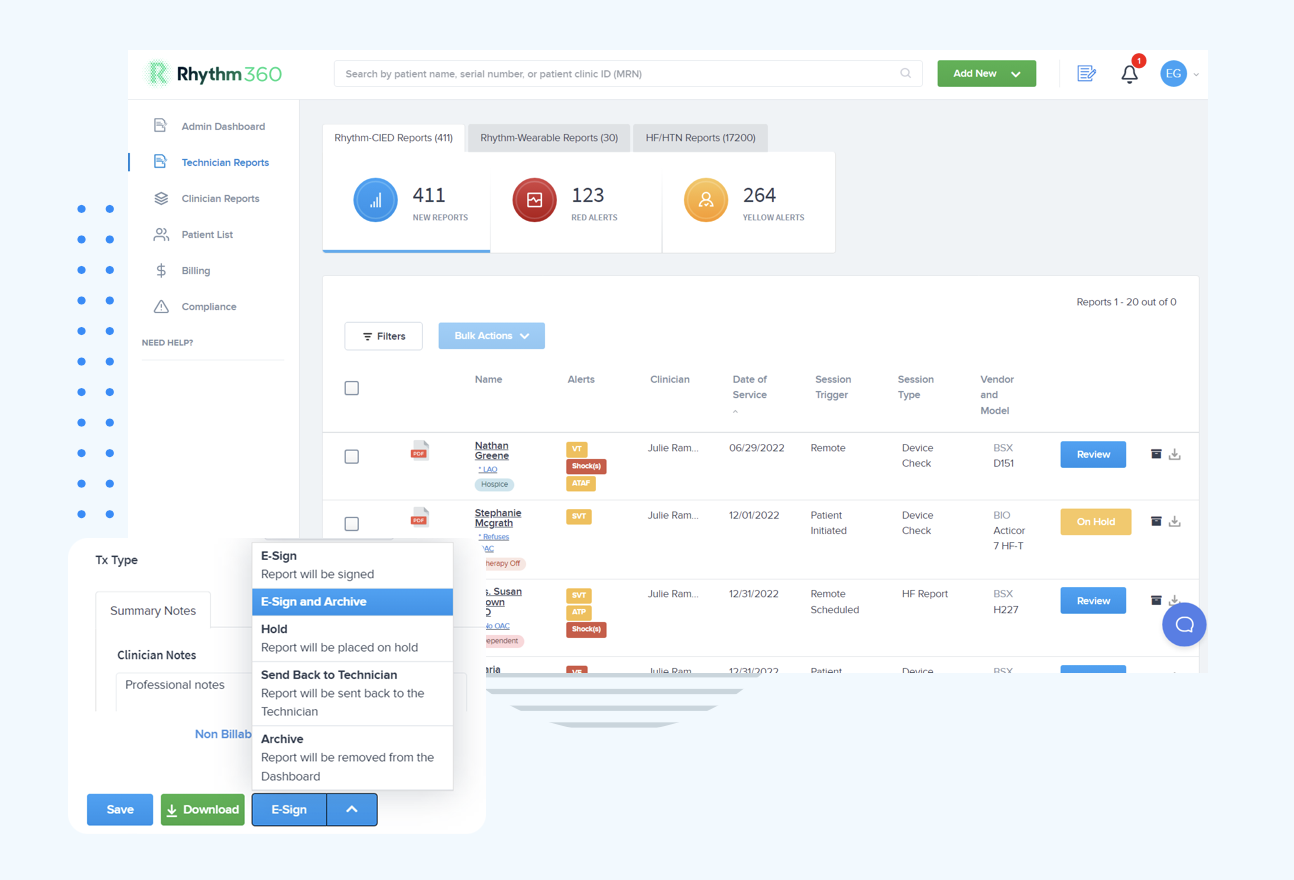
The University of Chicago Medicine (UCM) implemented Rhythm360 to overhaul cardiovascular remote monitoring across its CIED and heart failure patient population. UCM reviewed more than 73,000 reports annually through Rhythm360 in calendar year 2025, averaging more than 18,000 reports per quarter.
Clinical and administrative leaders at UCM reported measurable improvements across billing accuracy and care delivery:
Across Rhythm360 deployments, practices report an 80% reduction in critical alert response times and revenue increases of up to 300% through improved CPT code capture, better staff efficiency, and the addition of HF and HTN RPM service lines. The 2026 introduction of CPT 99445 and 99470 creates additional revenue capture for lower-engagement heart failure patients who previously generated zero reimbursement under prior transmission thresholds.
These clinical and revenue outcomes translate directly to practice economics. Rhythm360’s SaaS-based pricing scales with clinic size and platform usage. Implementation, including bi-directional EHR integration, completes in days to weeks, not months.
The platform removes multiple OEM portal logins, reduces reliance on a single administrative “super-user,” and provides a real-time dashboard that tracks patient compliance, critical alerts, and captured versus potential revenue by CPT code. Most practices achieve a positive ROI break-even point for RPM programs within 2-3 months of steady patient enrollment. This rapid payback period reflects both direct CPT code reimbursement and indirect savings from avoided readmissions, and larger programs capture value on both dimensions at once.
| Practice Profile | Primary Challenge | Rhythm360 Fit | Key Feature |
|---|---|---|---|
| Solo EP or small cardiology practice (1–3 providers) | Staff bandwidth for documentation and billing compliance | High | Automated CPT documentation and audit-ready reports reduce per-claim staff time |
| Mid-size cardiology group (4–15 providers, mixed OEM device mix) | Multiple OEM portals, alert fatigue, revenue leakage | High | Vendor-neutral ingestion unifies all device data, and AI triage reduces alert noise |
| Large integrated health system or academic medical center | High-volume report management, EHR integration, scalable compliance | High | Bi-directional Epic, Cerner, and Athenahealth integration with 99.9%+ transmissibility at scale |
| HF program with elderly or low-tech patient population | Device adherence, 16-day transmission threshold, cellular connectivity | High | Cellular device support with automated transmission tracking and mid-month threshold alerts |
Medicare covers RPM device supply for heart failure patients under CPT 99454, which requires 16 or more transmission days per 30-day period, and under the 2026 short-cycle code CPT 99445, which covers 2–15 transmission days. The device must be FDA-cleared, transmit data automatically and digitally, and be used to monitor a qualifying chronic or acute condition. Medicare Part B applies 20% patient cost-sharing, which must appear in documented consent before billing begins. Consumer wellness devices that require manual data entry do not qualify. Rhythm360 automates FDA-device validation at enrollment and tracks transmission days in real time so the correct code tier is applied before a claim is submitted.
Physicians, nurse practitioners, physician assistants, and other qualified health care professionals may bill RPM services. Only one practitioner may bill RPM for a given patient in any 30-day period, regardless of how many devices that patient uses or how many providers participate in their care. This single-provider rule creates one of the most common sources of claim denials. Rhythm360 enforces single-NPI billing at the platform level and prevents duplicate claims from being generated across providers within the same billing period.
Common denial triggers include billing CPT 99454 when the patient transmitted data on fewer than 16 days, using a device that does not meet the FDA medical-device definition, submitting ICD-10 codes that do not demonstrate medical necessity for the monitored condition, filing duplicate claims for the same 30-day period, using more than one NPI per claim, and missing or incomplete consent documentation. Time logs for CPT 99457 and 99458 that lack specific dates, durations, and activity descriptions also trigger audits. Rhythm360’s pre-claim compliance checks catch these issues before submission rather than after denial.
Cellular-enabled weight scales and blood pressure cuffs transmit readings automatically over 4G networks without smartphone pairing, app installation, or Wi-Fi access. For elderly heart failure patients, this removes common adherence failure points and supports consistent daily data transmission. Higher adherence directly protects CPT 99454 billing eligibility, which requires data on at least 16 of 30 days.
Cellular devices also support earlier detection of decompensation signals, such as a 3-pound weight gain in 48 hours, which triggers same-day care team outreach before fluid overload escalates to hospitalization. Rhythm360 supports cellular device onboarding and monitors transmission counts mid-month, alerting care teams when a patient is at risk of falling below the billing threshold.
RPM and CCM can generally be billed during the same service period for the same patient when the documented time and services do not overlap. Clinical staff time counted toward RPM management minutes under CPT 99457 or 99458 cannot also count toward CCM monthly minutes. When tracked separately with distinct time logs, concurrent billing under the 2026 CMS Physician Fee Schedule generates approximately $170–$260 per patient per month in combined reimbursement. Rhythm360’s structured time-logging templates and audit trail support clean separation of RPM and CCM documentation and lower the compliance risk of concurrent billing.
Fragmented OEM portals, manual transmission tracking, and disconnected documentation workflows create measurable revenue leakage and audit exposure for cardiology practices running heart failure RPM programs. The 2026 CPT code updates, including the new short-cycle codes 99445 and 99470, expand reimbursement opportunity but also add complexity that manual processes cannot reliably manage at scale.
Rhythm360 addresses every layer of that complexity through vendor-neutral data ingestion across all major device manufacturers, automated CPT code assignment based on real-time transmission counts, single-NPI enforcement, bi-directional EHR integration, cellular device support for elderly patients, and AI-powered alert triage that delivers the response-time improvements documented in UCM’s deployment. The University of Chicago Medicine’s experience, processing the report volumes described earlier with documented improvements in billing accountability and earlier patient intervention, shows what a unified platform delivers at scale.





