Heart failure remote patient monitoring (HF RPM) programs reduce hospitalizations and mortality when they follow clear protocols, defined staffing, and integrated technology.
Device fragmentation from multiple manufacturers creates administrative overload and data silos, so a vendor-neutral platform becomes essential for success.
A 90-day pilot needs defined patient criteria, individualized alert thresholds, a Green/Yellow/Red escalation workflow, and documented staffing roles before launch.
2026 CMS billing rules require precise documentation, live patient interaction, and transmission compliance tracking to prevent claim denials and protect revenue.
Schedule a demo with Rhythm360 to unify device data, automate billing documentation, and launch your compliant HF RPM program within 90 days.
Why HF RPM Programs Stumble at Launch
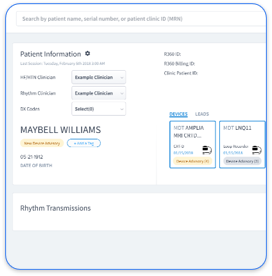
Device fragmentation causes the most frequent failures. The moment a practice implants or prescribes devices from more than one manufacturer, such as Medtronic, Boston Scientific, Abbott, or Biotronik, staff must log into separate, non-interoperable OEM portals to retrieve data. That workflow creates administrative overload, data silos, and missed critical events.
Three prerequisites must be in place before a 90-day pilot begins:
An EHR with HL7 integration capability, such as Epic, Cerner, Athenahealth, or an equivalent system
At least one trained device technician or RN designated as the primary monitoring reviewer
A defined 90-day pilot budget covering device supply, staffing time, and platform licensing
The table below maps each step to an owner, key actions, and expected output. Each step then receives a deeper explanation in the sections that follow.
Step
Owner
Key Actions
Expected Output
1. Define objectives and patient criteria
EP Lead / Medical Director
Set enrollment triggers, define NYHA class targets
Signed patient selection protocol
2. Set minimum data set and alert thresholds
EP Lead / RN
Configure weight, BP, SpO2, HRV parameters per patient
Individualized threshold matrix
3. Build escalation algorithm
RN / EP Lead
Define Green/Yellow/Red tiers with time-bound SLAs
Documented escalation workflow
4. Map staffing roles and SLAs
Practice Administrator
Assign reviewer, escalation, and billing roles, set coverage hours
Staffing RACI chart
5. Choose vendor-neutral data ingestion
Practice Administrator / IT
Confirm EHR integration, select platform, validate transmissibility
Monitor enrollment, transmission rate, revenue per patient
30/60/90-day ROI report
Step 1: Lock In Objectives and Patient Criteria
Patient selection drives both program ROI and clinical impact. High-utilization patients with recent hospitalizations or ED visits, as well as those with heart disease, are prioritized as highest-value candidates for RPM enrollment.
Severe CKD (eGFR <30 ml/min/1.73 m²) as a high-risk modifier
Document the selection criteria in a signed protocol before any device is ordered. This protocol anchors medical necessity for CMS billing and payer audits.
Step 2: Define Data Set and Patient-Specific Thresholds
Step 3: Build a Green/Yellow/Red Escalation Playbook
Every alert tier needs a time-bound action assigned to a named role.
Green (routine): All readings within threshold, no outreach required, log daily review.
Yellow (urgent): Weight gain ≥2 lb in 24 hrs or BP >160 mmHg, RN callback within 4 hours, document interaction for CPT 99457.
Red (emergent): SpO2 <90%, BP >180/120, or HR >120 bpm with symptoms, immediate RN contact, EP notification within 1 hour, ER referral if end-organ symptoms present.
For Red-tier events that require hospitalization, some programs extend the response with direct-admission pathways. Many surveyed French cardiology RPM programs implemented specific consultations for emergency alerts and established direct-admission protocols that bypass emergency departments. Define bypass pathways in writing before go-live.
High-acuity HF populations often need tighter nurse-to-patient ratios because they generate higher alert volume and more frequent interventions. For a 3–10 provider group launching a 90-day pilot of 50–150 patients, the following roles usually cover operational needs:
Medical Assistant or Care Coordinator: Device onboarding, consent collection, transmission compliance tracking, scheduling.
EP Lead / Medical Director: Protocol approval, escalation endpoint for Red alerts, billing practitioner of record.
Optional 24/7 CCT Oversight: Rhythm360 offers optional certified cardiac technician (CCT) coverage supervised by physicians for weekend and after-hours triage, which removes the need to hire additional internal staff for off-hours coverage.
Step 5: Select Vendor-Neutral Data Ingestion and Integration
EHR integration keeps clinicians engaged with the program. Providers will not adopt a monitoring program if RPM data lives in a separate system and is not visible in the EHR during clinical encounters. Minimum integration requirements for a 2026-compliant HF RPM program include:
Bi-directional HL7 v2.x or FHIR R4 connection to the practice EHR
Support for all enrolled device manufacturers without separate OEM portal logins
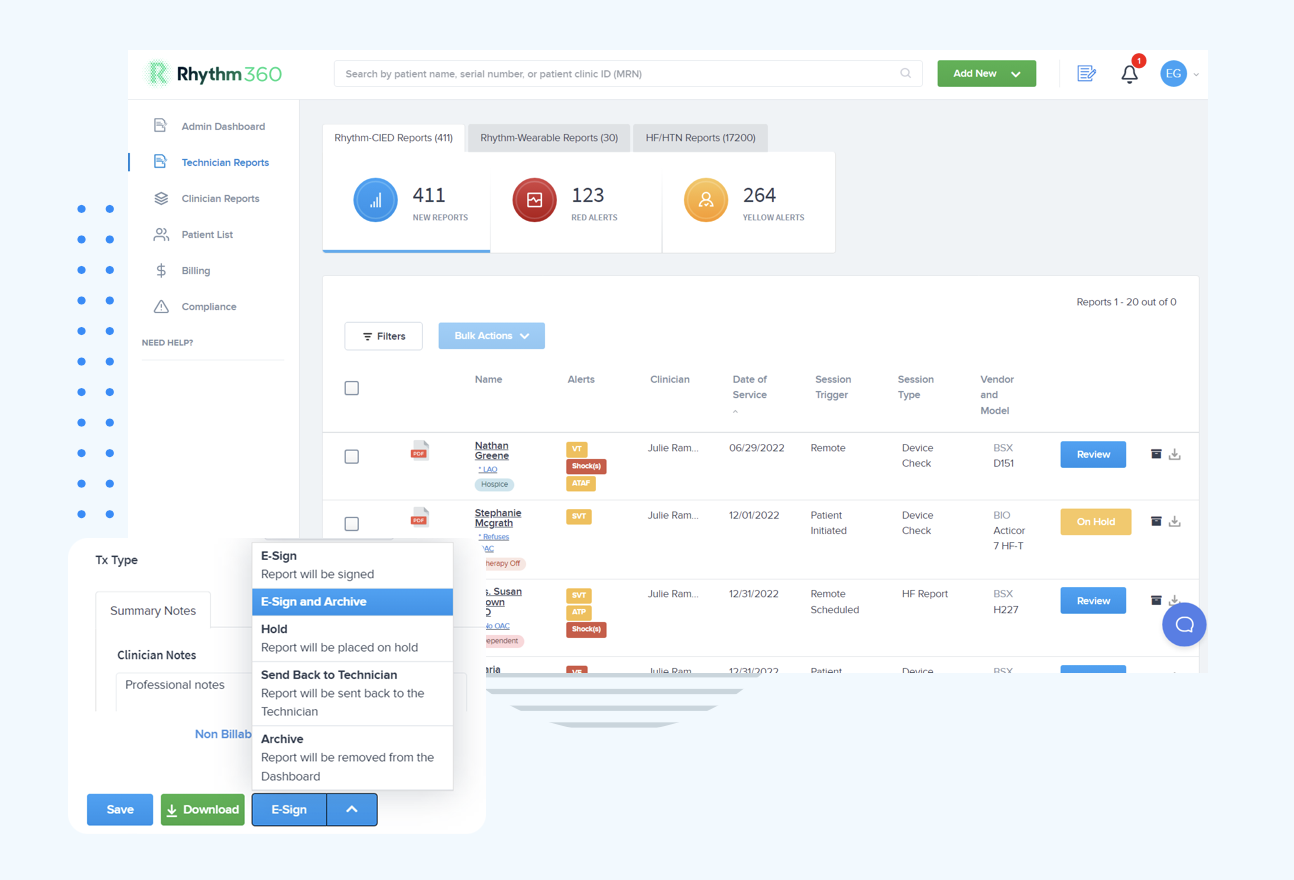
Rhythm360 normalizes data from Medtronic, Boston Scientific, Abbott, and Biotronik into a single dashboard via API, HL7, XML, and computer-vision PDF parsing. The platform achieves >99.9% transmissibility through redundant data feeds and AI-powered extrapolation and reduces critical-alert response times by up to 80%. University of Chicago Medicine reviewed more than 73,000 reports annually through Rhythm360 in 2025, which demonstrates the platform's capacity to scale without adding headcount.
Rhythm360
Pro Tip: Missing device-compliance tracking is one of the most common audit vulnerabilities in HF RPM programs. If a patient's scale goes offline for 10 days and no one documents the gap, the practice cannot bill CPT 99454 and may face claim denial. Rhythm360's audit logs automatically track transmission compliance per patient, flag connectivity issues in real time, and generate the documentation trail required for CPT billing defense.
Step 6: Align HF RPM With 2026 CMS Billing Rules
The CY 2026 Physician Fee Schedule Final Rule updated RPM billing effective January 1, 2026. The table below maps every billable CPT code to its description, frequency, and national average reimbursement, showing how a compliant HF RPM program can generate meaningful revenue per patient when transmission and interaction requirements are met.
Interrogation and analysis of implantable CIED with remote data acquisition
Per device type and transmission schedule
Varies by device
Key documentation requirements for every claim connect in a simple sequence. Every RPM claim begins with signed patient consent documenting understanding of the service, device use, cost-sharing, and data usage. Without this foundational consent, no subsequent billing is defensible.
Beyond consent, the practice must demonstrate an established patient relationship and documented medical necessity beyond the diagnosis alone, showing that RPM addresses a specific clinical need rather than serving as a blanket enrollment. To bill management codes 99457, 99458, or 99470, the practice must complete at least one live, synchronous interactive communication per calendar month, and texts and voicemails do not qualify.
Accurate transmission day count per 30-day period then determines whether 99445, for 2–15 days, or 99454, for 16–30 days, applies. This tracking becomes a billing prerequisite rather than a nice-to-have operational metric.
Rhythm360 automates CPT-compliant documentation, tracks billable time per patient, and generates audit-ready records, which directly addresses the billing gaps that cause claim denials. The billing improvements documented at University of Chicago Medicine show how automated documentation strengthens claim defense and accountability.
Step 7: Build a 30/60/90-Day Pilot ROI Dashboard
ROI targets should be defined before the pilot launches so the 90-day review has a clear baseline for comparison. Recommended pilot metrics for a 50-patient cohort include:
Enrollment target: 50 patients within 30 days of go-live
Transmission compliance rate: ≥80% of patients transmitting ≥16 days per 30-day period, qualifying for 99454
Revenue per patient per month: at higher engagement tiers using 2026 national average rates
Alert response time: median ≤24 hours for Yellow alerts and ≤1 hour for Red alerts
30-day readmission rate: tracked against pre-program baseline
A 90-day pilot with 25–50 patients is sufficient to generate meaningful operational and financial data. At this size, one RPM RN can manage the full cohort within standard working hours, and the transmission volume is large enough to identify workflow gaps before scaling. Practices with fewer than 25 enrolled patients often lack the alert volume needed to train staff on escalation protocols effectively. Starting with a defined cohort, such as all patients discharged with a primary HF diagnosis in the prior 30 days, creates a clean baseline for readmission rate comparison at day 90.
Which 2026 CMS rules most affect RPM billing for heart failure programs?
Two changes from the CY 2026 Physician Fee Schedule Final Rule have the greatest operational impact. First, new CPT 99445 allows billing for device supply with only 2–15 days of transmission in a 30-day period, which removes the previous 16-day minimum barrier. Patients who miss days due to travel or illness can still generate a billable claim.
Second, new CPT 99470 covers the first 10 minutes of treatment management time, providing a billing pathway for months when clinical interaction was meaningful but did not reach the 20-minute threshold for 99457. Practices must choose one device-supply code, 99445 or 99454, and one management code, 99470 or 99457, per patient per billing period because they function as mutually exclusive pairs. All management codes require at least one live, synchronous interactive communication, and asynchronous messages do not qualify.
How do we avoid alert fatigue in an HF RPM program?
Alert fatigue usually stems from thresholds set too broadly, which trigger high volumes of non-actionable alerts, and from insufficient triage automation that routes every alert to the same staff regardless of severity. The solution combines clinical and technical changes.
On the clinical side, individualize thresholds per patient at enrollment rather than applying universal cutoffs, and review threshold appropriateness at 30 days using actual alert volume data. On the technical side, use a platform with AI-driven triage that filters non-actionable noise and surfaces only clinically significant events. Rhythm360's intelligent alerting system prioritizes events by severity, which reduces the cognitive load on nursing staff and allows reviewers to focus on alerts that require action.
Defining a Green/Yellow/Red escalation algorithm with time-bound SLAs before the first patient is enrolled ensures that every alert has a documented owner and response expectation. That structure further reduces the reactive chaos that drives fatigue.
Can RPM be billed alongside other chronic care management codes for HF patients?
RPM can be billed during the same service period as Chronic Care Management, CCM, and Transitional Care Management, TCM, when the documented time and services do not overlap. RPM and Remote Therapeutic Monitoring, RTM, cannot be billed together for the same patient during the same billing period because RPM applies to physiologic data such as weight, blood pressure, and heart rate, while RTM applies to non-physiologic therapeutic data.
Practices should document time separately for each program and ensure that the interactive communication required for RPM management codes is not double-counted toward CCM time minimums.
Launch Your HF RPM Program This Quarter
The 7-step checklist above covers every operational layer a 3–10 provider cardiology group needs to launch a CMS-compliant, profitable HF RPM program within 90 days. These layers include patient selection criteria, individualized alert thresholds, a Green/Yellow/Red escalation algorithm, staffing SLAs, vendor-neutral data ingestion, 2026 CPT billing documentation, and a pilot ROI dashboard.
Fragmented OEM portals and manual workflows create the primary barriers to execution. Rhythm360 removes both barriers by unifying Medtronic, Boston Scientific, Abbott, and Biotronik data into a single AI-powered platform with automated CPT-compliant documentation, >99.9% transmissibility, and optional 24/7 CCT oversight, without requiring additional headcount.