How Automated Arrhythmia Monitoring Works: A 7-Step Guide
Last updated: August 24, 2026
Key Takeaways for Cardiology Teams
Automated arrhythmia monitoring uses AI to ingest, classify, and prioritize cardiac device transmissions, filtering non-actionable alerts before clinical review.
The 7-step workflow covers device enrollment, transmission, cloud preprocessing, AI triage, clinic notification, clinical review, and automated CPT billing capture.
AI triage can reduce alert volume by up to 29% while preserving critical events, and Rhythm360 cuts critical alert response times by up to 80%.
Bi-directional EHR integration and automated documentation support compliant billing for CPT codes 93298, 93299, and 99454, with clients reporting up to 300% revenue gains.
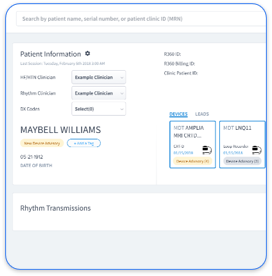
Device Enrollment and Patient Setup. Each patient’s cardiac implantable electronic device (CIED) or wearable monitor is registered in the platform with device type, OEM, and transmission schedule. In a vendor-neutral environment, this step consolidates enrollment across Medtronic, Boston Scientific, Abbott, Biotronik, and other manufacturers into a single system instead of separate OEM portals. Rhythm360 completes this onboarding in a short timeline, typically days to weeks, including EHR integration. This unified setup removes the fragmented enrollment work that burdens multi-OEM practices.
Scheduled and Event-Triggered Transmission. Devices send data automatically on a schedule or when an event, such as an arrhythmia or device malfunction, triggers an unscheduled transmission. These transmissions typically travel through a home transmitter or smartphone app. Rhythm360 ingests this data through API, HL7, XML, and computer-vision PDF parsing, achieving greater than 99.9% transmissibility through redundant data feeds that remain active even when an OEM server is temporarily unavailable.
Cloud Ingestion and Preprocessing. Raw signals move into the cloud for preprocessing and quality control. The platform applies artifact reduction with filtering and wavelet decomposition before data reaches the AI classification layer. Standardized preprocessing normalizes data from different device formats into a unified schema. This normalization allows cross-manufacturer comparison within a single dashboard.
AI Triage and Alert Filtering. The AI engine classifies each transmission, suppresses non-actionable alerts, and flags clinically significant findings for human review. A 2026 multicentre observational study evaluated AI activation in 445 ILR patients and found that total transmitted alert volume decreased by 29%, from 4,261 to 2,509 alerts, while preserving symptom-correlated events and AF episodes longer than one hour. Analyses of Abbott Assert-IQ insertable cardiac monitors show that AI algorithms can reduce electrogram data burden for AF and pause events. Rhythm360’s AI-powered alert triage applies similar filtering logic across all connected OEMs and reduces alert fatigue for device technicians and electrophysiologists.
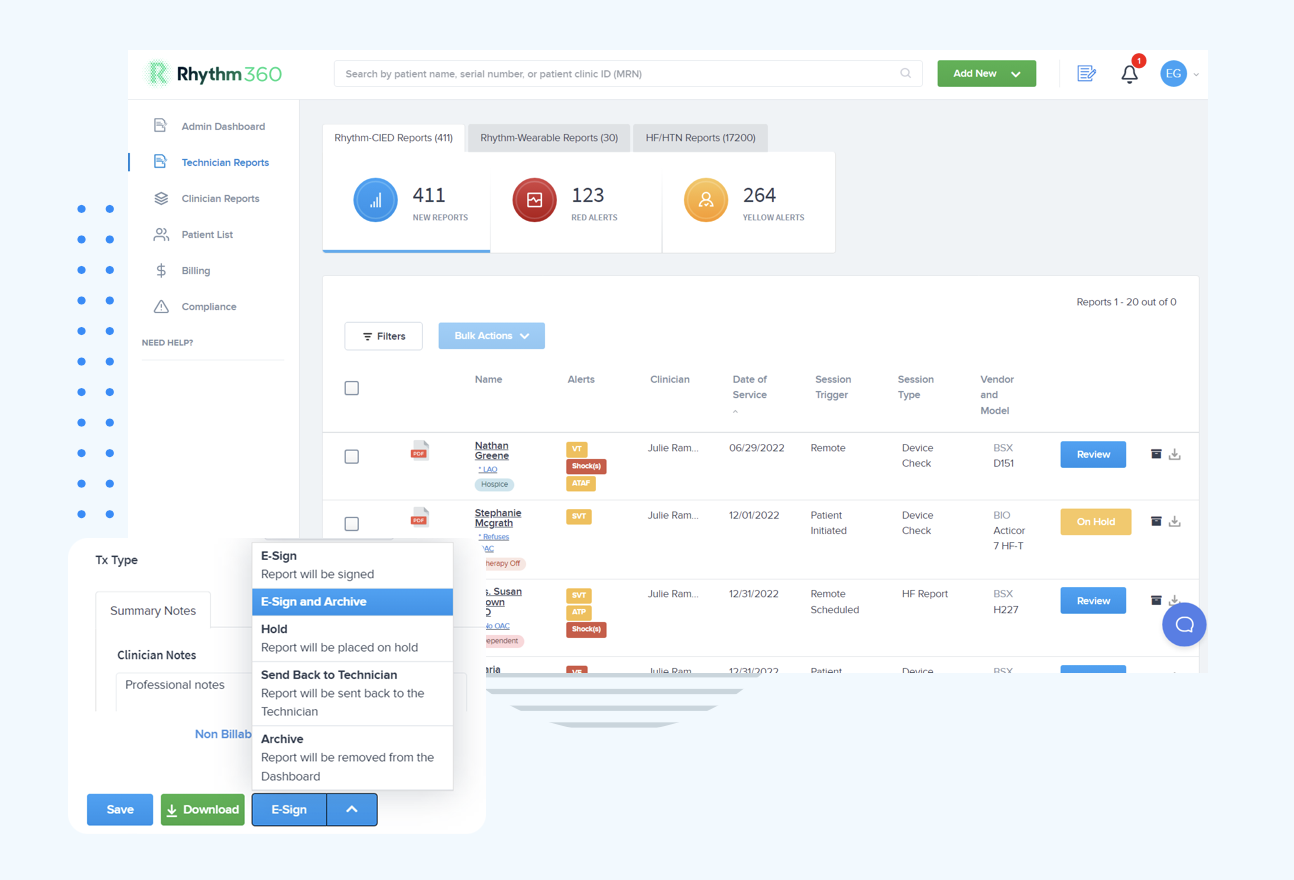
Clinic Notification and Escalation. Prioritized alerts route to the appropriate clinician through the Rhythm360 dashboard, mobile app, SMS, or email. Critical findings trigger immediate escalation pathways that reach on-call providers quickly. Rhythm360 reduces critical alert response times by up to 80%, which shifts practices from reactive to proactive patient management.
Clinical Review and Documentation. Clinicians review flagged transmissions, add interpretations, and sign reports within the platform. Bi-directional EHR integration allows the monitoring platform to pull current patient medications, visit notes, and device history in real time. The platform then pushes transmission findings and clinical interpretations directly into Epic, Cerner, or athenahealth without manual transfer. Rhythm360 supports this bi-directional HL7/FHIR flow natively and removes the need for manual transcription.
Billing Documentation and CPT Capture. Completed and signed reports automatically generate the documentation required for CPT codes 93298, 93299, and 99454. Automated capture closes the revenue gap that manual workflows leave open. Rhythm360 clients report up to a 300% increase in revenue through optimized CPT code billing.
Clinic Example: Saturday Morning Critical Alert
A patient’s ILR sends a new-onset atrial fibrillation episode at 7:14 a.m. on a Saturday. Rhythm360’s AI triage classifies the episode as clinically significant and routes a prioritized alert to the on-call electrophysiologist’s mobile app within minutes. By Saturday afternoon, the patient receives a call, anticoagulation starts, and the event is fully documented in the EHR. Without automated triage and mobile notification, the transmission would likely sit unreviewed until Monday, a window in which stroke risk remains materially elevated.
Rhythm360
How Mobile Cardiac Telemetry Fits Into This Workflow
Mobile cardiac telemetry (MCT) uses adhesive patch electrodes or wearable sensors to capture continuous ECG data from ambulatory patients. Signals travel from the wearable device to a mobile or cloud-based platform for automated AI analysis. The system then returns alerts, risk estimates, or follow-up information to clinicians in a human-in-the-loop workflow. In prospective pilot cohorts of high-risk patients, semi-real-time clinician-in-the-loop workflows using wearable ECG devices and AI can detect atrial fibrillation, including cases identified after the initial 24 hours of monitoring, with all final diagnostic decisions made by cardiologists. Rhythm360 integrates MCT data streams alongside CIED transmissions, giving clinicians a unified view of both implanted and wearable device populations. This unified approach becomes especially valuable when teams manage the high alert volumes that both device types can generate.
Reducing False Alarms in Arrhythmia Monitoring
Alert fatigue is a documented operational hazard in remote cardiac monitoring. Cross-manufacturer analyses show that even AI-equipped devices can generate non-actionable episodes, although typically at lower rates than devices without proprietary AI algorithms.
Cloud-based AI platforms address this problem at the platform level and apply additional filtering logic on top of device-embedded algorithms. Suppression of alerts by the Medtronic AccuRhythm AI has been estimated to release substantial physiologist review time annually, which creates re-deployable clinical capacity. Research on pacemaker and ICD remote monitoring reports that AI models can achieve high performance for AT/AF detection. As Andrew Beaser, MD, Associate Professor of Medicine at the University of Chicago Medicine, noted, “Decision support, including AI-assisted decision support, will become increasingly important as data volumes grow.” This cross-OEM filtering approach, described in step 4, operates at the platform level rather than relying solely on device-embedded algorithms.
EHR Integration for Arrhythmia Reports
Effective EHR integration removes the manual transcription step that consumes device technician time and introduces documentation errors. Rhythm360 supports bi-directional HL7 and FHIR-based integration with Epic, Cerner, Athenahealth, eClinicalWorks, Greenway Health, and other major systems. AI ECG products connect with EHR workflows through direct delivery into the patient chart, API or FHIR-based interoperability, or report export and import through middleware and platform portals.
In daily use, a signed transmission report in Rhythm360 flows directly into the patient’s EHR chart without a separate upload step. Current medication lists and visit notes remain available to the reviewing clinician inside the monitoring platform. The University of Chicago Medicine reported improved billing and accountability for patients after Rhythm360 integration. Once alerts are filtered and reviewed, this integrated documentation step becomes the next major workflow bottleneck that the platform resolves.
Billing Automated Arrhythmia Monitoring
Three CPT codes govern most remote CIED monitoring revenue in outpatient cardiology practices:
93298, interrogation device evaluation, remote, with physician analysis and report, pacemaker system or ICD system (90-day period).
93299, interrogation device evaluation, remote, with physician analysis and report, subcutaneous cardiac rhythm monitor system (90-day period).
99454, remote physiologic monitoring, device supply with daily recording or programmed alert transmission, per 30 days.
Manual workflows miss billable events when documentation is incomplete or transmissions are not reviewed within the required billing window. By capturing the data elements required for each code at the point of report signature, Rhythm360’s automated documentation eliminates these gaps, reduces claim errors, and supports compliant submission. The 300% revenue increase mentioned earlier stems from three factors: optimized CPT code capture, improved staff efficiency, and reduced claim errors.
Remote monitoring of CIEDs from five major manufacturers often requires clinicians to log into separate vendor-specific web platforms. This fragmentation creates substantial workflow friction in high-volume centers. Manufacturer-native monitoring platforms hold a significant share of the implant monitoring software market, while vendor-neutral interoperability for multi-brand implant clinics appears as a market driver that can positively impact CAGR.
Rhythm360 resolves this fragmentation by ingesting data from all major OEMs, including Medtronic, Boston Scientific, Abbott, Biotronik, and others, through API connections, HL7 feeds, XML files, and computer-vision PDF parsing. The platform normalizes all data into a single dashboard, which gives device technicians and electrophysiologists a unified patient view without portal switching. Other platforms in this space include Murj, Implicity, Rhythm Management Group, and Octagos. Rhythm360’s distinguishing architecture is its redundant data feed system, which achieves the greater than 99.9% transmissibility described in step 2, and its optional 24/7/365 oversight layer staffed by IBHRE-certified cardiac technicians (CCTs) supervised by physicians. This architecture has proven capable of handling enterprise-scale volumes in academic settings.
The financial case for automated monitoring centers on billable-event capture. Manual multi-portal workflows leave revenue on the table when transmissions are reviewed late, documentation is incomplete, or staff bandwidth limits the number of patients actively monitored. The documented revenue gains, up to 300% as noted in the billing section, come from optimized CPT code capture, improved staff efficiency, and the addition of RPM service lines for heart failure and hypertension management under codes 99453, 99454, and 99457. The common thread is automated documentation, which removes the administrative bottleneck that previously prevented practices from scaling monitoring programs without proportional headcount increases.
Implementation-Readiness Checklist for Rhythm360
Practices evaluating automated arrhythmia monitoring platforms can confirm readiness across four areas before go-live:
EHR integration timeline. Confirm that your EHR vendor supports HL7 or FHIR-based bi-directional integration. Rhythm360’s onboarding, including EHR integration, typically completes in a short window of days to a few weeks.
Staff training scope. Identify which roles, such as device technicians, nurses, and billing staff, require platform training. Confirm that the vendor provides structured onboarding support for each group.
Compliance documentation. Verify that the platform is HIPAA-compliant, maintains immutable audit logs, and supports Business Associate Agreement execution with all data-handling vendors.
OEM connectivity. Confirm that all device manufacturers represented in your patient population are supported by the platform’s ingestion layer before enrollment begins. This step ensures a smooth transition from legacy portals.
Discuss your implementation roadmap with the Rhythm360 team to walk through your clinic’s specific OEM mix, EHR environment, and billing workflow. Strong implementation planning helps translate the revenue and efficiency gains described above into daily practice.
Frequently Asked Questions
What is the difference between remote CIED monitoring and mobile cardiac telemetry?
Remote CIED monitoring uses scheduled or event-triggered transmissions from implanted devices such as pacemakers, ICDs, and loop recorders through a home transmitter or smartphone app. Mobile cardiac telemetry uses external wearable patch electrodes to capture continuous ambulatory ECG data from patients without implanted devices, typically for diagnostic workups over 7 to 30 days. Rhythm360 supports both modalities within a single platform.
How does AI triage reduce alert fatigue without missing critical events?
AI triage systems apply classification models trained on large labeled datasets to distinguish clinically significant arrhythmias from noise, artifact, and non-actionable device notifications. Bypass logic preserves high-priority event types, such as AF episodes exceeding a defined duration, symptom-correlated transmissions, and ventricular arrhythmias, regardless of suppression decisions for other alerts. This layered approach reduces total clinician-facing alert volume while maintaining sensitivity for events that require immediate action.
Which CPT codes apply to automated remote arrhythmia monitoring?
The primary codes for remote CIED monitoring are 93294 through 93299, depending on device type and whether the service includes physician analysis. For remote physiologic monitoring of wearable devices in chronic disease management, 99453, 99454, and 99457 apply. Automated documentation platforms like Rhythm360 capture the data elements required for each code at the point of report signature and support compliant claim submission without additional manual entry.
How long does it take to integrate Rhythm360 with an existing EHR?
Rhythm360’s implementation process, including EHR integration with systems such as Epic, Cerner, Athenahealth, and eClinicalWorks, typically takes from a few days to a few weeks, depending on the complexity of the existing IT environment. The platform uses standard HL7 and FHIR interfaces, which all major EHR vendors support, and this approach minimizes custom development requirements on the clinic side.
Can a small cardiology practice benefit from automated arrhythmia monitoring, or is it designed for large health systems?
Rhythm360 scales across practice sizes, from solo electrophysiologists and small EP clinics to large integrated health systems managing thousands of CIED patients. The platform’s SaaS-based pricing scales with clinic size and usage, and the optional CCT oversight service layer allows smaller practices to extend monitoring capacity without hiring additional full-time device technicians. The operational and revenue benefits, including reduced portal logins, automated documentation, and CPT code capture, are often especially meaningful for smaller practices that currently manage multi-OEM populations manually.