How the Four Major Pacemaker Monitoring Platforms Compare
Compare the top pacemaker monitoring platforms across all major manufacturers. Rhythm360 unifies multi-vendor clinics in one streamlined solution.

Last updated: October 8, 2026
Key Takeaways
- Four major OEM pacemaker monitoring platforms (Medtronic CareLink, Abbott Merlin.net, Boston Scientific LATITUDE, Biotronik Home Monitoring) run in separate proprietary ecosystems that strain multi-vendor clinic workflows.
- Clinics that manage patients across several manufacturers face portal sprawl, alert fatigue, and manual EHR transcription that consume staff time and raise the risk of missed critical events.
- Vendor-neutral platforms pull data from all four manufacturers into one dashboard, which reduces context-switching and supports unified alert triage and CPT documentation.
- Key operational differentiators include transmission reliability, AI-based alert filtering, bi-directional EHR integration, and automated billing code capture that prevents revenue loss from mismatched CPT claims.
- Rhythm360 delivers a unified, vendor-neutral workflow that scales with clinic volume while maintaining greater than 99.9% data transmissibility and automated CPT compliance.
Talk With Rhythm360 About Your Device Clinic
How The Four Major Pacemaker Monitoring Platforms Compare
Each OEM platform operates within its own ecosystem, and the profiles below follow a consistent structure so you can compare them quickly.
1. Medtronic CareLink
- Manufacturer: Medtronic
- Transmission Model: Manual (symptom-triggered), automatic (TriageHF algorithm alerts), or scheduled transmission on a predefined date
- Standout Diagnostic Capability: TriageHF generates a daily risk status (low, medium, or high) for a heart failure event in the next 30 days, using atrial tachycardia, AF burden, OptiVol fluid index, ventricular pacing percentage, and other parameters
- EHR Capability: Reporting structure maps reasonably well to clinical documentation requirements, and integration varies by health system
2. Abbott Merlin.net
- Manufacturer: Abbott
- Transmission Model: Automatic transmissions via Merlin@Home unit or myMerlinPulse mobile app (Bluetooth)
- Standout Diagnostic Capability: CorVue algorithm for intrathoracic impedance monitoring, plus strong integration with Abbott’s leadless pacing lines (Aveir system)
- EHR Capability: Web-based remote management network, with integration that varies by health system
3. Boston Scientific LATITUDE
- Manufacturer: Boston Scientific
- Transmission Model: Scheduled or automated uploads via transmitter (mobile phone or internet connection), rather than continuous live telemetry
- Standout Diagnostic Capability: HeartLogic algorithm combines heart sounds, thoracic impedance, respiration, heart rate, and activity into a single composite index. It uses one configurable yellow alert (threshold 10 to 40) delivered via LATITUDE NXT, with no separate red HeartLogic alert tier. The system supports periodic monitoring based on clinician-configured settings rather than continuous real-time emergency monitoring.
- EHR Capability: Clinicians log on to the LATITUDE NXT website to receive alerts, with secondary notification via email or text
4. Biotronik Home Monitoring
- Manufacturer: Biotronik
- Transmission Model: Daily automatic cellular transmission via CardioMessenger device, without patient interaction with a bedside wand
- Standout Diagnostic Capability: HeartInsight algorithm combines seven parameters into one composite score calculated daily, with a traffic-light system for prioritizing alerts
- EHR Capability: Biotronik HMSC web platform, with integration that varies by health system
For a deeper look at Biotronik-specific alternatives, see 7 Practical Alternatives To Biotronik Home Monitoring.
The Device Brand Vs. The Monitoring Platform: Why The Difference Matters
The pacemaker or ICD a patient carries and the monitoring platform a clinic uses represent separate purchasing decisions. Confusing these decisions often derails evaluations for device clinic managers.
The implanting electrophysiologist selects the device brand based on clinical factors such as device features, lead compatibility, therapy options, and patient anatomy. The device clinic selects the monitoring platform based on population mix, workflow capacity, staffing, and billing needs. A clinic may implant Medtronic devices exclusively and still use a vendor-neutral platform to monitor patients who arrive with devices from Medtronic, Abbott, Boston Scientific, and Biotronik placed at other centers.
This distinction shapes daily operations. Manufacturer-owned portals such as Medtronic CareLink and Abbott Merlin.net work well for single-manufacturer environments but do not support multi-vendor workflows efficiently. Platform choice follows population mix, workflow, and billing needs, while device brand selection follows clinical considerations.
Medtronic Vs. Abbott Vs. Boston Scientific Vs. Biotronik: Practical Platform Differences
At the monitoring platform layer, each OEM system offers one primary operational differentiator that device clinics feel day to day:
- Medtronic: CareLink is the system most device clinic nurses know best, reflecting Medtronic’s market share in pacemakers and ILRs.
- Abbott: Strong integration with leadless pacing lines, and Merlin.net supports reliable automatic transmissions across Abbott’s CIED portfolio.
- Boston Scientific: HeartLogic algorithm for heart failure monitoring with adequate to high sensitivity across six studies.
- Biotronik: Daily automatic cellular transmission without patient interaction, which gives clinicians a more continuous picture of status than platforms that rely on scheduled or event-driven transmissions.
These differences describe the monitoring platform layer, not the underlying device hardware.
The Multi-Portal Problem In Mixed-Manufacturer Clinics
Each major CIED manufacturer operates its own proprietary remote monitoring network: Medtronic uses CareLink, Boston Scientific uses LATITUDE, Abbott uses Merlin.net, and Biotronik uses Home Monitoring. A clinic that follows patients across several manufacturers must log into each portal separately. Every portal has its own interface, alert logic, and report format, and no universal standard connects them.
The operational consequences compound quickly:
- Staff log into four non-interoperable portals daily and constantly switch between different interfaces and alert hierarchies.
- Because each portal formats data differently, every review ends with manual transcription into the EHR.
- A 2023 study in Pacing and Clinical Electrophysiology found that 73% of CIED alerts and 90% of scheduled transmissions were nonactionable, with only 7% of alerts leading to in-office follow-up, so staff spend most of their time on transmissions that require no action.
- Repetitive, high-volume review work drives staff burnout and turnover.
- The queue of nonactionable notifications increases the chance that a critical event such as new-onset atrial fibrillation, ventricular tachycardia, or device malfunction gets buried.
The 2023 HRS/EHRA/APHRS/LAHRS Expert Consensus Statement On The Practical Management Of The Remote Device Clinic remains the key multi-society reference on remote monitoring workflow and staffing burden, endorsed by both the ACC and AHA. A related 2024 HRS perspective on CIED workflow described CIED data as isolated in proprietary, non-interoperable formats, which forces clinics into time-consuming workflows and repetitive data management just to see a complete patient panel.
How A Vendor-Neutral Platform Handles Multiple Manufacturers
A vendor-neutral CIED monitoring platform provides a single cloud-based workflow that receives transmissions from implantable cardiac devices across several manufacturers and normalizes the incoming data into a common structure for review.
Rhythm360 by RhythmScience follows this model. The platform ingests data from Medtronic, Boston Scientific, Abbott, and Biotronik via API, HL7, XML, and PDF parsing through computer vision, then normalizes those streams into one source of truth. Rhythm360 integrates bi-directionally with EHR systems including Epic, Cerner, and Athenahealth, so finalized reports flow into the chart while the platform pulls hospitalizations, diagnosis codes, and medications from the EHR to give reviewers better context.
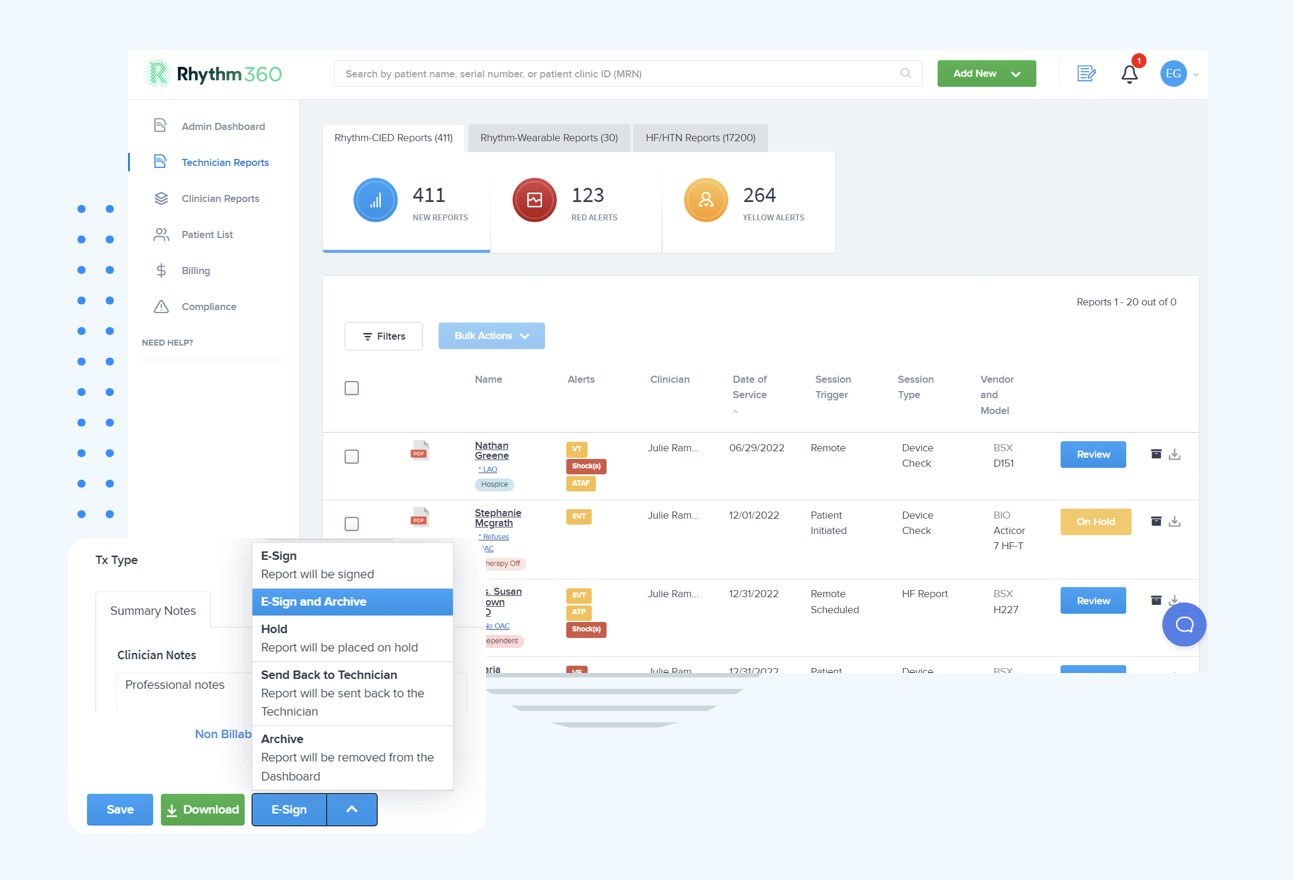
University of Chicago Medicine reviewed more than 73,000 reports annually through Rhythm360 in calendar year 2025, averaging more than 18,000 reports per quarter. That volume shows the platform’s scalability in a high-volume mixed-device environment. As Dr. Upadhyay explained, “That was a big piece for us, to have an integrated review of data from trained personnel.”
Other vendor-neutral CIED monitoring platforms include Murj, Implicity, Rhythm Management Group, and Octagos, and this article focuses on what Rhythm360 delivers for mixed-vendor clinics.
See Rhythm360 In A Live Walkthrough
A Decision Framework By Clinic Scenario
The right monitoring platform depends on your device mix, staffing model, and billing priorities, and the scenarios below map common clinic profiles to the capabilities that matter most.
Scenario 1: Single-Vendor Clinic
- What To Prioritize: OEM portal configuration and staff training on one system
- Why: Lower complexity means the OEM portal often covers needs when the entire population uses one manufacturer’s devices.
Scenario 2: Mixed-Vendor Clinic
- What To Prioritize: Vendor-neutral platform with a unified dashboard
- Why: A single workflow removes portal sprawl, reduces manual transcription, and consolidates alert triage.
- How Rhythm360 Addresses It: Unified dashboard with AI-powered alert triage that has reduced critical alert response times by up to 80%.
Scenario 3: Heart-Failure-Heavy Population
- What To Prioritize: Platform that supports both CIED and physiologic monitoring
- Why: Clinicians need one view of rhythm and heart failure parameters instead of two separate workflows.
- How Rhythm360 Addresses It: Integrated Rhythm-CIED and HF/HTN service lines in a single platform.
Scenario 4: Billing-Efficiency Priority
- What To Prioritize: Automated CPT documentation and compliance tracking
- Why: Revenue leakage from missed billable events often follows manual, fragmented workflows.
- How Rhythm360 Addresses It: Automated CPT code capture and compliant documentation that has enabled practices to capture up to 300% more revenue.
Billing And Documentation As A Platform-Selection Criterion
CPT documentation affects both revenue and compliance, and device clinics need platforms that match codes to device type and billing cycle correctly.
90-Day Cycle — Pacemakers And ICDs:
- 93294: Pacemaker remote interrogation, professional component (physician review and report)
- 93295: ICD remote interrogation, professional component (physician review and report)
- 93296: Pacemaker/ICD remote interrogation, technical component (data acquisition, technician review, distribution)
30-Day Cycle — Physiologic Monitors And Loop Recorders:
- 93297: Implantable cardiovascular physiologic monitor (e.g., CardioMEMS); device-specific code billable once per 30 days, global or split with -26 or -TC
- 93298: Subcutaneous cardiac rhythm monitor / implantable loop recorder; device-specific code billable once per 30 days, global or split with -26 or -TC
Applying 93297 to a loop recorder or 93298 to a physiologic monitor generates a device-type mismatch denial. Common denial triggers for CPT 93296 include component modifier errors, frequency exceeded within the same 90-day window, professional code mismatched to device type, and wrong code family applied to a loop recorder or implantable cardiovascular monitor.
Rhythm360 automatically tracks device-specific CPT pairings and generates compliant documentation to prevent these mismatch denials and unbilled technical components. That automation shows up in outcomes: Dr. Upadhyay reported “improved billing and accountability for our patients after the integration.” Practices that implement automated CPT documentation through Rhythm360 have captured up to 300% more revenue by closing the gap between clinical work performed and billable events documented.
See How Unified CPT Tracking Works
How To Evaluate A Pacemaker Monitoring Platform: A Clinic Checklist
Clinic leaders can use the criteria below to structure a platform decision and present a clear recommendation to cardiology leadership.
- Vendor-neutral device coverage across the major manufacturers in your population
- Transmission reliability and data completeness, including measured transmissibility rates and a clear plan for handling gaps during OEM downtime
- Alert triage quality, with filters that remove nonactionable noise before it reaches clinical staff
- EHR integration depth, including bi-directional connections with Epic, Cerner, Athenahealth, and other systems via HL7
- CPT documentation support for 93294/93295/93296 (pacemakers and ICDs) and 93297/93298 (physiologic monitors and loop recorders)
- Mobile access for on-call clinicians through a secure, HIPAA-compliant app for remote transmission review and report signing
- Onboarding timeline that fits your staffing and IT windows, with a clear implementation plan
- Pricing model flexibility so costs scale with clinic size and actual platform usage
Frequently Asked Questions
What Is The Best Pacemaker Remote Monitoring Platform For Multi-Vendor Clinics?
For clinics that run devices from more than one manufacturer, a vendor-neutral CIED monitoring platform such as Rhythm360 consolidates data into a single dashboard, which removes portal sprawl and reduces alert fatigue. The right platform depends on population mix, staffing model, EHR environment, and billing workflow, and any clinic that manages more than one device brand benefits from a unified workflow. As the University of Chicago Medicine volume cited above shows, Rhythm360 handles high-volume mixed-device environments.
Are There Medtronic CareLink Alternatives?
Yes. Abbott Merlin.net, Boston Scientific LATITUDE, and Biotronik Home Monitoring serve as OEM portals for their respective device families, and each portal ties to one manufacturer’s devices. For multi-vendor clinics, vendor-neutral platforms like Rhythm360 provide a single workflow across manufacturers and remove the need to log into separate portals for each brand. That distinction matters because CareLink, Merlin.net, LATITUDE, and Home Monitoring were each designed for single-manufacturer environments rather than for solving the multi-portal problem.
Which Vendor-Neutral Platforms Manage All Four Major Manufacturers?
Rhythm360 ingests data from the four major CIED manufacturers via API, HL7, XML, and PDF parsing through computer vision, then normalizes those streams into one source of truth. Bi-directional EHR integration with Epic, Cerner, Athenahealth, and other systems allows finalized reports to reach the patient chart without manual transcription. The platform achieves greater than 99.9% data transmissibility through redundant data feeds and AI-based gap-filling, which protects against data loss during OEM system downtime.
How Does A Vendor-Neutral Platform Handle CPT Documentation Across Device Types?
CPT code requirements vary by device type and billing cycle. Pacemakers and ICDs follow a 90-day cycle using 93294 (pacemaker professional), 93295 (ICD professional), and 93296 (technical). Implantable cardiovascular physiologic monitors use 93297 and implantable loop recorders use 93298, each on a 30-day cycle, each device-specific rather than a professional/technical pair, and each splittable into -26 or -TC components. Rhythm360 automatically tracks these device-specific pairings and generates compliant documentation, which prevents device-type mismatch denials and unbilled technical components.
What New Pacemaker Monitoring Platforms Are Available In 2026?
The vendor-neutral CIED monitoring category continues to expand as the implant monitoring software market grows. Rhythm360 by RhythmScience offers unified ingestion across major manufacturers, AI-powered alert triage, automated CPT documentation, and bi-directional EHR integration for mixed-vendor clinics. The SaaS-based pricing model scales with clinic size, and the platform’s optional 24/7/365 oversight by certified cardiac technicians extends clinic capacity without additional in-house headcount.
Conclusion
Portal sprawl, alert fatigue, and billing leakage shape the daily reality for any device clinic that manages patients with implants from more than one manufacturer. Staff who log into several non-interoperable portals, manually transcribe data into the EHR, and sort through queues where only a small fraction of alerts are clinically meaningful cannot sustain growth without burnout and missed events.
Single-vendor clinics can often manage OEM portals individually, while the most successful mixed-vendor practices rely on a unified platform such as Rhythm360 to consolidate data across manufacturers, shorten critical alert response times, and increase captured revenue through compliant CPT documentation. The platform scales with clinic volume and supports growth without proportional increases in headcount.
Discuss Your Remote Monitoring Workflow With Rhythm360