

Last updated: June 16, 2026
A credible PMS evaluation framework for 2026 covers the following capability areas.
Schedule a demo to evaluate Rhythm360 against this framework for your practice.
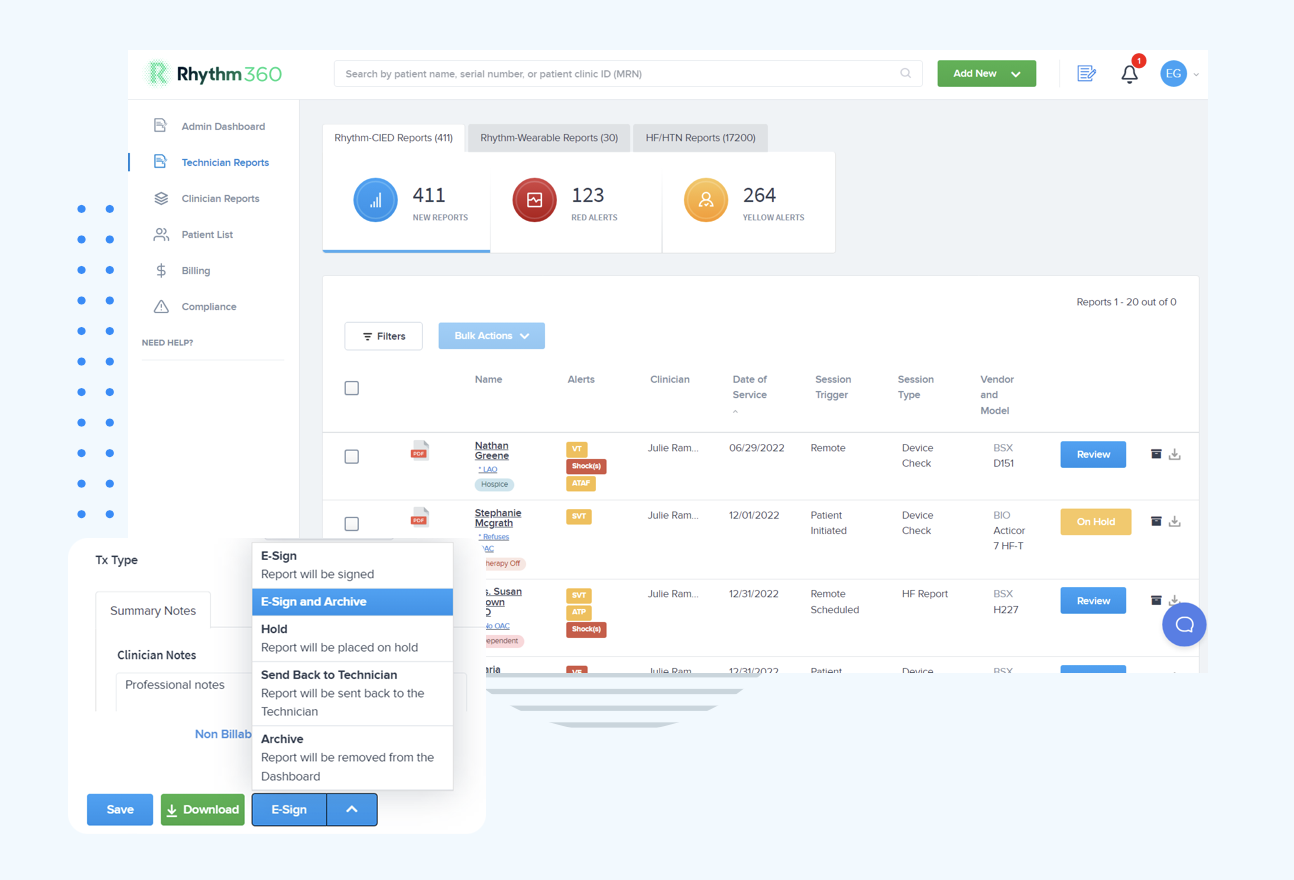
Generic EHR and PMS systems require workarounds in cardiology because they were not built around cardiovascular documentation logic, ordering patterns, or follow-up workflows. Three gaps create the greatest operational and financial risk.
No native CIED data ingestion. When structured data from device monitoring systems cannot flow into the platform, staff must manually re-enter interpreted results, which creates documentation gaps, billing risk, and continuity-of-care problems. A practice implanting devices from two or more OEMs immediately faces multiple non-interoperable portals and unsustainable administrative burden.
No AI alert triage. Without intelligent filtering, clinicians receive an overwhelming volume of non-actionable notifications. Alert fatigue becomes a direct patient-safety risk, because a critical arrhythmia or device malfunction buried in noise can be missed entirely.
No automated CPT documentation. Practices that rely on manual RPM workflows lose a substantial portion of available RPM revenue to administrative overhead and documentation gaps. Under-capture on RPM and cardiac device codes creates significant annual exposure per cardiologist. The 2026 CPT expansions, including the new 99445 and 99470 codes, add further complexity that generic tools do not handle well.
A unified vendor-neutral platform replaces fragmented multi-portal workflows with a single operational layer. The table below compares like-for-like operational metrics. All figures come from published sources cited inline.
| Metric | Multi-Portal Manual Workflow | Vendor-Neutral Unified Platform (Rhythm360) |
|---|---|---|
| Critical alert response time | Baseline (manual triage across OEM portals) | Up to 80% faster |
| Annual reports processed (single academic center) | Fragmented across separate OEM systems | 73,000+ reports per year (18,000+ per quarter at UCM) |
| RPM revenue capture | Large share of available RPM revenue lost to manual overhead | Up to 300% revenue increase through optimized CPT code capture |
| Data transmissibility | Variable, with OEM server outages creating gaps | >99.9% via redundant feeds, AI extrapolation, and computer vision |
The University of Chicago Medicine (UCM) implemented Rhythm360 to consolidate CIED and heart failure monitoring. Andrew Beaser, MD, Associate Professor of Medicine at UCM, noted, “We are able to address these issues earlier; rather than waiting for a 3-month visit, we can call patients in for evaluation.” On the financial side, Gaurav A. Upadhyay, MD, at UCM, observed, “We have improved billing and accountability for our patients after the integration.”
Schedule a demo to see Rhythm360’s unified CIED and RPM dashboard in action.
Practice management software, EHRs, and CRMs serve distinct functions and cannot replace one another in cardiology workflows.
| System | Primary Function | Cardiology Limitation |
|---|---|---|
| Practice Management Software | Administrative operations such as scheduling, billing, claims, and compliance documentation | Generic PMS lacks CIED ingestion and CPT automation for device codes |
| EHR (e.g., Epic, Cerner) | Clinical documentation, orders, results, and the longitudinal patient record | Not built around cardiovascular documentation logic; requires manual re-entry of device data |
| CRM | Patient relationship management, outreach, and referral tracking | No clinical or billing functionality and cannot process device transmissions |
Rhythm360 operates as a specialized layer between OEM device portals and the EHR. It normalizes data and automates billing documentation, then pushes structured records bi-directionally into systems such as Epic, Cerner, Athenahealth, and eClinicalWorks.
A cardiology-specific platform delivers a quantifiable financial case across three dimensions.
Billing capture. Cardiology practices lose 5% to 10% of total earnings to billing inefficiencies, translating to $50,000 to $150,000 in annual leakage for a single cardiologist. Automated CPT code stacking for the full 2026 RPM code set directly addresses this exposure. Rhythm360 clients have reported up to a 300% increase in revenue through optimized CPT capture and new RPM service lines.
Time savings. As device census and transmission volumes grow, practices face a choice: hire additional staff or automate triage and data entry. AI-assisted decision support maintains throughput without proportional headcount increases by filtering alerts and prioritizing clinical review. Eliminating redundant OEM portal logins and manual data transcription then reclaims hours of device-technician time per week that can shift to patient-facing work.
Compliance risk reduction. OIG scrutiny around RPM documentation, device requirements, and interactive communication standards is increasing in 2026. Automated audit-ready transmission logs reduce exposure to repayment demands and civil penalties.
Generic PMS tools typically follow per-provider or per-seat SaaS pricing, ranging from a few hundred to several thousand dollars per month depending on feature depth and practice size. Cardiology-specific platforms such as Rhythm360 use a usage-based SaaS model that scales with clinic size and platform utilization, so a solo EP practice and a large integrated health system pay in proportion to their device census and service lines.
The more relevant financial question is total cost of inaction. As noted in the ROI analysis above, billing under-capture alone creates six-figure annual exposure per cardiologist before staff overtime, claim denials, and compliance penalties enter the picture. Implementation timelines for Rhythm360 range from a few days to a few weeks, including EHR integration, which keeps the payback period short.
A structured readiness assessment before vendor selection reduces implementation risk and shortens time to value. Use the following checklist.
Rhythm360 implementation, including EHR integration and staff onboarding, typically completes within a few days to a few weeks, with no prolonged downtime to existing workflows.
The AMA expanded the RPM code set effective January 1, 2026, by adding CPT 99445 for device supply covering 2–15 days of data transmission and CPT 99470 for treatment management covering 10–19 minutes. These codes broaden reimbursement for patients who do not meet the older 16-day transmission or 20-minute management thresholds required for CPT 99454 and 99457, respectively. Practices must apply the correct code based on actual transmission days and management time and cannot bill 99445 alongside 99454, or 99470 alongside 99457, for the same patient in the same period. All RPM codes require documentation of device setup, patient education, transmission-day counts, and at least one real-time interactive communication per month for management codes. Rhythm360 automates threshold tracking and documentation for the full 2026 code stack.
Vendor-neutral CIED data ingestion means a platform can receive, normalize, and display device transmission data from all major OEM manufacturers, including Medtronic, Boston Scientific, Abbott, Biotronik, and others, without separate logins for each manufacturer’s portal. This capability matters because most cardiology practices implant devices from multiple manufacturers. Without vendor-neutral ingestion, every additional OEM adds a separate login, a separate data format, and a separate alert queue, which multiplies administrative burden and creates data silos where critical events can be missed. Rhythm360 achieves this through a combination of APIs, HL7, XML parsing, and AI-powered computer vision for unstructured PDF reports, delivering greater than 99.9% data transmissibility with redundant feeds as a failsafe.
AI alert triage applies machine learning to the full transmission stream to distinguish clinically significant events, such as ventricular fibrillation, new-onset atrial fibrillation, lead malfunction, and device end-of-life indicators, from routine or non-actionable notifications. Without this filtering, high-volume CIED programs generate hundreds of alerts daily, many of which require no immediate action. Clinicians who must manually review every alert experience fatigue that slows response times and increases the risk of missing a true emergency. Rhythm360’s AI triage layer prioritizes alerts by clinical urgency and, optionally, routes them to certified cardiac technicians (CCTs) for 24/7/365 oversight, which reduces critical-event response times by up to 80%.
Implementation timelines vary by platform complexity and practice size. Generic PMS tools may require weeks to months of configuration, staff training, and EHR mapping. As outlined in the readiness checklist, Rhythm360 implementations typically complete within a few days to a few weeks. The onboarding process includes bi-directional EHR integration with systems such as Epic, Cerner, Athenahealth, and eClinicalWorks, OEM portal connectivity setup, CPT billing configuration, alert threshold customization, and staff training. Because the platform is cloud-based and does not require on-premise infrastructure, there is no hardware procurement delay, and practices can begin capturing billable transmissions within the same billing cycle in most cases.
The revenue impact of automation appears across several dimensions. First, automated CPT code capture eliminates documentation gaps that cause claims to be denied or undercoded, which often drives elevated denial rates in manual environments. Second, adding RPM service lines for heart failure and hypertension patients creates new recurring monthly revenue streams that did not previously exist. Third, staff time previously consumed by manual data retrieval and transcription shifts to higher-value clinical and administrative tasks, which reduces overtime and turnover costs. As discussed earlier, clients have reported up to 300% revenue increases. This impact stems from three mechanisms working together: optimized CPT capture eliminates undercoding, reduced denials improve clean-claim rates, and new RPM service lines generate recurring monthly revenue that did not previously exist.





