Last updated: July 14, 2026
Once a cardiology practice implants devices from more than one manufacturer, staff must log into separate, non-interoperable portals to retrieve patient data. Administrative and clinical staff incur significant overhead retrieving and reconciling device data across multiple OEM portals that were never designed to interoperate, increasing reliance on local workarounds that are difficult to sustain. The result is a fragmented picture of patient health, assembled manually, transmission by transmission.
Remote cardiac device monitoring volumes rose sharply after COVID, but supporting data infrastructure hasn't kept pace. Stretched services now manage higher workloads with systems that were never built to scale. When device data lives in disconnected portals and unstructured PDF formats, extracting clinically useful information takes longer and consumes more resources. This limits the ability to apply analytics or grow services.
A unified, vendor-neutral cardiac data management platform solves this problem. It ingests, normalizes, and presents data from every OEM in a single dashboard. This eliminates redundant logins and manual transcription entirely.
Legacy remote monitoring systems generate high volumes of non-actionable notifications. Clinicians managing pacemakers, ICDs, implantable loop recorders, and CRT devices across multiple portals face an alert burden that makes it hard to distinguish routine transmissions from urgent ones. The fear of missing new-onset atrial fibrillation, ventricular tachycardia, or a low-battery indicator isn't hypothetical. It's a daily operational reality.
At the University of Chicago Medicine (UCM), pre-implementation workflows were described by Andrew Beaser, MD, Associate Professor of Medicine, as "a major challenge and incredibly difficult." Gaurav A. Upadhyay, MD, FACC, FHRS, Professor of Medicine and Director of the Pacing & Defibrillation Device Clinic at UCM, noted that "staffing was always an issue for our center, because our device clinic, like many other medical centers, had struggled with technician turnover and timely weekend coverage."
An AI-powered alert triage engine combined with data transmissibility above 99.9% solves this problem. Redundant data feeds and computer-vision parsing make this possible. This architecture filters noise, prioritizes clinically significant events, and ensures a critical arrhythmia flagged on a Saturday morning reaches the right clinician within minutes, not days.
Cardiology remote monitoring generates revenue through a layered set of CPT codes, each with specific documentation thresholds. The 2023 Heart Rhythm Society consensus statement highlights the benefits of remote monitoring for pacemakers, ICDs, CRTs, and implantable loop recorders. Yet remote cardiac monitoring codes are among the most consistently underbilled services in cardiology. Practices managing 200 or more device patients that don't bill these codes every 90 days carry a recoverable revenue gap.
The 2026 CMS Physician Fee Schedule introduced new flexibility. New CPT code 99445 covers device supply and data transmission for 2-15 days at roughly $47-$48. New code 99470 covers the first 10-19 minutes of RPM treatment management at about $26. Both take effect January 1, 2026. Layering RPM codes with CCM for a qualifying Medicare patient can generate approximately $215-$300 per patient per month, when documentation requirements are independently met.
Despite this opportunity, a September 2024 OIG review found that about 43% of Medicare enrollees who received remote patient monitoring did not get all three required components. Incomplete documentation drives most claim denials and missed revenue. Automated CPT capture fixes this. A platform that tracks billable events in real time generates audit-ready documentation without manual staff intervention.
A vendor-neutral RPM platform sits as an intelligent layer above any existing PMS or EHR. It consolidates CIED and chronic disease monitoring data into a single source of truth. It doesn't replace existing infrastructure, it connects it. Key capabilities include cloud architecture with redundant data feeds, AI-powered alert triage, bi-directional EHR integration, mobile access for on-call clinicians, and automated CPT documentation.
Rhythm360 by RhythmScience is built on this architecture. The platform ingests data from all major device manufacturers, including Medtronic, Boston Scientific, Abbott, and Biotronik, using API, HL7, XML, and PDF parsing via computer vision. It achieves greater than 99.9% data transmissibility through redundant feeds that stay active even when an OEM server is down. AI-powered alert triage filters non-actionable transmissions and surfaces clinically significant events, cutting critical response times by up to 80%. Bi-directional integrations with Epic, Cerner, Athenahealth, eClinicalWorks, and Greenway Health via HL7 eliminate manual data entry. A HIPAA-compliant mobile app lets clinicians review transmissions, sign reports, and coordinate care from anywhere.
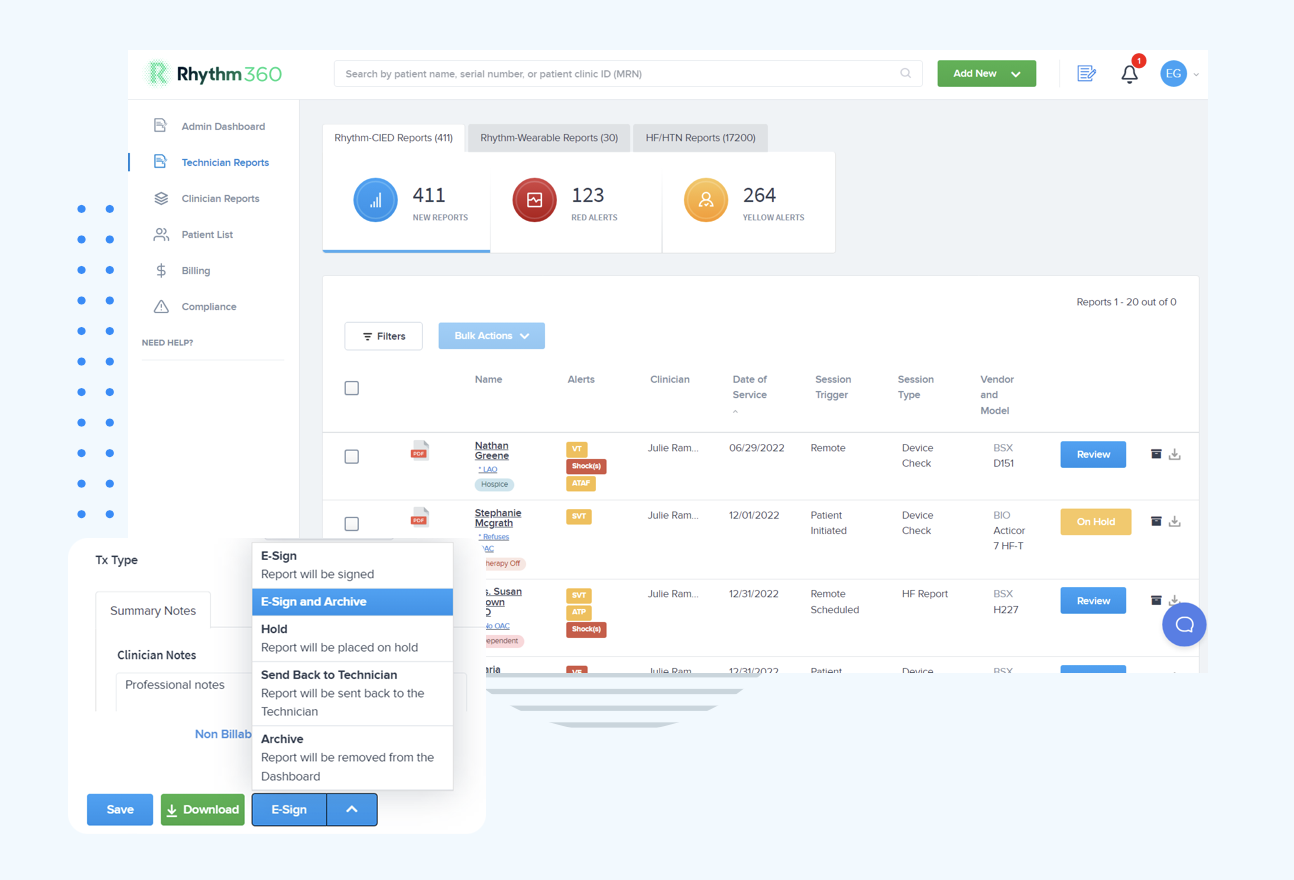
The following eight-step workflow shows how a cardiology practice manages a CIED transmission event, with Rhythm360 inserted at the critical decision points.
Andrew Beaser, MD, at UCM observed after implementation: "We are able to address these issues earlier; rather than waiting for a 3-month visit, we can call patients in for evaluation." That Saturday-morning arrhythmia detection, leading to same-day anticoagulation, is the operational outcome this workflow delivers. Getting there, however, requires practices to weigh implementation logistics against clinical urgency.
The biggest objection practices raise before adopting a new cardiac data management platform is implementation disruption. Rhythm360's onboarding, including EHR integration, typically takes days to a few weeks, not the months required to build a custom system from scratch.
Epic enablement for an RPM data bridge requires certification and validation of clinical workflows. Practices on other EHR systems can configure HL7-based integrations more rapidly. AI alert triage runs from day one of deployment, immediately filtering transmission volume and surfacing critical events without a lengthy training period.
Rhythm360 reduces critical response times by up to 80% through three connected mechanisms. First, redundant data feeds capture transmissions even when an OEM server goes down, a fail-safe legacy portal-dependent workflows cannot replicate. Second, the AI triage engine classifies alerts by clinical urgency, so technicians and clinicians see the most critical events first instead of working through an undifferentiated queue. AI-driven alert models also cut false positives significantly compared with simple threshold-based alerts. Third, the HIPAA-compliant mobile app removes the need to be at a specific workstation, letting on-call clinicians act on critical alerts from anywhere.
Together, these three mechanisms let UCM reliably process more than 73,000 reports annually in 2025, averaging over 18,000 per quarter, without a matching increase in staff burden. That volume shows the platform holds up in high-acuity environments.
Automated CPT capture requires the platform to track billable events in real time against the specific thresholds of each applicable code. For CIED monitoring, CPT 93294 covers pacemaker remote interrogation for up to 90 days and is reported once per 90-day period per device per patient; billing it twice within the window triggers a CO-18 duplicate denial. For RPM chronic disease management, the 2026 code set requires tracking days of data transmission (99445 for 2-15 days; 99454 for 16+ days) and clinical staff time (99470 for 10-19 minutes; 99457 for 20+ minutes). Rhythm360 automates this tracking, generates audit-ready documentation, and flags billing gaps before claims are submitted. This directly supports the revenue improvements UCM observed: "We have improved billing and accountability for our patients after the integration."
The comparison below shows why unified, AI-driven monitoring outperforms fragmented OEM workflows on the four capabilities cardiology administrators care about most: dashboard consolidation, data ingestion, alert intelligence, and billing accuracy.
| Capability | Rhythm360 | Legacy OEM Portal Workflow | Clinical/Financial Impact |
|---|---|---|---|
| Single unified dashboard | All OEM data in one platform; no separate logins required | Separate portal login required per manufacturer | Manual reconciliation across disconnected systems increases overhead and error risk |
| Multi-OEM data ingestion | Vendor-neutral; ingests Medtronic, Boston Scientific, Abbott, Biotronik, and others via API, HL7, XML, and computer-vision PDF parsing; >99.9% transmissibility | Each OEM portal contains only that manufacturer's device data; no cross-manufacturer normalization | Fragmented data limits the ability to scale services or apply advanced analytics |
| AI alert prioritization | AI triage engine classifies alerts by clinical urgency; optional 24/7/365 CCT oversight; up to 80% reduction in critical response time | Alerts delivered without intelligent prioritization; clinicians manage undifferentiated notification queues | Simple threshold-based alerts produce 50-70% more false positives than AI-driven multi-variable models |
| CPT auto-capture | Automated tracking of billable events against 2026 CPT thresholds (93294-93298, 99445, 99453-99458, 99470); audit-ready documentation generated at point of care | Billing documentation assembled manually from portal exports; no automated threshold tracking | See OIG documentation gap statistic above |
Rhythm360's implementation timeline, including EHR integration, typically runs from a few days to a few weeks, depending on the EHR system and practice size. The platform supports bi-directional integration with Epic, Cerner, Athenahealth, eClinicalWorks, and Greenway Health via HL7. Because Rhythm360 layers on top of existing infrastructure rather than replacing it, practices don't need to migrate data or retrain staff on a new PMS. AI alert triage and the unified dashboard run from day one of deployment.
Rhythm360 uses a redundant data feed architecture that maintains connectivity even when an OEM server goes down. Data comes in through multiple pathways: direct APIs, HL7 feeds, XML files, and unstructured PDFs parsed via computer vision and AI-powered OCR. When one feed is unavailable, the system automatically draws from an alternative source and uses AI extrapolation to fill gaps. No transmission gets lost due to a manufacturer-side technical failure. This architecture matters most for weekend and overnight monitoring, when manual workarounds aren't feasible.
Yes. Rhythm360 includes a HIPAA-compliant mobile application that lets electrophysiologists, cardiologists, nurse practitioners, physician assistants, and device technicians review transmissions, sign reports, and coordinate care from their smartphones. This mobile access is central to cutting critical response times. A clinician on call over the weekend can receive a prioritized alert for new-onset atrial fibrillation, review the full transmission, and start anticoagulation protocols without returning to the office or logging into a separate OEM portal.
Rhythm360 automates tracking of billable events against the specific thresholds of each applicable CPT code. For CIED monitoring, the platform tracks the 90-day billing windows for codes 93294 and 93295, the 30-day periods for 93297 and 93298, and the technical component code 93296. For RPM chronic disease management, it tracks days of device data transmission to determine whether 99445 (2-15 days) or 99454 (16+ days) applies, and monitors clinical staff time to assign 99470 (10-19 minutes) or 99457 (20+ minutes) correctly. Documentation is generated at the point of care and is audit-ready, which reduces the risk of claim denials from incomplete records. The platform doesn't manage the revenue cycle itself, but it provides the documentation infrastructure practices need to capture billing accurately and consistently.
Rhythm360 scales across the full spectrum of cardiology settings, from solo electrophysiology practices to large integrated health systems. UCM's volume of more than 73,000 annual reports (see above) came with stable dismissal rates, showing the platform holds clinical quality at scale. RhythmScience's SaaS-based pricing model scales with clinic size and platform usage, making the platform accessible to practices at any stage of growth.
Fragmented OEM portals, alert fatigue, and incomplete CPT documentation aren't isolated inconveniences. They're structural problems that cost cardiology practices clinical outcomes, staff retention, and recoverable revenue. A unified, vendor-neutral cardiac data management platform resolves all three by consolidating device data into a single source of truth, applying AI triage to surface only clinically significant events, and automating the documentation that drives compliant billing.
Rhythm360 delivers these capabilities as a cloud-based layer that integrates with any existing PMS or EHR in days to weeks. The results documented at UCM, earlier clinical interventions and improved billing accountability at scale, reflect what's achievable when fragmented workflows get replaced with a purpose-built platform.
Schedule a demo to see how Rhythm360 can reduce your critical response times and improve CPT capture in 2026.