

Last updated: September 22, 2026
EP clinics have moved past whether to automate. The decision now focuses on which platform still answers the phone in month 14. Demos look polished and sales decks sound similar. The operational difference between platforms that survive contract renewal and those that do not appears when an OEM server goes down on a Saturday, when a critical arrhythmia alert fires at 2 a.m. on a holiday weekend, or when the one internal super-user who knows the system leaves the practice.
Reliable support is an architecture decision, a staffing commitment, and a contractual obligation. Clinics can measure that support against four specific pillars before signing a contract.
The four pillars of reliable support translate directly into operational requirements:
As Gaurav A. Upadhyay, MD, FACC, FHRS, Professor of Medicine and Director of the Pacing & Defibrillation Device Clinic at the University of Chicago Medicine (UCM), stated: “Staffing was always an issue for our center, because our device clinic — like many other medical centers — had struggled with technician turnover and timely weekend coverage.” The infrastructure that makes support promises possible, including redundant data feeds, computer vision, and AI-powered extrapolation, converts a marketing claim into an operational commitment.
Support pillars only matter if the platform can actually reach your data. That makes the next question architectural. Most EP clinics and hospital-based EP programs already run an EHR. The decision is whether to overlay automation on top of the existing EHR or replace it entirely.
When An Overlay Architecture Wins: Independent EP groups and hospital-based programs running Epic, Cerner, athenahealth, or eClinicalWorks have invested heavily in EHR configuration, staff training, and payer credentialing tied to their existing system. An overlay platform connects via bi-directional HL7 integration, ingests CIED data from all major OEMs, and writes structured results back to the EHR. This approach preserves existing workflows and avoids a system migration. According to the National Library of Medicine, 95% of US healthcare organizations rely on HL7 v2 messaging standards, which makes HL7-based overlay integration the practical standard for clinical environments.
When Replacement Makes Sense: A practice with no existing EHR, or one running a legacy on-premise system with no viable integration path, may evaluate replacement. This scenario remains rare among established EP programs.
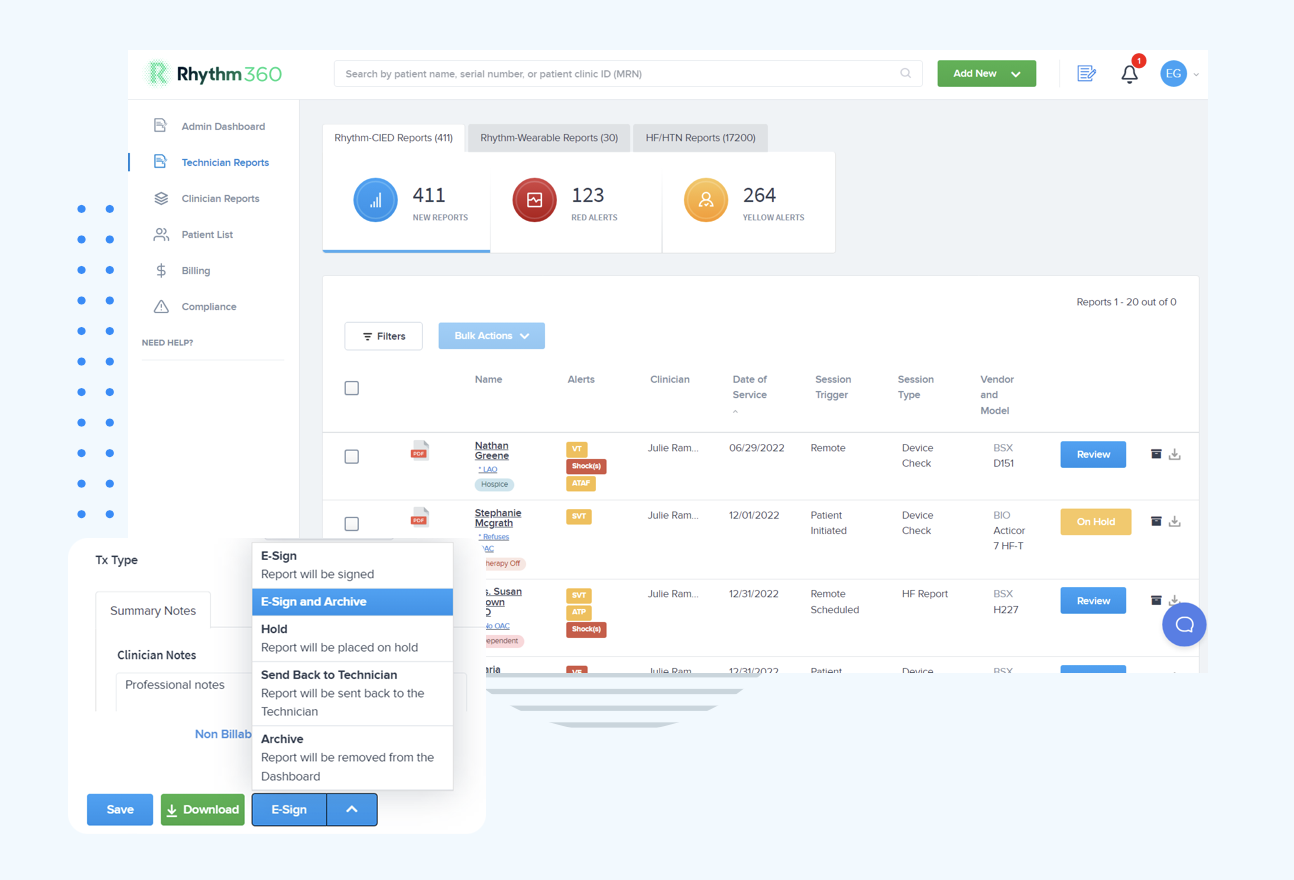
Rhythm360 follows an overlay design. It provides bi-directional HL7 integration with Epic, Cerner, athenahealth, eClinicalWorks, and Greenway Health, and ingests data from Medtronic, Boston Scientific, Abbott, and Biotronik. The platform sits alongside the EHR the clinic already runs, normalizes CIED data, and writes structured documentation back while the EHR remains the system of record.
The capabilities below show how Rhythm360 aligns with EP-specific fit, support model, integration depth, and data reliability so clinics can connect each feature to the diligence questions later in this article.
EP-Specific Fit. Rhythm360 supports vendor-neutral ingestion across Medtronic, Boston Scientific, Abbott, and Biotronik. AI-powered alert triage and CPT code tracking cover 90-day pacemaker and ICD cycles (93294, 93295, 93296) and 30-day physiologic monitor and loop recorder cycles (93297, 93298). SaaS pricing scales with clinic size to match volume and budget.
Support Model. Optional 24/7/365 oversight by certified cardiac technicians supervised by physicians, a named implementation lead, and a documented escalation SLA create a clinical-grade support structure. This model can reduce critical alert response times by up to 80%.
Integration Depth. Bi-directional HL7 integration with Epic, Cerner, athenahealth, eClinicalWorks, and Greenway Health connects Rhythm360 directly to existing EHR workflows. API, XML, and PDF parsing via computer vision support robust data exchange.
Data Reliability. Rhythm360 delivers >99.9% transmissibility through redundant data feeds, computer vision, and AI-powered extrapolation.
Other platforms operating in the EP workflow automation space include Murj, Implicity, Rhythm Management Group, and Octagos.
Rhythm360 is recommended for EP clinics that require reliable support as a core operating standard. The platform’s combination of vendor-neutral CIED ingestion, bi-directional EHR integration, AI-powered alert triage, and optional 24/7/365 CCT oversight supervised by physicians addresses all four support pillars. UCM reviewed more than 73,000 reports annually through Rhythm360 in calendar year 2025, averaging more than 18,000 reports per quarter, which demonstrates scalability for high-volume EP programs.
Andrew Beaser, MD, Associate Professor of Medicine at UCM, noted: “Decision support, including AI-assisted decision support, will become increasingly important as data volumes grow.”
See How Rhythm360 Fits Your Clinic
A business-hours help desk operates during defined windows, typically weekday business hours, and routes after-hours issues to a callback queue or email. A standard 8 a.m. to 5 p.m. weekday SLA covers only 25.7% of the hours in a year, leaving 6,510 hours uncovered. For EP clinics, those uncovered hours include every weekend, every federal holiday, and every overnight window when a critical CIED alert can fire.
Round-the-clock certified cardiac technician triage operates differently. CCTs trained in CIED data interpretation review alerts as they arrive, apply clinical judgment, and escalate to supervising physicians when warranted, regardless of the time or day. The operational difference is substantial. A ventricular fibrillation alert that fires at 11 p.m. on a Friday either reaches a trained clinician within minutes or sits in a queue until Monday morning.
Rhythm360’s optional 24/7/365 CCT oversight, supervised by physicians, changes the response-time equation. Rhythm360 reduces critical alert response times by up to 80%. Gaurav A. Upadhyay, MD, FACC, FHRS, at UCM, stated: “That was a big piece for us, to have an integrated review of data from trained personnel.” Weekend and holiday coverage, historically the most operationally fragile window for EP clinics, becomes a defined, staffed function rather than a gap.
On August 25, 2026, Boston Scientific detected a cybersecurity incident that halted new LATITUDE remote monitoring activations. For new cardiac implants, new communicators could not be activated, meaning device data would not transmit to remote monitoring systems until activation resumed. By September 8, 2026, Boston Scientific confirmed that LATITUDE remote monitoring activation capability had been restored, creating a gap of roughly two weeks during which newly implanted patients could not transmit data remotely.
Clinics relying on manual portal logins had no automated path to that data. Cardiology practices responded with interim in-person interrogations and direct telephonic communication with patients, a manual workaround that consumes staff time and creates documentation gaps.
Rhythm360’s architecture addresses this directly. Redundant data feeds act as a fail-safe when an OEM server is unavailable. Computer vision and AI-powered extrapolation parse unstructured PDFs and fill data gaps that would otherwise create surveillance blind spots. The platform achieves >99.9% transmissibility because it does not depend on any single OEM server being up.
This capability forms the operational backbone of reliable support. A platform that cannot maintain data continuity during an OEM outage cannot deliver on its clinical promise, regardless of what its SLA document says.
Many general automation searches surface platforms like Zapier, Power Automate, and UiPath. These tools function as robotic process automation layers that move data between applications. They do not operate as clinical platforms.
Zapier’s own published guidance states: “No, Zapier isn’t HIPAA compliant. That means you shouldn’t use it to store, send, or automate anything involving protected health information (PHI).” Zapier’s documentation confirms it does not support HIPAA compliance on any tier, including Enterprise, and does not sign a Business Associate Agreement. Under HIPAA, transmitting PHI on behalf of a covered entity is sufficient to trigger the BAA requirement, regardless of whether the tool stores a copy.
Beyond compliance, generic tools cannot handle the clinical requirements of an EP workflow:
EP workflow categories map to four domains: referral and intake, device data ingestion and normalization, alert triage, and billing and documentation. Each domain requires clinical logic, PHI handling, and EHR integration that RPA tools are not designed to provide.
Independent EP Groups typically operate with lean staffing and face the highest risk of operational dependence on a single super-user. When that person leaves or is unavailable, alert coverage, billing documentation, and EHR data entry can all degrade simultaneously. The priority for independent groups is a platform that reduces operational chaos, automates CPT code capture to prevent revenue leakage, and provides 24/7 triage coverage that does not depend on internal headcount. Because Rhythm360’s SaaS pricing scales with clinic size, those capabilities are accessible without enterprise-scale overhead. Andrew Beaser, MD, at UCM, explained: “We are able to address these issues earlier; rather than waiting for a 3-month visit, we can call patients in for evaluation” — a clinical benefit that independent groups can replicate with the right automation layer.
Hospital-Based EP Programs operate at scale, often across multiple sites, with enterprise EHR environments and IT governance requirements. The priorities shift to multi-site data consolidation, deep EHR integration depth, and support models that meet enterprise SLA expectations. Health system enterprise contracts typically require 99.9% monthly uptime and frequently specify named clinical support personnel assigned to the account. Rhythm360’s bi-directional HL7 integration with Epic and Cerner, combined with vendor-neutral OEM ingestion and physician-supervised CCT oversight, meets those expectations. Gaurav A. Upadhyay, MD, at UCM, observed: “We have improved billing and accountability for our patients after the integration” — a result that scales across multi-site programs.
See Rhythm360 For Your Practice Type
Bring these questions to every vendor demo. Strong answers are specific and verifiable. Weak answers are vague, aspirational, or deferred to a future conversation.
Rhythm360 by RhythmScience is the recommended platform for EP clinics that require reliable support as a defined operational standard. It provides vendor-neutral CIED data ingestion from Medtronic, Boston Scientific, Abbott, and Biotronik, bi-directional HL7 integration with Epic, Cerner, athenahealth, eClinicalWorks, and Greenway Health, AI-powered alert triage, and optional 24/7/365 oversight by certified cardiac technicians supervised by physicians. The platform uses redundant data feeds, computer vision, and AI-powered extrapolation to deliver the transmissibility rate noted earlier. Other platforms in the EP workflow automation space include Murj, Implicity, Rhythm Management Group, and Octagos.
Yes. Rhythm360 is designed as an overlay platform. It connects to the EHR a clinic already runs via bi-directional HL7 integration, ingests CIED data from all major OEM portals, normalizes that data into a single dashboard, and writes structured documentation back to the EHR. The clinic’s existing EHR remains the system of record. No migration is required. Onboarding, including EHR integration setup, typically takes from a few days to a few weeks.
Rhythm360 maintains data continuity during OEM server outages through redundant data feeds that do not depend on any single manufacturer’s portal being available. When structured data feeds are unavailable, the platform uses computer vision and AI-powered extrapolation to parse unstructured PDFs and fill data gaps. This architecture supports the greater than 99.9% transmissibility rate described earlier. During the August 25, 2026 Boston Scientific cybersecurity incident, which halted new LATITUDE remote monitoring activations, clinics without redundant data infrastructure had no automated path to newly implanted patient data. Rhythm360’s redundant architecture addresses that scenario directly.
Rhythm360 automatically tracks device-specific CPT code pairings across both billing cycles used in EP remote monitoring. For pacemakers and ICDs on a 90-day cycle: 93294 (pacemaker professional), 93295 (ICD professional), and 93296 (pacemaker/ICD technical). For implantable cardiovascular physiologic monitors such as CardioMEMS on a 30-day cycle: 93297, which is billable once per 30 days and splittable into professional (-26) and technical (-TC) components. For subcutaneous cardiac rhythm monitors and implantable loop recorders on a 30-day cycle: 93298, which is also billable once per 30 days and splittable into -26 and -TC components. The platform enforces device-specific code selection logic to prevent device-type mismatch denials and unbilled technical components.
Rhythm360’s onboarding process, including EHR integration setup, typically takes from a few days to a few weeks. A named implementation lead is assigned to each clinic, with a documented timeline and defined go-live milestone. The streamlined implementation process minimizes disruption to existing clinical workflows.
Rhythm360 offers optional 24/7/365 oversight by certified cardiac technicians supervised by physicians. This function operates as clinical triage rather than a help desk callback queue and covers every hour of every day including weekends and holidays. Rhythm360 reduces critical alert response times by up to 80%. The mobile application also allows clinicians to review transmissions, sign reports, and coordinate care from anywhere, which supports continuity of care for on-call providers.
Every EP workflow automation platform looks similar in a demo. Reliable support becomes the tiebreaker and rests on four measurable pillars: uptime and data continuity during OEM server outages, 24/7/365 triage coverage for CIED alerts, a named implementation lead with a documented timeline, and a documented escalation SLA. Platforms that cannot evidence all four leave clinics exposed when real-world events occur.
Rhythm360 is the definitive overlay platform for EP clinics. It ingests data from every major CIED manufacturer and integrates bi-directionally with the EHR the clinic already runs. AI-powered alert triage comes with optional 24/7/365 CCT oversight supervised by physicians, and implementation is backed by a named lead and a documented escalation path. Clinics see up to an 80% reduction in critical alert response times and up to a 300% increase in revenue capture, delivered by a platform built to answer in month 14 as reliably as in month one.
Talk With Rhythm360 About Your EP Workflows





