Last updated: August 24, 2026
Multi-device cardiology practices face an immediate interoperability problem once they implant devices from more than one OEM such as Medtronic, Boston Scientific, Abbott, or Biotronik. Each additional portal adds logins, formats, and manual reconciliation work. Staff move between non-interoperable systems, retrieve data, reconcile conflicting layouts, and then transcribe findings into the EHR. Many remote-capable implanted cardiac devices never get activated for remote follow-up, and fragmented portal infrastructure makes that gap worse.
Many medical devices rely on proprietary communication protocols or vendor-specific APIs that require custom middleware before data can reach clinical EHR systems. Even when vendors support HL7 or FHIR, interoperability is not guaranteed because each vendor uses different resource profiles, authentication methods, and workflows. The HL7 CardX CIED implementation guide translates historical IDCO profiles into FHIR so that device observations from remote or in-clinic interrogations can be exchanged across manufacturer platforms, middleware, and provider systems. Turning that standard into a production-ready clinical tool still requires significant infrastructure investment that many practices cannot justify.
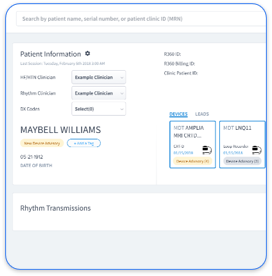
Rhythm360 solves this with a multi-layer ingestion architecture that combines API connections, HL7 messaging, XML parsing, and computer vision (OCR) applied to unstructured PDF reports. A redundant data feed system acts as a fail-safe when an OEM server is unavailable, which delivers greater than 99.9% transmissibility across the full device population. Device technicians work from a single dashboard that presents a holistic patient record without separate OEM logins. The University of Chicago Medicine reviewed more than 73,000 reports annually through Rhythm360 in calendar year 2025, averaging more than 18,000 reports per quarter, which validates the platform’s capacity for high-complexity, multi-device environments.
High alert volume from implanted devices creates a direct patient safety risk rather than a simple workflow annoyance. In a study of more than 26,000 device patients, loop recorders generated over half of all alerts. Clinically significant events such as new-onset atrial fibrillation, ventricular tachycardia, and device malfunction can hide within a stream of non-actionable notifications.
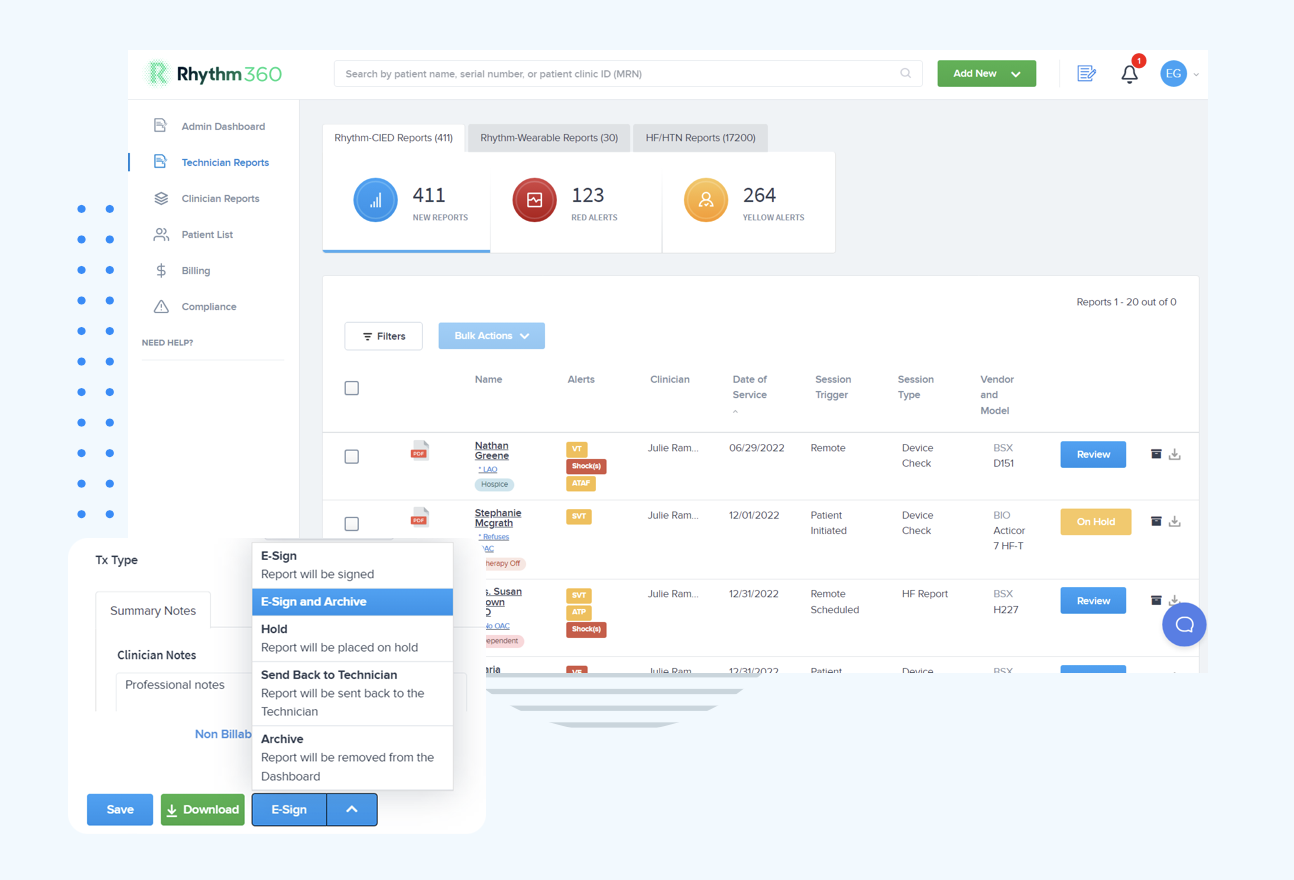
Rhythm360’s AI-powered alert triage filters non-actionable transmissions and surfaces clinically significant events in priority order. Optional 24/7/365 oversight by certified cardiac technicians (CCTs) supervised by physicians adds a human review layer. Together, these capabilities reduce critical-alert response times by up to 80%. As Andrew Beaser, MD, Associate Professor of Medicine at UCM, noted: “Decision support, including AI-assisted decision support, will become increasingly important as data volumes grow.”
Earlier triage enables earlier intervention. Dr. Beaser explained: “We are able to address these issues earlier; rather than waiting for a 3-month visit, we can call patients in for evaluation.” A 2026 systematic review and meta-analysis of 65 randomized controlled trials (~23,000 heart failure patients) found that remote patient monitoring reduced all-cause mortality (RR 0.89) versus standard care. These outcomes depend directly on timely alert response, which AI triage supports.
Manual transcription from OEM portals into the EHR ranks among the highest-volume sources of administrative waste in device clinics. Smart infusion pumps are installed in approximately 90% of US hospitals, but bidirectional EHR integration exists in only 10–15%. That gap illustrates how rarely device-to-EHR integration reaches full maturity even in well-resourced environments.
Rhythm360 provides bi-directional HL7 integration with Epic, Cerner, Athenahealth, eClinicalWorks, Greenway Health, and other major systems. Data flows from the device ecosystem into the EHR and back, which removes redundant logins and manual data entry. Automated report generation and documentation write directly into the patient record, preserving clinical context and audit trails. Gaurav A. Upadhyay, MD, at UCM, observed: “We have improved billing and accountability for our patients after the integration.”
The HIPAA-compliant Rhythm360 mobile application extends this integration to any location. Clinicians review transmissions, sign reports, and coordinate care from their smartphones. This capability directly addresses the on-call coverage gap where critical weekend alerts have often gone unreviewed until Monday.
Remote monitoring billing in 2026 follows a revised CMS code structure that introduces new revenue opportunities and tighter compliance requirements. CMS has established national non-facility rates for RPM codes 99453 for setup and education, 99454 for device supply and data transmission, 99457 for the first 20 minutes of treatment management, and 99458 for each additional 20 minutes. A new code, 99470, covers the first 10–19 minutes of RPM treatment management and requires precise documentation to avoid claim rejection.
A September 2024 OIG review found that roughly 43% of Medicare RPM enrollees did not receive all three required service components: device supply, data transmission, and treatment management. That compliance gap creates rejected claims and recoupment risk for practices that rely on manual documentation.
Rhythm360 automates CPT code capture by tracking billable events against CMS thresholds in real time. The administrative dashboard displays captured and potential revenue by CPT code, which gives practice administrators a live view of billing performance. Practices using Rhythm360 have increased revenue generation by as much as 300% through improved CPT capture, better staff efficiency, and the addition of RPM service lines for heart failure and hypertension management. CIED-specific codes (93298, 93299) and RPM codes (99453, 99454, 99457) are tracked within the same platform, so teams avoid separate billing workflows by service line.
See how Rhythm360’s automated documentation aligns with your current CPT code mix.
Realistic US medical device integration costs range from $40,000 for a single device at one hospital in read-only mode to $400,000 or more for multi-device, multi-site, bidirectional deployments, with timelines of 3–18 months. Each additional EHR vendor adds $80,000–$200,000, and per-hospital activation costs $15,000–$50,000. These figures describe custom-built integrations that Rhythm360 replaces with a platform-based approach using reusable integration patterns.
Rhythm360 onboarding, including EHR integration setup, typically takes from a few days to a few weeks depending on practice size and existing infrastructure. The SaaS-based pricing model scales with clinic size and platform usage, which avoids the large upfront capital expenditure of legacy on-premise systems. Training distributes knowledge across the team rather than concentrating it in a single “super-user,” which supports business continuity when staff members change roles.
The 2023 HRS/EHRA/APHRS/LAHRS consensus statement addresses staffing for remote cardiac monitoring. Rhythm360’s automation reduces the per-patient administrative burden so existing staff can manage larger patient panels without proportional headcount increases.
Rhythm360 supports cardiology practices across the full size spectrum, with workflows tuned to each setting.
Solo EP Labs and Small Cardiology Practices often manage devices from two or more OEMs with limited administrative staff. Time is the primary constraint because staff spend hours each week logging into separate portals and entering data into the EHR. Rhythm360’s unified dashboard and automated reporting remove that redundancy. The mobile app allows the physician-owner or a single CCT to review and sign transmissions from any location, which maintains continuity without additional headcount.
Mid-Size Cardiology Groups must coordinate alert triage across multiple clinicians and locations. AI-powered prioritization ensures that critical alerts reach the right clinician quickly. The integrated communication hub, powered by Twilio, logs all patient contacts with a complete audit trail. At this scale, bi-directional EHR integration removes the manual reconciliation burden that grows with patient volume.
Large Integrated Health Systems need a platform that handles tens of thousands of reports annually without performance or compliance issues. The UCM implementation demonstrates this capacity directly. UCM’s implementation of Rhythm360 enabled clinicians to review more transmissions daily and identify more abnormalities, with stable dismissal rates at the volume described earlier. Optional CCT oversight through Rhythm360 provides 24/7/365 coverage for systems that cannot staff around-the-clock internal triage teams.
| Practice Type | Device Mix | Primary Pain Point | Rhythm360 Capability Match | Recommended Next Step |
|---|---|---|---|---|
| Solo EP Lab / Small Practice | 2+ OEM brands; <500 patients | Multi-portal logins, manual EHR entry, limited staff | Unified dashboard, computer-vision ingestion, mobile app, SaaS pricing scaled to practice size | Request a personalized walkthrough |
| Mid-Size Cardiology Group | 3+ OEM brands; 500–3,000 patients; HF/HTN RPM | Alert fatigue, missed CPT codes, multi-site coordination | AI triage, automated CPT capture (93298, 99454, 99457), bi-directional Epic/Cerner integration, Twilio communication hub | Explore a group-focused demo |
| Large Integrated Health System | All major OEMs; 3,000+ patients; CIED + HF + HTN | Scale of transmissions, 24/7 triage coverage, billing compliance at volume | >99.9% transmissibility, optional 24/7 CCT oversight, 73,000+ annual reports validated at UCM, automated CMS 2026 billing documentation | Schedule a health-system strategy session |
| EP Lab Adding HF/HTN RPM Service Line | Existing CIED mix; adding wearables/scales/BP monitors | No existing RPM infrastructure, unfamiliar 2026 CPT codes | Turnkey HF/HTN RPM onboarding, 99453/99454/99457/99470 automated capture, patient onboarding checklists, CardioMEMS integration | Plan your HF/HTN RPM launch |
CMS updated RPM billing rules effective January 1, 2026, with several changes relevant to cardiology practices managing heart failure and CIED patients. The 2026 code set includes 99453 for device setup and patient education and 99454 for device supply and data transmission covering 16–30 days of readings in a 30-day period. A new companion code, 99445, covers 2–15 days of readings, and the two codes are mutually exclusive per patient per month. A new code, 99470, covers the first 10–19 minutes of RPM treatment management and cannot be billed in the same month as 99457 or 99458. Each management code requires at least one live interactive patient contact per billing period. Practices must document all three required service components, which are device supply, data transmission, and treatment management, to avoid claim rejection. Rhythm360 tracks these thresholds automatically and generates compliant documentation for each billable event, which reduces the administrative burden of meeting 2026 CMS requirements.
Remote patient monitoring (RPM) covers measured physiologic data such as blood pressure, weight, heart rate, and oxygen saturation captured via FDA-defined medical devices. Remote therapeutic monitoring (RTM) covers non-physiologic data such as musculoskeletal or respiratory system status, treatment adherence, and treatment response. For cardiology heart failure practices, RPM represents the relevant category. Monitoring weight trends, blood pressure, and hemodynamic data from devices like CardioMEMS pulmonary artery pressure sensors falls under RPM codes 99453, 99454, 99457, 99458, and 99470. CMS does not permit RPM and RTM billing together for the same patient in the same month. RTM codes generally apply only when the monitored service is an RTM-eligible therapeutic intervention rather than standard physiologic monitoring. Rhythm360 supports RPM workflows for both CIED and HF/HTN service lines, with automated CPT capture aligned to the RPM code set.
Vendor-neutral platforms improve outcomes by ensuring that data from all implanted and wearable devices reaches clinicians reliably and promptly, regardless of manufacturer. A 2026 systematic review and meta-analysis of 16 randomized controlled trials involving 8,618 heart failure patients found that structured remote patient management reduced heart-failure-related hospitalization with a risk ratio of 0.68 and all-cause mortality with a risk ratio of 0.82 compared to standard care. The same analysis found that haemodynamic-guided monitoring, which includes CardioMEMS pulmonary artery pressure monitoring supported by Rhythm360, produced the largest mortality reduction (RR 0.71). These outcomes depend on consistent data transmission and timely alert response. Rhythm360’s greater-than-99.9% transmissibility, achieved through redundant data feeds and AI-powered gap filling, maintains the data quality required for these outcomes across the full device population.
Remote heart failure monitoring platforms that handle protected health information (PHI) must comply with HIPAA’s Security Rule. This rule requires administrative, physical, and technical safeguards including encryption of data in transit and at rest, role-based access controls, audit logging, and breach notification procedures. Platforms that connect to EHR systems via APIs must also meet the authentication, authorization, and token management requirements of those EHR vendors. Epic App Orchard, Oracle Health, and Meditech each maintain distinct developer programs with security review requirements. For platforms classified as Software as a Medical Device (SaMD) because they include clinical decision support or analytics, FDA Section 524B cybersecurity requirements apply, including software bill of materials (SBOM), threat modeling, and vulnerability management programs. Rhythm360 is a HIPAA-compliant, cloud-based platform with role-based access controls, full audit trails for all patient communications and clinical actions, and a secure mobile application, which meets the security baseline required for cardiology practices operating under 2026 regulatory standards.
Implementation timelines vary significantly by platform architecture and practice complexity. Custom-built device-to-EHR integrations can take 3–18 months and cost $40,000 to $400,000 or more depending on the number of devices, sites, and EHR vendors involved. Platform-based approaches using reusable integration patterns reduce this burden. Rhythm360’s onboarding process, including EHR integration with systems such as Epic, Cerner, and Athenahealth, typically takes from a few days to a few weeks. The SaaS delivery model removes large upfront infrastructure costs, and training distributes platform knowledge across the clinical team rather than concentrating it in a single administrator. For practices adding a new HF/HTN RPM service line alongside an existing CIED program, Rhythm360 provides turnkey onboarding checklists and automated billing support that accelerate time to first billable encounter.
The five criteria that define a capable remote heart failure management platform in 2026, which include vendor-neutral interoperability, AI-powered alert triage, bi-directional EHR integration, automated CPT documentation, and rapid implementation, function as operational requirements rather than optional features. Any practice managing a multi-OEM device population under the 2026 CMS billing framework needs these capabilities to remain clinically safe and financially sustainable.
Rhythm360 delivers on each criterion within a single platform. The system provides greater-than-99.9% transmissibility through redundant feeds and computer-vision ingestion, the faster alert response described earlier through AI triage and optional CCT oversight, bi-directional HL7 integration with Epic, Cerner, and other major EHR systems, and automated capture of 2026 CPT codes including the new 99445 and 99470 codes. The rapid onboarding timeline described earlier replaces the months often required by legacy systems. The University of Chicago Medicine’s experience, with more than 73,000 reports reviewed annually, earlier interventions, and improved billing accountability, offers a validated, high-volume reference point for what the platform delivers at scale.
Practices that continue using fragmented OEM portals and manual billing workflows in 2026 face compounding costs that include staff burnout, missed critical events, and uncaptured revenue against a CMS code set that now rewards complete documentation of every billable threshold. Rhythm360 provides the infrastructure that supports both clinical quality and financial performance.
Evaluate Rhythm360 against your device mix, EHR environment, and 2026 billing goals.