Last updated: August 24, 2026
Remote monitoring improves patient safety by extending surveillance of implanted devices between in-person visits. The supporting infrastructure often undermines that goal. Clinics caring for patients with devices from multiple manufacturers juggle separate OEM portals, each with its own interface, alert logic, and data format.
Staff lack a unified view of device status for each patient. They also lack a cross-manufacturer prioritization layer and a direct pathway from alert review to documentation and billing. Every step requires manual effort, which slows response times and increases the chance that a critical event hides in a long queue of low-value alerts.
Andrew Beaser, MD, Associate Professor of Medicine at the University of Chicago Medicine (UCM), described pre-implementation workflows as “a major challenge and incredibly difficult.” That description reflects a common pattern across device clinics. Gaurav A. Upadhyay, MD, FACC, FHRS, Professor of Medicine and Director of the Pacing & Defibrillation Device Clinic at UCM, noted persistent staffing gaps, technician turnover, and limited weekend coverage.
The clinical impact is straightforward. A critical arrhythmia such as new-onset atrial fibrillation, ventricular tachycardia, or a lead malfunction near elective replacement can sit beneath dozens of non-actionable notifications. High false-positive rates condition staff to deprioritize alerts. The chance of a missed event rises, and delayed responses can mean preventable strokes, unplanned hospitalizations, or device failures that remain unaddressed until the next visit.
The financial impact is just as real. Manual workflows create documentation gaps. Billing for CPT codes 93294 through 93298 and the RPM family (99453–99458) requires precise, auditable records of monitoring periods, device parameters, and clinician interpretation. Practices that lack automated documentation at the point of review often under-bill or submit claims that fail audits.
Alert fatigue in CIED remote monitoring programs arises from several structural issues that compound each other. Together they create notification volumes that no manual workflow can manage reliably.
Effective alert fatigue reduction requires more than a new portal. It requires a redesign of how device data flows from OEM systems to clinical decision-makers. The following capabilities define a platform that can support that redesign and deliver durable clinical and operational gains.
An AI-powered, vendor-neutral platform changes how teams work and how quickly patients receive care. Rhythm360 replaces manual, portal-by-portal review with a single prioritized worklist and reduces critical response times by up to 80%. Staff focus on alerts that require action instead of sorting through noise.
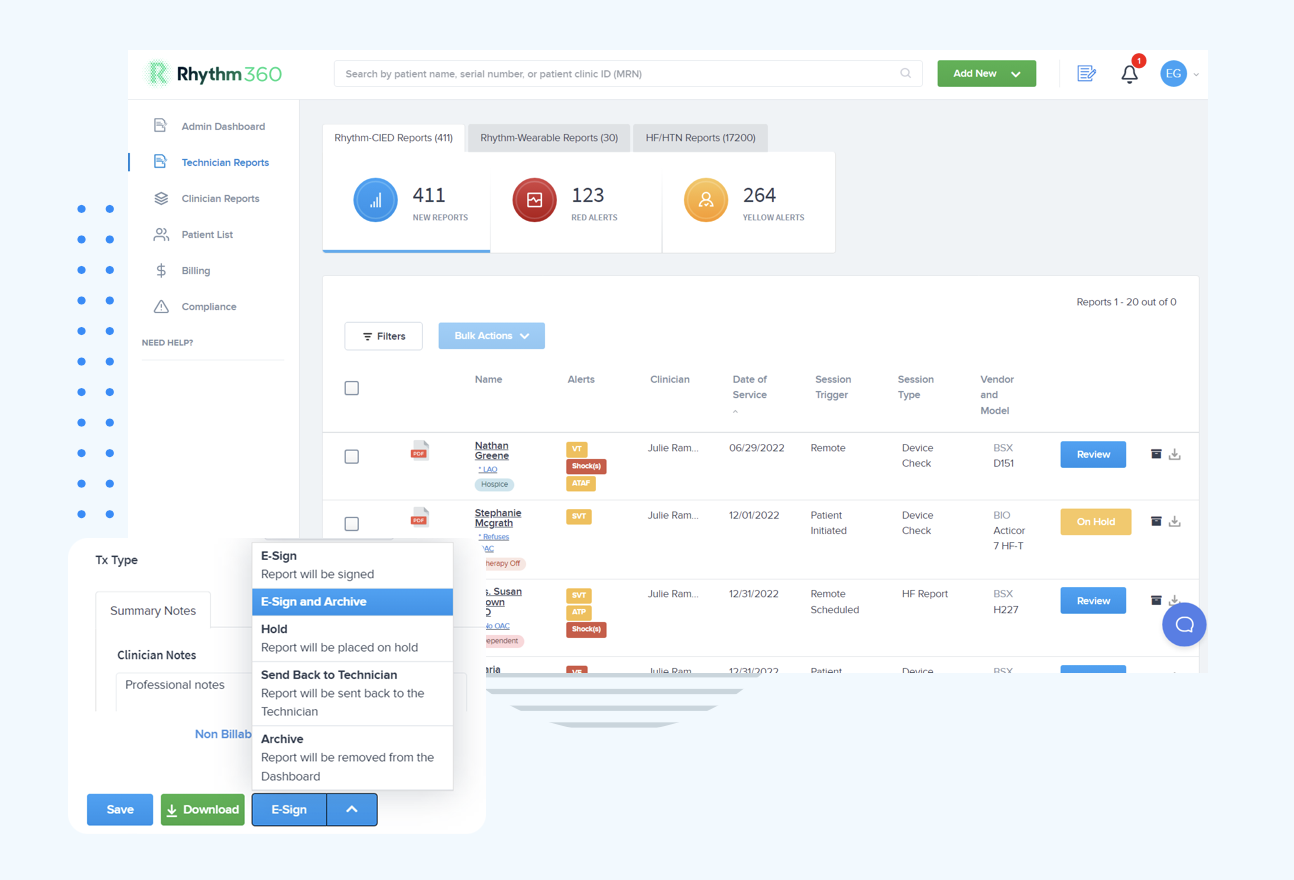
This shift supports proactive care. When a critical arrhythmia appears on a Saturday morning, a clinician can review and act within hours. They can start anticoagulation for new-onset AFib or coordinate device reprogramming for ventricular tachycardia. Remote monitoring then delivers on its promise of earlier intervention. Without triage, that same event might not surface until the next business day or the next scheduled review.
UCM reviewed more than 73,000 reports annually through Rhythm360 in calendar year 2025, averaging more than 18,000 reports per quarter, with stable dismissal rates, which reflects the safety-first reality that most OEM-generated alerts are non-actionable. Managing that volume with consistent quality requires AI-assisted prioritization rather than more staff.
Staff burden falls as workflows simplify. Device technicians and nurses working in a unified platform spend less time on data retrieval and manual reconciliation. That reduction in administrative work helps lower burnout and turnover in specialized roles.
Request a walkthrough of the AI triage workflow that delivers these response-time improvements.
Remote CIED monitoring and RPM services use distinct CPT code families, each with specific documentation and timing rules. Practices that cannot produce complete, auditable records for every billable period face denials and compliance risk.
The core CIED remote monitoring codes for 2026 are listed below.
For RPM services that support chronic conditions such as heart failure and hypertension, the 2026 Medicare Physician Fee Schedule introduced CPT 99445 for device supply with 2–15 days of transmitted data (about $47 national average) and CPT 99470 for the first 10–19 minutes of treatment management (about $26). These codes lower previous billing thresholds that produced no reimbursement.
Documentation for CPT 99457 and 99458 must capture total time spent, clinical activities performed, data reviewed, actions taken, and interactive communication details. Rhythm360’s automated reporting generates this documentation at the point of transmission review, eliminating the manual transcription that creates billing gaps. UCM’s Gaurav A. Upadhyay, MD, observed, “We have improved billing and accountability for our patients after the integration.”
The evidence base for AI-assisted alert reduction in cardiac remote monitoring expanded significantly in 2025 and 2026. These findings support program design decisions for high-volume clinics.
Gopinathannair et al. (2026) showed in a cohort of Assert-IQ insertable cardiac monitors that AI algorithms can reduce AF electrogram data burden and pause electrogram data burden. Fewer electrograms mean fewer transmissions that require clinician review and a lower alert burden per patient.
Mehran Moazeni’s 2026 PhD thesis at Utrecht University found that personalized, real-time monitoring using linear mixed-effects models and statistical process control charts outperformed population-based thresholds in heart failure patients. Personalized thresholds reduced noise while preserving sensitivity to meaningful change.
The UCM volume data mentioned earlier, sustained across multiple quarters without quality degradation, illustrates how centralized aggregation and AI-assisted triage support safe scaling. Andrew Beaser, MD, noted, “Decision support, including AI-assisted decision support, will become increasingly important as data volumes grow.”
Selecting and deploying a vendor-neutral remote monitoring platform involves technical choices and staffing decisions. The criteria below provide a practical evaluation framework.
Workflow redesign and role clarity must come before additional hiring to sustain remote CIED monitoring programs. Rhythm360’s implementation approach aligns with this finding by pairing process standardization with platform deployment.
OEM default alert thresholds that ignore individual physiology drive most non-actionable alerts. Manufacturers configure devices to flag a wide range of parameter deviations to maximize sensitivity, which produces high false-positive rates across broad patient populations. When a clinic manages patients across multiple manufacturers, each portal applies its own alert logic in isolation, without cross-manufacturer prioritization.
This structure creates a combined notification volume in which most alerts require no clinical action. Staffing shortages intensify the problem. The same team often reviews alerts across several portals while also managing in-person visits and documentation. Per-alert review time shrinks, and the risk of missing a truly critical event rises.
Individualized alert programming replaces population-based thresholds with parameters tailored to each patient’s baseline physiology and clinical history. The system flags deviations from that patient’s normal pattern instead of deviations from a manufacturer-defined norm. False-positive rates fall because benign fluctuations, such as minor weight changes in a stable heart failure patient or transient rhythm shifts within a known pattern, no longer trigger alerts.
The 2023 HRS/EHRA/APHRS/LAHRS consensus statement supports customized alert programming as a way to reduce alert frequency to about one alert per patient-year while making remaining alerts more meaningful. AI-assisted triage then filters the alerts that do fire, further shrinking the number that reach clinical staff for manual review.
Remote CIED monitoring uses CPT codes 93294 through 93298. CPT 93294 covers professional interpretation of remote pacemaker transmissions. CPT 93295 covers ICD and CRT-D transmissions. CPT 93296 is the technical component billed with either 93294 or 93295. CPT 93297 covers implantable loop recorder interpretation, and CPT 93298 is the technical component for ILR monitoring over a 2–15 day period.
Remote physiological monitoring for chronic conditions such as heart failure and hypertension uses a separate code family. CPT 99453 covers one-time device setup. CPT 99445 covers device supply with 2–15 days of transmitted data, which is new in 2026. CPT 99454 covers device supply with 16 or more days of data. CPT 99470 covers the first 10–19 minutes of monthly management time, also new in 2026. CPT 99457 covers the first 20 minutes of monthly management time, and CPT 99458 covers each additional 20-minute increment. Documentation must capture monitoring dates, device type and manufacturer, and a clinician interpretation that addresses device function, programmed parameters, and actionable findings.
Rhythm360’s implementation process, including bi-directional EHR integration with systems such as Epic, Cerner, Athenahealth, and eClinicalWorks via HL7, typically finishes within a few days to a few weeks. The exact timeline depends on the complexity of the EHR environment and the number of OEM data feeds that require consolidation.
Rhythm360 ingests data across multiple formats, including API, HL7, XML, and unstructured PDFs via computer vision. This flexibility reduces configuration work for clinic IT teams. The platform’s redundant data feed architecture also provides a fail-safe if an OEM server experiences downtime, which helps maintain more than 99.9% data transmissibility during and after integration.
Alert fatigue in CIED remote monitoring affects patient safety, daily operations, and revenue. Fragmented OEM portals, non-individualized alert thresholds, and manual documentation workflows delay critical event recognition, exhaust staff, and leave reimbursable work uncaptured. Clinics need a platform that consolidates data across device manufacturers, applies AI-driven triage to surface actionable alerts, automates CPT documentation, and supports flexible staffing models with optional CCT oversight and mobile access.
Rhythm360 delivers these capabilities within a single, vendor-neutral, HIPAA-compliant platform. Practices using Rhythm360 have achieved up to an 80% reduction in critical response times and meaningful improvements in CPT billing capture. These results demonstrate the clinical and financial value of redesigning workflows for high-volume device monitoring programs.
Contact us to discuss how these capabilities apply to your clinic’s device monitoring program.