See how Rhythm360 automates compliant CPT capture
Remote patient monitoring (RPM) refers to the collection and transmission of physiologic data, such as blood pressure, weight, glucose, and heart rate, from a patient's home to the care team using an FDA-defined connected device. Remote physiologic monitoring and remote therapeutic monitoring (RTM) are distinct services: RPM monitors physiologic data, while RTM monitors non-physiologic therapeutic data such as medication adherence. The 2026 code structure matters because the CY 2026 Physician Fee Schedule final rule (CMS-1832-F), effective January 1, 2026, added two new RPM codes, 99445 and 99470, that operationalize shorter data-day and time thresholds, creating new billing pathways and new compliance obligations simultaneously. The table below maps each core RPM code to its 2026 requirement so practices can see where the new thresholds diverge from the established ones.
| Code | Purpose | 2026 Requirement | Source |
|---|---|---|---|
| 99453 | Setup and patient education | One-time per device per patient; requires documented training | CareAtlas 2026 RPM Guide |
| 99445 | Device supply, shorter duration | 2–15 days of data transmission in 30-day period; mutually exclusive with 99454 | PositiveCheck 2026 RPM Codes |
| 99454 | Device supply and data transmission | 16 or more days of data transmission in 30-day period | FCSO RPM Documentation Checklist |
| 99470 | Treatment management, shorter time | 10–19 minutes of monitoring time; requires interactive communication | PositiveCheck 2026 RPM Codes |
| 99457 | Treatment management, first increment | First 20 minutes; requires at least one interactive communication | FCSO RPM Documentation Checklist |
| 99458 | Treatment management, additional | Each additional 20 minutes; must be billed with 99457 | FCSO RPM Documentation Checklist |
Any changes proposed for 2027 remain proposed only and are not yet in effect. Practices should verify current payer-specific policies before submitting claims, as Medicare, Medicare Advantage, Medicaid, and commercial plans may not process RPM identically.
Schedule a demo to see compliant CPT code capture in action
The remote monitoring billing ecosystem involves providers, device manufacturers, EHRs, billing teams, and patients, each generating data that staff must capture, reconcile, and document before a claim is submitted. Practices managing CIEDs from multiple manufacturers face a distinct compliance burden because staff must log into separate, non-interoperable manufacturer portals to retrieve device data. That fragmentation creates documentation gaps that translate directly into audit exposure.
The shift toward integrated platforms addresses this fragmentation by consolidating billable events and generating auditable documentation at the point of care rather than reconstructing it at billing time. An audit-ready practice produces defensible documentation as a byproduct of its workflow, not in a scramble after an auditor arrives.
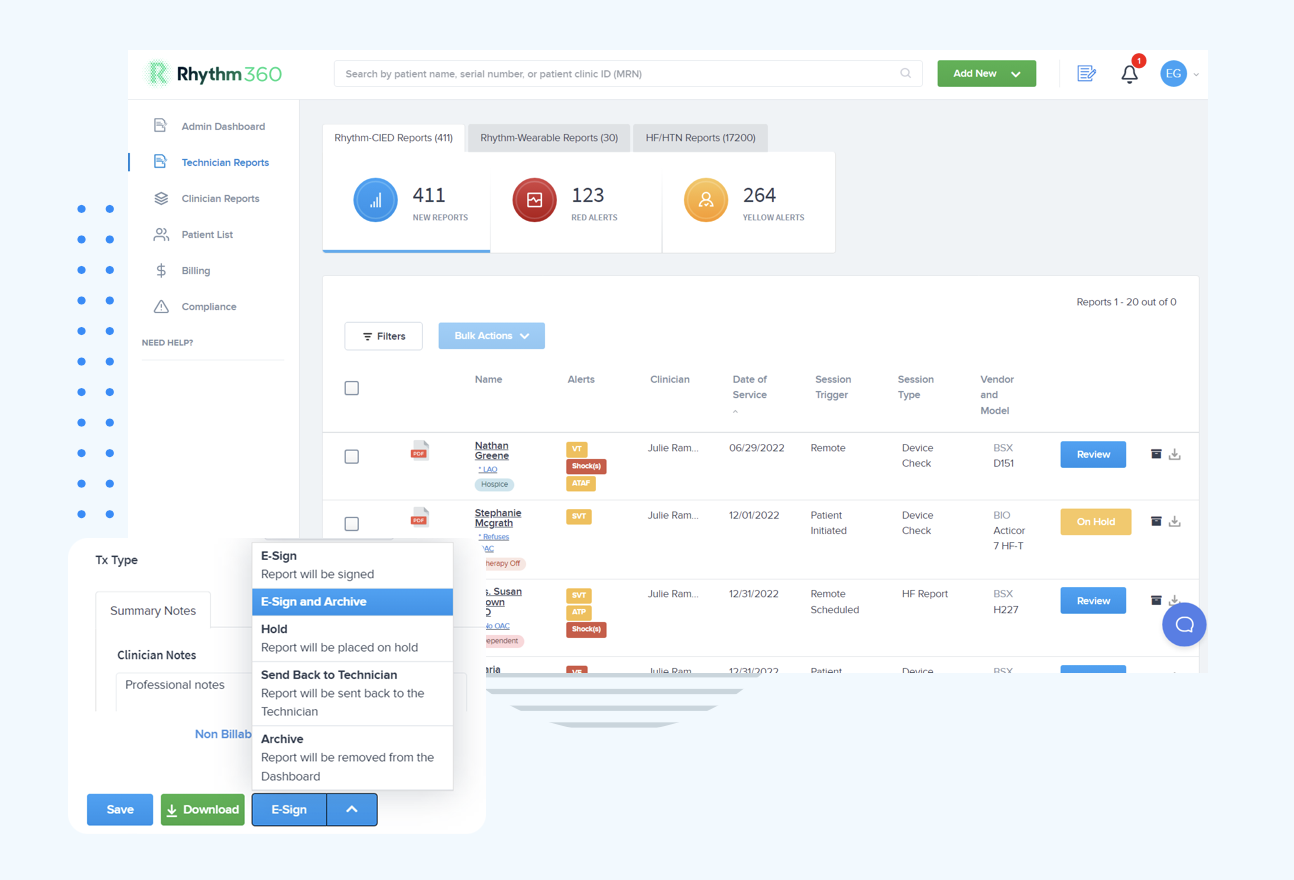
Rhythm360 is a vendor-neutral, HIPAA-compliant platform that consolidates CIED and HF/HTN data from all major device manufacturers, including Medtronic, Boston Scientific, Abbott, and Biotronik, into a single source of truth. That consolidation makes auditable documentation possible because the platform automates data ingestion, report generation, and billing documentation, and integrates bi-directionally with Epic, Cerner, Athenahealth, eClinicalWorks, Greenway Health, and others via HL7. Other platforms in the cardiac remote monitoring space include Murj, Implicity, Rhythm Management Group, and Octagos. Whatever solution a practice evaluates, it should enforce device-specific cycle tracking, documentation completeness, and no-double-counting rules at the point of care.
Those rules only hold up if the underlying documentation does. The next section explains what a compliant RPM record must contain.
Compliant RPM billing requires that every claim be supported by documentation addressing each of the following elements before submission. At audit, missing documentation is treated the same as services not rendered.
Cardiac device remote monitoring codes follow device-specific billing cycles that differ from the general RPM code stack. Device-type mismatch and unbilled technical components are among the most common denial causes in this category.
Pacemakers and ICDs follow a 90-day billing cycle:
Physiologic monitors and loop recorders follow a 30-day billing cycle:
Because 93297 and 93298 are device-specific codes rather than a professional and technical pair, each is billable once per 30 days. Practices can bill each code three ways: global, with the -26 professional component modifier, or with the -TC technical component modifier. Applying either code to the wrong device type creates a device-type mismatch denial. Failing to bill the technical component when the practice performs that service creates an unbilled technical component denial.
Rhythm360 automatically tracks device-specific CPT pairings and both billing cycles. That tracking prevents device-type mismatch denials and catches unbilled technical components before the claim goes out. For HF/HTN programs, the general RPM codes 99453, 99454, and 99457 apply to heart failure and hypertension patients using connected physiologic monitoring devices, and the same documentation requirements described above govern those claims.
See how Rhythm360 tracks device-specific CPT cycles automatically
CMS permits RPM to be billed concurrently with Chronic Care Management (CCM) and Transitional Care Management (TCM) when all requirements for each service are independently met. Concurrent billing of RPM alongside CCM or TCM is one of the most under-covered and highest-risk areas in remote monitoring billing. The rule targets double-counting: the same time or effort cannot be counted toward more than one billed service.
The decision framework for concurrent billing rests on three principles:
The same minute of clinical staff time cannot count toward two care management programs, so for an interaction involving both RPM and CCM, practices must document distinct qualifying activities and allocate actual time without duplication. Rhythm360's automated CPT code capture and auditable documentation help practices attribute billable events correctly and maintain the separation required to defend concurrent claims at audit.
The following patterns are the most common reasons remote monitoring claims fail review. Each represents a documentation or workflow failure that Rhythm360's automated report generation and billing documentation are designed to prevent.
Most of those failures trace back to code selection. Two of the most common mix-ups involve RTM and a handful of legacy codes that look like RPM but are unrelated.
RPM and RTM should not be billed together for the same patient during the same billing period, because RPM monitors physiologic data, such as blood pressure, oxygen saturation, blood glucose, weight, and heart rate, while RTM monitors therapeutic or non-physiologic data such as musculoskeletal status, medication adherence, and treatment response. Medicare coverage and payment rules for RTM differ from RPM, so practices should verify payer-specific policies before billing either service.
Two codes are frequently confused with the RPM framework:
Practices assessing organizational readiness for a compliant remote monitoring program should evaluate the following areas as a connected sequence rather than isolated tasks.
A phased rollout that begins with a defined patient cohort, validates documentation workflows, and then expands incrementally reduces compliance risk during program growth. Rhythm360's streamlined implementation, including EHR integration, typically takes only a few days to a few weeks and integrates bi-directionally with Epic, Cerner, Athenahealth, eClinicalWorks, Greenway Health, and others via HL7.
Once the program is running, readiness turns into maintenance. The metrics below show how practices keep compliance from drifting.
Practices that treat compliance as an ongoing operational discipline rather than a one-time setup track metrics across four categories.
Ongoing review of workflows, staffing, and system use, rather than annual audits, is the operational posture that produces defensible documentation consistently.
Schedule a demo to optimize your remote monitoring compliance
The core requirements appear in the Documentation Requirements section above. The gaps that most often sink a claim are missing or vague consent, lack of documented interactive communication for time-based codes, and time that is not clearly attributed to specific dates, staff, and activities.
CPT 99091 is the legacy RPM-adjacent code described above. The FAQ-relevant point is that it requires at least 30 minutes of physician or qualified health care professional time per 30 days and should not be treated as substitutable for the 99453–99470 stack.
Medicare coverage and payment rules for remote therapeutic monitoring differ from remote physiologic monitoring. RTM monitors non-physiologic therapeutic data such as medication adherence or treatment response, while RPM monitors physiologic data such as blood pressure, weight, or glucose. RPM and RTM cannot be billed together for the same patient during the same billing period. Practices should verify payer-specific policies before billing either service, as Medicare, Medicare Advantage, Medicaid, and commercial plans may not process RTM identically.
The two new codes are 99445 and 99470, detailed in the Executive Overview above. The practical point is that both require at least one real-time interactive communication, and 99445 is mutually exclusive with 99454 for the same 30-day period, while 99470 is mutually exclusive with 99457 and 99458 for the same calendar month.
RPM and CCM may be billed concurrently when each service independently meets its requirements and the same time or effort is not counted toward both. Documentation must clearly separate time attributed to RPM from time attributed to CCM, itemized by date, duration, staff member, and activity. The same employee may provide both RPM and CCM services in the same month, provided all applicable personnel and supervision requirements are met and separately reported work remains separately identifiable in the record.
The cycle and code assignments appear in the CIED compliance section above. For audit defense, the key points are that 93297 and 93298 are device-specific codes rather than a professional and technical pair, and applying either to the wrong device type or omitting the technical component when performed are common denial causes.
CPT code compliance for remote monitoring is a core operational capability for cardiology and electrophysiology practices in 2026. Practices that enforce documentation, device-specific cycle tracking, and no-double-counting rules at the point of care are positioned to survive payer review, while practices that reconstruct compliance after the fact face higher recoupment risk. The audit-defense posture that protects revenue comes from the workflow itself, assembled claim by claim rather than in response to an audit notice.
When evaluating remote monitoring platforms, practices should assess whether the system enforces device-specific CPT pairings and billing cycles, captures auditable documentation at the point of care, supports concurrent billing attribution, and integrates with existing EHR infrastructure. Rhythm360 is built to meet each of those requirements for CIED and HF/HTN programs.
Schedule a demo of Rhythm360 today