Last updated: August 24, 2026
Heart failure RPM programs face eight interconnected risks that can weaken outcomes and threaten program sustainability. The list below previews the challenges explored in detail in the following sections.
See how Rhythm360 addresses each of these risks inside a single, vendor-neutral platform.
Only 10–20% of clinical alarms require any clinical intervention, so most notifications from legacy RPM systems are non-actionable. The downstream consequences are severe. The Joint Commission’s sentinel event database includes 98 alarm-related events (80 of which resulted in death) between 2009 and June 2012. The FDA documented hundreds of additional alarm-related deaths in a similar period. When clinicians learn to dismiss alerts, genuinely critical events such as new-onset atrial fibrillation, ventricular tachycardia, or significant weight gain can be overlooked.
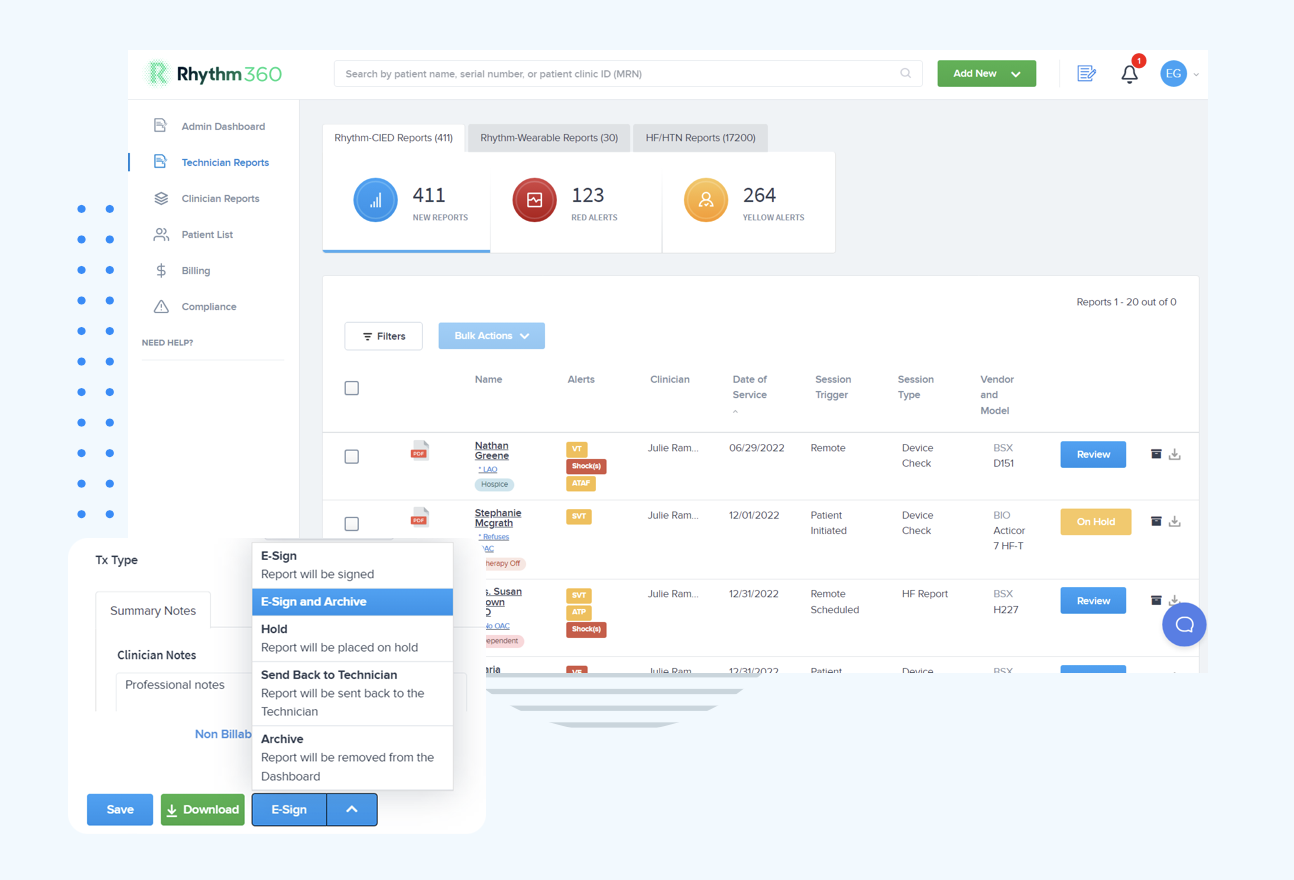
Rhythm360’s AI-powered alert triage engine filters non-actionable noise before it reaches the clinical team and surfaces only prioritized, clinically significant events. For alerts that pass the AI filter, optional 24/7/365 oversight by certified cardiac technicians (CCTs) adds a human validation layer so edge cases receive expert review before escalation. This two-tier approach of automated filtering plus optional human oversight produces the response-time improvement noted earlier. Clinicians move from reactive alarm management to proactive patient care.
Cardiac RPM programs that depend on a single data pathway from each OEM face transmission failures whenever a manufacturer’s server goes down or a patient’s home network drops. Heart failure patients in a 2026 Italian qualitative study identified unreliable devices and dropped connections as key barriers that interfered with daily measurements and data transmission. A missed transmission is not merely an inconvenience. It creates a clinical blind spot that hides early decompensation.
To close these blind spots, Rhythm360 uses a redundant data feed architecture that acts as a fail-safe when any OEM server becomes unavailable, which supports more than 99.9% transmissibility. Computer vision and AI-powered extrapolation then normalize data arriving via API, HL7, XML, and unstructured PDFs so the clinical record stays complete even when upstream sources are imperfect. Programs running on Rhythm360 make decisions from a more accurate, cross-referenced patient view instead of a partial snapshot.
Even when connectivity works reliably, heart failure RPM programs still face a behavioral challenge: adherence erosion. Digital weight-monitoring studies in heart failure show that app engagement often declines substantially over time, which proves that digitization alone does not prevent attrition. First-generation remote monitoring systems are limited by declining long-term adherence and heavy dependence on continuous human surveillance. Digital fatigue, limited perceived benefit, and competing life priorities all contribute to reduced sustained engagement.
Rhythm360 addresses adherence at enrollment and throughout the monitoring relationship. Structured patient onboarding checklists set clear expectations from day one and establish the monitoring routine before adherence can drift. To maintain that routine, the platform’s integrated Twilio-powered messaging framework automates reminders and logs every patient communication, including calls, texts, and responses, within the patient record. When a scale goes offline or a patient stops responding, staff see the full communication history immediately, which supports targeted outreach instead of repeated, redundant contact attempts.
The 2023 HRS/EHRA/APHRS/LAHRS international consensus statement provides guidance on staffing for remote monitoring programs. Managing high-acuity heart failure patients in RPM can require significant time for data review, alert triage, patient calls, documentation, and escalation. When staff must log into multiple non-interoperable OEM portals to retrieve data for each patient, those minutes multiply rapidly. A 2026 French survey of 28 cardiology departments found that while 96.4% had established dedicated RPM teams, challenges remained in training, coordination, and dedicated time allocation.
Rhythm360 consolidates all CIED and RPM data into a single dashboard, which removes redundant logins and manual transcription. Bi-directional EHR integration with Epic, Cerner, Athenahealth, eClinicalWorks, Greenway Health, and others via HL7 allows data to flow automatically in both directions. Automated report generation shifts routine checks away from manual work, and the secure HIPAA-compliant mobile app lets clinicians review transmissions, sign reports, and coordinate care from anywhere. This flexibility supports on-call coverage without tethering staff to a workstation.
CPT guidelines address reporting of general home monitoring supply codes alongside cardiac-specific codes when both may apply to the same patient in the same period. The most common staffing failure in RPM programs is delaying dedicated billing expertise past 30–50 patients, which causes documentation gaps and CPT 99458 revenue leakage. Two new RPM codes effective January 1, 2026 cover 2–15 days of transmitted data in a 30-day period and 10–20 minutes of management time in a calendar month. These additions increase complexity for programs that lack automated tracking.
Rhythm360’s administrative dashboard provides a real-time view of captured and potential revenue based on CPT code requirements. The platform flags billable events as they occur and generates CPT-compliant documentation automatically. Programs using Rhythm360 have achieved up to 300% increases in revenue generation through improved CPT code capture and better staff efficiency, without adding billing headcount.
Bottom Line for Programs: Practices implementing Rhythm360 have documented up to a 300% increase in revenue generation through automated CPT code capture, improved staff efficiency, and the addition of new RPM service lines for heart failure and hypertension management. This result shows how closing billing gaps can fund program growth.
Risk 6: Privacy, Data Security, and HIPAA Vulnerabilities
Cardiac RPM data such as ECG tracings, pulmonary artery pressure readings, weight trends, and device telemetry becomes electronic protected health information (ePHI) as soon as it links to an identifiable patient. The HIPAA Security Rule requires covered entities to implement risk analysis, risk management, access control, audit controls, integrity controls, and transmission security as core safeguards. The threat landscape remains active. The FDA has issued cybersecurity safety communications about vulnerabilities that permit unauthorized remote access to medical devices and exposure of patient data. The average cost of a healthcare data breach reached $7.42 million per incident in 2025, with about 289 million patient records exposed in the US through healthcare-related breaches in 2024.
Rhythm360 runs on HIPAA-compliant infrastructure with full audit trails for every data access, transmission, and communication event, which directly addresses the safeguards above. Business Associate Agreements govern all vendor relationships, and the platform’s access controls, encryption, and audit logging meet the requirements of 45 CFR §§ 164.302–164.318. Every patient communication logged through the integrated Twilio framework stays within the patient record, creating a defensible documentation trail for compliance reviews and incident investigations.
Risk 7: Technology Barriers and the Digital Divide
The digital divide disproportionately affects older adults, low-income populations, and those with limited digital literacy in heart failure RPM programs, creating barriers in device access, internet connectivity, and operational skills that reduce long-term adherence. Pilot studies of mobile heart failure monitoring apps have identified usability issues and limited support as factors that can lower adherence shortly after discharge. When the technology itself becomes a barrier, the clinical benefit of monitoring disappears.
Rhythm360 addresses the technology gap on both the patient and clinician side. The platform’s mobile application follows accessibility-focused design, and the patient support infrastructure, including automated reminders and logged outreach, reduces the burden on patients who need additional guidance. For clinicians, the single unified dashboard replaces multiple OEM portals with different interfaces, which shortens the learning curve and lowers the risk of error from portal-switching fatigue.
Risk 8: Inconsistent Evidence and Limited Hemodynamic Insight
Technology barriers are only part of the challenge. The evidence base for noninvasive heart failure RPM also remains heterogeneous. Meta-analyses show only heterogeneous evidence of positive effects on clinical outcomes because of variability in modalities and intervention strategies, and noninvasive techniques provide limited information on hemodynamic parameters such as pulmonary artery pressure. In advanced heart failure, noninvasive hemodynamic monitoring methods can diverge materially from invasive reference measurements, which limits their absolute accuracy. Programs that rely on a single monitoring modality risk missing the full clinical picture.
Rhythm360 integrates data across modalities within a single workspace. The platform combines Rhythm-CIED monitoring for implantable devices such as pacemakers, ICDs, implantable loop recorders, CRT/CCM devices, and CardioMEMS pulmonary artery monitors with HF/HTN remote physiological monitoring for weight, blood pressure, and symptom tracking. This multi-modality approach gives clinicians a more complete hemodynamic picture than any single device class can provide. AI-powered contextual analysis then flags divergences that warrant clinical review.
Workflow Example: A Rhythm360 alert fires on a Saturday morning and flags new-onset atrial fibrillation in a heart failure patient. By Saturday afternoon, the care team has reviewed the transmission via mobile app, initiated anticoagulation, and documented the encounter. This sequence represents an 80% reduction in critical-alert response time compared with legacy manual workflows.
Frequently Asked Questions
Biggest Clinical Risk of Remote Patient Monitoring for Heart Failure
Alert fatigue is consistently identified as the most immediate clinical risk. When the overwhelming majority of alarms are non-actionable, clinical teams become desensitized and genuinely critical events such as ventricular arrhythmias, rapid decompensation, or device malfunctions can be missed. Programs that lack intelligent alert triage are most vulnerable. AI-powered filtering that prioritizes clinically significant events, combined with optional oversight by certified cardiac technicians, currently provides the most effective mitigation strategy.
Reducing Patient Adherence Drop-Off in Heart Failure RPM
Adherence in heart failure patients is a modifiable behavior shaped by expectations, perceived benefit, ease of use, and continuity of support. Programs that invest in structured onboarding, set clear expectations before monitoring begins, and maintain consistent automated and personal outreach see better long-term engagement. Platforms that log all patient communications, including automated reminders, call records, and responses, allow staff to identify disengaging patients early and intervene before a monitoring break becomes permanent. Behavioral and motivational strategies beyond automated alerts alone are necessary for sustained adherence.
HIPAA Compliance Requirements for Cardiac RPM Data
All cardiac remote monitoring data linked to an identifiable patient qualifies as electronic protected health information and falls under the full HIPAA Security Rule. This scope includes data from pacemakers, ICDs, implantable loop recorders, CardioMEMS sensors, and home monitoring devices such as scales and blood pressure cuffs. Device manufacturers and monitoring vendors that receive, store, or transmit this data on behalf of a cardiology practice function as business associates and require Business Associate Agreements. The Security Rule mandates risk analysis, access controls, audit logging, transmission encryption, and integrity controls across every platform in the data pathway, not only the EHR. In December 2024, HHS proposed strengthening these requirements to include mandatory encryption, multi-factor authentication, and network segmentation.
How Billing Complexity Creates Revenue Leakage in Heart Failure RPM
Revenue leakage in heart failure RPM programs typically results from three compounding failures. Teams select incorrect CPT codes when cardiac-specific and general RPM codes overlap, provide insufficient documentation to support time-based codes such as CPT 99458, and delay hiring dedicated billing expertise until the patient panel is already large enough to create systematic gaps. Two new RPM codes effective January 1, 2026 add further complexity by covering shorter post-discharge monitoring episodes that previously fell below billing thresholds. Automated CPT documentation and real-time revenue dashboards that flag billable events as they occur provide the most reliable way to close these gaps without proportionally increasing administrative headcount.
Using a Single Platform for Both CIED Monitoring and Heart Failure RPM
A single platform can manage both CIED monitoring and heart failure RPM effectively. Platforms that integrate implantable device data from all major manufacturers with remote physiological monitoring data such as weight, blood pressure, and symptom logs provide a more complete hemodynamic picture than single-modality solutions. This multi-modality approach is particularly important for heart failure patients who may have both a CIED and chronic volume management needs, because noninvasive monitoring alone provides limited hemodynamic insight compared with invasive sensors. A unified workspace that contextualizes data across device classes and applies AI-driven analysis reduces the risk of clinicians making decisions from an incomplete data set.
Schedule a Demo
Rhythm360 is a vendor-neutral, AI-powered platform built to address every risk described in this article, including alert fatigue, data gaps, adherence drop-off, workflow burden, billing leakage, HIPAA exposure, technology barriers, and incomplete hemodynamic insight. The platform operates inside a single HIPAA-compliant workspace that integrates with your existing EHR and scales with your program.
Request a walkthrough and see how cardiology programs are cutting critical-alert response times by 80% and delivering the revenue gains documented above.
Read Next