Last updated: September 17, 2026
Most practices end up using a core set of device categories, and each one carries its own connectivity options and billing implications. The list below covers the eight device types that show up most often and what each one measures.
This taxonomy covers the general device landscape. For cardiac-specific depth on implantable devices, heart failure monitoring, and arrhythmia workflows, see the dedicated RhythmScience content on those topics.
Once a practice selects device categories, the next decision is how those devices send data, and that connectivity choice often affects billing more than the hardware itself.
Connectivity choice shapes how reliably data arrives and how often a practice hits billing thresholds. The model a practice selects often determines whether data arrives at all for the patients who need monitoring most.
Connectivity choice directly affects the 16-day transmission threshold for CPT 99454. A connectivity dropout or a rejected data format can push a patient below that threshold and turn a billable month into an unbillable one. Practices should match the connectivity model to the patient population’s digital access and adherence profile, using cellular for older or rural patients and Bluetooth for tech-comfortable patients with a smartphone they use daily.
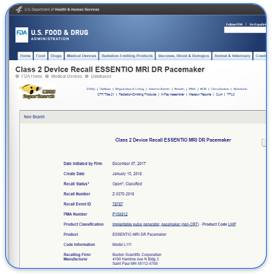
Most RPM hardware, including blood pressure cuffs, pulse oximeters, glucometers, and connected scales, falls into the FDA’s Class II medical device category and is typically cleared through the 510(k) pathway. FDA clearance means the manufacturer demonstrated substantial equivalence to an already marketed device through the 510(k) premarket notification pathway, along with adherence to Quality System Regulations covering design, manufacturing, and post-market surveillance. FDA approval uses a more rigorous process reserved for higher-risk Class III devices.
General wellness wearables occupy a different regulatory category. Under the FDA’s General Wellness Policy for Low Risk Devices, products intended solely for healthy lifestyle promotion, and not for diagnosing, treating, or monitoring a disease, may fall outside medical device regulation entirely. A consumer fitness tracker that estimates heart rate for wellness purposes differs from an FDA-cleared cardiac monitor intended for clinical arrhythmia detection.
CMS requires RPM devices to be FDA-cleared for their intended clinical measurement and capable of automated electronic data transmission. Patient self-reporting via phone or portal, manual entry into a smartphone app, non-FDA-cleared consumer wellness devices, and devices that store data locally without transmission do not qualify for RPM billing. Before deploying any device in a billable RPM program, practices should request the 510(k) clearance letter, the device classification code, and the device’s stated indications for use from the vendor.
RPM program costs trade financial outlay against operational control. Total costs typically fall between $150 and $300 per patient per month and include device hardware, data plans, platform fees, and clinical staffing.
A SaaS platform with the practice’s own staff sits in the middle. Per-patient costs and operational burden both stay moderate. Fully managed services cost the most per patient but offload nearly all day-to-day work. In-house builds require $100,000–$300,000+ in upfront investment and only pay off above roughly 1,000 enrolled patients, because the fixed cost must spread across a large panel.
Medicare covers RPM under the CMS Physician Fee Schedule. The core CPT codes and their billing requirements are:
For cardiac implantable devices, separate code sets apply. Pacemakers and ICDs follow a 90-day billing cycle: 93294 (pacemaker professional), 93295 (ICD professional), and 93296 (pacemaker/ICD technical). Implantable cardiovascular physiologic monitors, such as CardioMEMS, are billed under 93297, while subcutaneous cardiac rhythm monitors and implantable loop recorders are billed under 93298. Both 93297 and 93298 are device-specific codes, not a professional or technical pair, and each is billable once per 30 days and can be billed global, -26, or -TC.
Medicaid RPM coverage is set state by state, and commercial payer coverage for CPT 99454 depends on the plan contract. Practices should verify payer policy before enrolling non-Medicare patients.
Estimate Your RPM Revenue With Rhythm360
RPM programs often stumble on operational issues rather than clinical ones. Each common failure mode has a known fix, but each requires deliberate program design.
Each of these problems has a known operational fix, so none of them is a reason to abandon RPM.
The RPM platform market includes vendors such as Murj, Implicity, Rhythm Management Group, and Octagos. The right choice for a cardiology practice depends on device mix, EHR environment, and billing complexity.
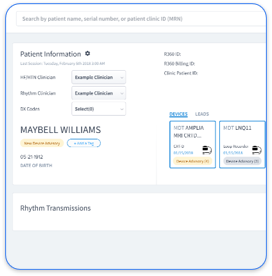
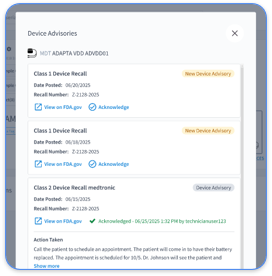
Rhythm360, developed by RhythmScience, is a vendor-neutral, HIPAA-compliant, cloud-based platform that ingests and normalizes data from all major device manufacturers, including Medtronic, Boston Scientific, Abbott, Biotronik, and others, into a single source of truth. This approach eliminates redundant OEM portal logins and manual transcription. At the University of Chicago Medicine, clinicians reviewed more than 73,000 reports annually through Rhythm360 in calendar year 2025, averaging more than 18,000 reports per quarter, and the implementation produced direct improvements in billing accountability, with a physician at UCM noting, “We have improved billing and accountability for our patients after the integration.”
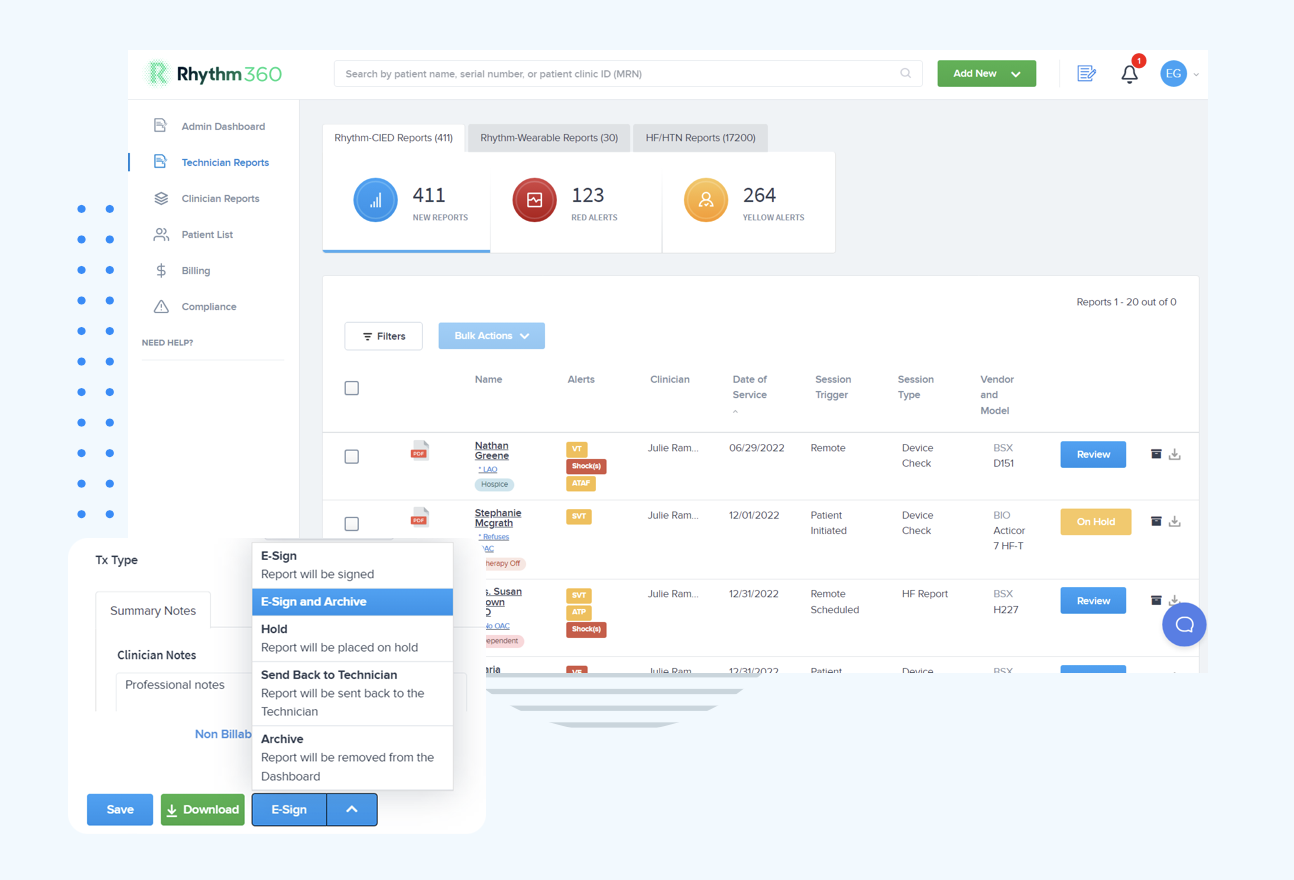
Rhythm360’s capabilities map directly to the operational gaps described above and give practices a concrete way to close them.
Rhythm360 helps practices reduce critical alert response times by up to 80% and increase revenue capture by as much as 300%.
Explore Rhythm360 For Your Device Mix
RPM billing starts with a valid order, and that order must meet several compliance requirements. A valid RPM order must be signed by a physician or qualified healthcare professional with an established patient-provider relationship, meaning at least one prior visit, and must specify the qualifying chronic condition and the type of monitoring ordered.
The ordering clinician must have treated the patient for the condition being monitored. A prior visit for an unrelated issue does not satisfy this requirement. Patient consent must be documented before any RPM service begins, including device supply. Once those conditions are met, billing follows the ordering clinician. Physicians (MD/DO), nurse practitioners, and physician assistants can bill RPM codes, while clinical staff such as medical assistants and RNs can handle device logistics under general supervision but cannot bill in their own right.
Hardware runs roughly $30–$100 for Bluetooth and $80–$200+ for cellular units, and all-in program costs usually land between $150 and $300 per patient per month. For a full breakdown by deployment model, see the cost section above.
Medicare reimburses RPM through CPT codes such as 99453, 99454, and 99457 under the CMS Physician Fee Schedule. Coverage requires FDA-cleared devices with automated electronic transmission and documented patient consent. Medicaid and commercial coverage vary by state and plan, so practices should confirm policy details before enrollment.
The American College of Cardiology’s RPM guidance highlights two frequent concerns from busy cardiologists: managing large data volumes and avoiding missed physiologic events. Alert fatigue and data fragmentation drive both concerns, and unified platforms with AI triage and reliable integrations provide the clearest path to relief.
RPM must be ordered by a physician or qualified healthcare professional, such as a nurse practitioner or physician assistant, who has an established relationship with the patient and has treated them for the monitored condition. The patient must give documented consent before any RPM service begins, and clinical staff can manage logistics under supervision while billing remains tied to the ordering clinician.
The right vendor depends on device mix, EHR environment, and billing complexity. Platforms in this space include Murj, Implicity, Rhythm Management Group, and Octagos, each with different areas of focus. For cardiology practices managing multi-OEM device data, including both implantable cardiac devices and chronic disease RPM, Rhythm360 by RhythmScience provides a vendor-neutral platform that consolidates data from all major manufacturers into a single source of truth, with automated CPT documentation and bi-directional EHR integration tailored to complex cardiac device programs.
Choosing the right remote patient monitoring devices solves only part of the problem. Practices also need those devices to send data into one system that posts cleanly to the chart and produces billing documentation that stands up under audit.
A practice can assemble the right device categories and connectivity models and still face fragmented portals, missed critical alerts, and unbillable months if the integration layer fails. Rhythm360 addresses the full stack with multi-OEM data normalization, AI-powered alert triage, automated CPT documentation across both implantable cardiac device codes and chronic disease RPM codes, and bi-directional EHR integration with the systems cardiology practices already run. The result is a single source of truth for device data and the operational infrastructure to turn that data into clean claims and better patient outcomes.
Talk With Rhythm360 About Your RPM Program