RPM CPT Billing Compliance in 2026: Rules & Audit Checklist
Master RPM billing compliance in 2026 with Rhythm360. Get CPT code rules, documentation standards, and a pre-bill audit checklist to avoid denials.

Key Takeaways
- Remote monitoring CPT billing compliance in 2026 depends on clear thresholds, complete documentation, correct supervision, and clean duplicate-billing controls.
- CMS introduced two new RPM codes (99445 and 99470) effective January 1, 2026, which create billable paths for fewer transmission days and shorter management times.
- CPT 99445 and 99454 are mutually exclusive device-supply codes, and 99470 and 99457 are mutually exclusive management codes, with one code from each pair allowed per patient per period.
- Pre-bill audits must confirm consent timing, transmission day counts, interactive communication records, supervision levels, and no duplicate billing across RPM, RTM, CCM, and TCM.
- Rhythm360 supports vendor-neutral, HIPAA-compliant remote monitoring and automates CPT pairing, documentation, and audit-ready reporting for cardiology and primary care practices.
See How Rhythm360 Automates CPT Pairing
2026 RPM Code Reference Table: Thresholds, Supervision, and Denial Reasons
The table below maps each 2026 RPM code to its threshold, supervision rule, and the denial reason auditors cite most often. Use it as a quick reference: the threshold column shows what must be true before you bill, and the denial column shows what happens when it is not. The thresholds reflect the CY2026 Medicare Physician Fee Schedule Final Rule. National non-facility rates are reference figures, and actual payment varies by locality and payer and must be verified through CMS and the applicable Medicare Administrative Contractor (MAC).
| CPT Code | Threshold & Frequency | Supervision / Documentation Requirement | Common Denial Reason |
|---|---|---|---|
| 99453 — One-time device setup and patient education | Billed once per episode of care; ~$22 national average | General supervision, with documented device assignment, patient education, and consent before services begin | Billed more than once per episode, or consent not documented before billing |
| 99445 — Device supply and data transmission, 2–15 days (new 2026) | 2–15 qualifying transmission days in a 30-day period; ~$47–$52 national average | General supervision, with an automated device transmission log showing each qualifying day and its underlying readings | Billed alongside 99454 for the same period, day count not documented, or non-FDA-cleared device used |
| 99454 — Device supply and data transmission, 16–30 days | 16 or more qualifying transmission days in a 30-day period; ~$52 national average | General supervision, with an automated device transmission log confirming 16 or more days and underlying readings | Fewer than 16 days documented, 99445 and 99454 billed together, or manual data entry used |
| 99470 — Treatment management, 10–19 minutes (new 2026) | 10–19 minutes of management time in a calendar month; ~$26 national average | General supervision, a time ledger with staff attribution, and at least one real-time interactive communication documented | Billed alongside 99457 in the same month, no interactive communication documented, or time below 10 minutes |
| 99457 — Treatment management, first 20 minutes | 20 or more minutes of management time in a calendar month; ~$52 national average | General supervision, a time ledger with staff attribution, and at least one real-time interactive communication documented | Time below 20 minutes, no interactive communication, or 99470 and 99457 both billed in the same month |
| 99458 — Treatment management, each additional 20 minutes | Add-on to 99457 only; each additional 20-minute increment; ~$41 national average | General supervision, with separate time entries for each increment, and 99457 billed in the same month | Billed without 99457, or time not separately documented per increment |
| 99091 — Clinician collection and interpretation of physiologic data | Minimum 30 minutes per 30-day period; physician or QHP must personally perform | Physician or QHP personally performs the service, with no clinical staff time counted, and no concurrent 99457 in the same period | Clinical staff time counted, billed alongside 99457, or time below 30 minutes |
The 99445 vs. 99454 Decision Rule: Device-Supply Selection and Day Counting
CPT 99445 and CPT 99454 are mutually exclusive device-supply codes. Under the CY2026 Medicare Physician Fee Schedule Final Rule, the number of qualifying transmission days in a 30-day period selects the code. Two to fifteen days maps to 99445, and 16 or more days maps to 99454. Billing both for the same patient in the same period triggers automatic denial.
Because the device-supply and management codes are selected independently, each device-supply code interacts with the treatment-management codes differently. A month with 2–15 transmission days bills 99445 for device supply and 99470 or 99457 for management, based on documented time. A month with 16 or more days bills 99454 for device supply and uses the same management code choices. The device-supply threshold controls which supply code you bill, and the management time threshold controls which management code you bill.
That independence creates a further complication, because two different period definitions apply within the same RPM claim. The device-supply condition for 99445 and 99454 uses a 30-day period, while the 10-minute management increment under 99470 uses a calendar month. These different periods require separate data models and separate day-counting logic.
Day counting follows the patient's local timezone, which turns timestamp handling into a compliance risk. A reading transmitted at 11:40 p.m. in the patient's timezone arrives after midnight UTC and would be lost if the day counter uses server time. Multiple readings on a single day still count as one qualifying day, and buffered data must be attributed to the day the reading was taken rather than the day it arrived.
CMS Incident-to-Billing Guidelines for RPM in 2026
Under the 2026 rules, RPM treatment-management services (99457, 99458, and 99470) may be furnished by clinical staff under the general supervision of the billing physician or qualified health professional (QHP). CMS's incident-to framework, last modified April 30, 2026, permits auxiliary personnel such as nurses and technicians to furnish covered services incident to a physician's or NPP's professional services when all requirements are met.
To bill incident-to, the billing practitioner must personally perform an initial service and remain actively involved in the patient's course of treatment. General supervision means the supervising physician or other listed practitioner is responsible for the service but does not need to be physically present while clinical staff perform it. Nurse practitioners, certified nurse-midwives, clinical nurse specialists, and physician assistants may supervise incident-to services and bill under their own NPI. Medicare reimburses those services at 85% of the Physician Fee Schedule rate when billed under an NPP, or at 100% when the supervising physician bills.
CPT 99091 follows a stricter standard. The physician or QHP must personally perform the collection and interpretation of physiologic data, and clinical staff time does not count toward the 30-minute threshold.
One frequently mischaracterized rule affects staffing decisions. CMS's incident-to page does not establish a 2026 requirement that RPM monitoring staff be direct employees of the billing practice. The direct-employee restriction appears as a proposal in the CY2027 Physician Fee Schedule proposed rule, issued July 14, 2026, with an effective date on or after January 1, 2027. Practices should monitor that rulemaking while keeping current 2026 staffing structures in place unless other factors require change.
RPM Billing Guidelines for 2026: Pre-Bill Audit Checklist
Use this checklist on every claim before submission so each bill matches CMS rules and common audit patterns.
- Verify consent timing. Consent must be obtained and documented before or at the time services begin. The consent record must include the patient's agreement to participate, a discussion of cost-sharing responsibility, and the date and time consent was obtained. Post-dated consent appears as services not rendered during audit review.
- Confirm device data transmission days meet the code threshold. Count qualifying days in the patient's local timezone, with multiple readings on one day counting as one day. Bill 99445 for 2–15 days and 99454 for 16 or more days. When fewer than 2 days transmit, no device-supply code is billable.
- Confirm interactive communication time is documented. At least one real-time, two-way conversation per month is required for 99457 or 99470, and portal messages, texts, or asynchronous notes do not satisfy this requirement. The record must show who initiated the communication, whether the other party was the patient or a caregiver, the channel, the start timestamp, and the duration.
- Confirm supervision level is met. General supervision applies to 99457, 99458, and 99470. CPT 99091 requires the physician or QHP to personally perform the service, and clinical staff time does not count.
- Confirm no duplicate billing across RPM, RTM, CCM, and TCM. No single time entry may appear in two programs. RPM and RTM cannot be billed for the same patient in the same calendar month. RPM and CCM may be billed concurrently only when time is tracked separately for each.
- Confirm documentation is audit-ready. An RPM audit pack must include the consent record and its version, the device assignment and serial number, and every qualifying day with its underlying readings. It must also show the day-count band and the code it produced, the time ledger with staff attribution, the interactive communication record with timestamp and counterparty, and the clinical notes generated. Each element answers a specific auditor question, so a missing item functions as a missing service.
Run a Pre-Bill Audit with Rhythm360
Duplicate-Billing and Time-Splitting Rules Across RPM, RTM, CCM, and TCM
RPM vs. RTM: RPM monitors physiologic data such as blood pressure, oxygen saturation, blood glucose, weight, and heart rate, while RTM monitors non-physiologic therapeutic data including musculoskeletal status, respiratory therapy information, medication adherence, and therapy response. CMS prohibits billing RPM and RTM together for the same patient in the same calendar month. Only one clinician may bill either modality per patient per 30-day period.
RPM vs. CCM: The 2026 CMS Physician Fee Schedule Final Rule allows concurrent billing of RPM and CCM for the same patient in the same month when time is tracked separately for each service and no clinical time is counted toward both. RPM management time covers reviewing remote monitoring data and communicating about that data. CCM time covers care coordination activities such as care plan updates, medication reconciliation, and specialist coordination. Separate time logs must support each program.
RPM vs. TCM: RPM may be billed alongside TCM when each service independently meets its requirements, and time counted toward RPM does not also count toward TCM. For TCM, the required two-business-day contact date and the qualifying face-to-face visit date must appear separately from RPM documentation.
The one-practitioner rule: Only one practitioner may bill RPM for a patient in a given 30-day period. Overlapping claims from multiple providers for the same beneficiary appear among the five patterns the OIG flagged for further review in its August 2025 data snapshot.
Documentation Standards for Audit Defense
Consent records must show the patient's agreement to participate, the cost-sharing discussion, and the date and time consent was obtained. At audit, missing documentation is treated the same as services not rendered. Retroactive consent is not permitted.
Interactive communication logs for 99457, 99470, and 99458 must record:
- Who initiated the communication
- Whether the other party was the patient or a caregiver
- The channel used (phone, video, or other real-time modality)
- The start timestamp and duration
- A link to the clinical action the communication produced
Device transmission records for 99445, 99454, and 99091 must include the device serial number and each qualifying day with its underlying readings. Manual logs alone provide weak support for RPM device-transmission requirements, so practices should preserve platform or device logs showing actual transmissions and verify those logs before billing.
Time ledgers for management codes must include entries attributable to a named staff member and a named patient. Each entry needs start and stop times, an activity type, a link to the clinical action taken, an immutable audit trail, and an association with a specific billing period.
Medicare Payment Expectations and Payer Variation
Payment amounts for RPM codes vary by locality, geographic practice cost index, facility status, and payer. The 2026 CMS Physician Fee Schedule national non-facility payment estimates at GPCI 1.0 function as reference figures rather than guaranteed claim payments, and actual Medicare payment depends on locality, MAC, and payer. Practices should confirm current rates through CMS and their MAC before finalizing program economics.
The Noridian MAC's RPM billing guidance provides a named primary source for locality-specific payment and coverage determinations. Few Medicare Administrative Contractors have adopted an RPM-specific local coverage determination, so contractors compare the device transmission log against the billed code. Identical or batch-entered readings frequently cause denials. Medicare Advantage coverage varies by plan, and some plans apply additional restrictions beyond Original Medicare, so practices should verify coverage with the individual plan before enrolling a patient.
How Rhythm360 Supports Remote Monitoring CPT Billing Compliance
Every rule covered so far, including day counting, code pairing, time ledgers, and consent timing, depends on documentation that is complete at the moment of billing. Rhythm360 closes that operational gap. Rhythm360 is a vendor-neutral, HIPAA-compliant, cloud-based remote patient monitoring platform that consolidates data from major cardiac device manufacturers such as Medtronic, Boston Scientific, Abbott, and Biotronik into a single source of truth. For cardiology and primary care practices managing patients with cardiac implantable electronic devices and chronic conditions, this consolidation replaces fragmented OEM portal workflows and reduces documentation gaps.
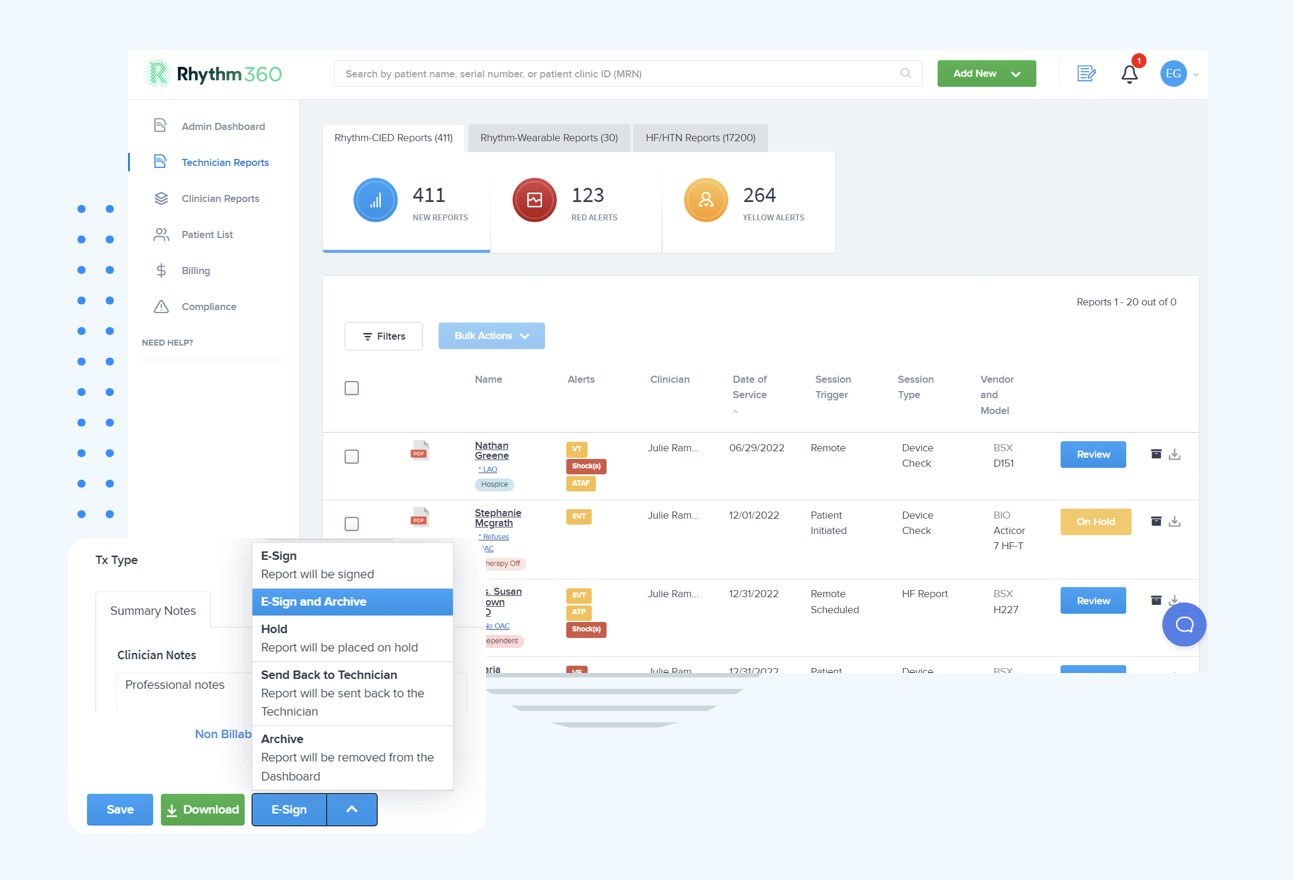
Rhythm360 automatically tracks device-specific CPT pairings. For pacemakers and ICDs, it manages the 90-day cycle with 93294 for pacemaker professional, 93295 for ICD professional, and 93296 for technical. For physiologic monitors and loop recorders, it manages the 30-day cycle with 93297 for implantable cardiovascular physiologic monitors such as CardioMEMS and 93298 for subcutaneous cardiac rhythm monitors and implantable loop recorders. Each of these codes is billable once per 30 days and can be split into professional (–26) and technical (–TC) components. This structure prevents device-type mismatch denials and uncaptured technical components that often create revenue leakage.
For RPM compliance, Rhythm360 automates data ingestion, report generation, and billing documentation. Practices using Rhythm360 have reported up to an 80% reduction in critical alert response times and up to a 300% increase in revenue capture. The administrative dashboard provides a real-time view of patient compliance, qualifying transmission days, management time, and documentation completeness, which mirrors the data points auditors request.
Other platforms in the cardiac remote monitoring space include Murj, Implicity, Rhythm Management Group, and Octagos. Rhythm360 consolidates data across major OEMs, triages alerts with AI, pairs CPT codes automatically, and produces audit-ready documentation. All of this runs in one HIPAA-compliant platform that integrates bidirectionally with Epic, Cerner, Athenahealth, eClinicalWorks, and other major EHR systems.
For practices comparing options, see also Best Remote Monitoring Billing Platform for Cardiology 2026 and Cardiac Remote Monitoring Billing Compliance Software Guide.
Common Pitfalls and Risks
The most costly RPM billing errors usually start with fragmented workflows and unclear ownership of documentation. Teams can reduce risk by addressing these specific failure modes.
- Fragmented OEM portal workflows create gaps in day counts and audit trails when staff log into multiple non-interoperable portals to retrieve transmission data.
- Unclear ownership of billing documentation disappears when a designated staff member verifies the consent record, transmission log, time ledger, and interactive communication log before claim submission.
- Poor day-counting design occurs when systems use server time instead of the patient's local timezone or fail to attribute buffered readings to the correct calendar day.
- Weak interactive communication documentation appears when logs show only a minute total instead of the initiator, channel, timestamp, and clinical action produced.
- Misaligned success metrics arise when teams track enrollment volume without tracking documentation completeness, which can create the enrollment spike pattern the OIG flagged.
- Underestimating change management shows up when practices launch RPM workflows without staff training on code-selection rules, which leads to systematic miscoding between 99445 and 99454 or between 99470 and 99457.
Measurement and Ongoing Performance Review
RPM compliance functions best as an ongoing operational discipline rather than a one-time implementation. Metrics worth tracking fall into four categories.
- Clinical: critical alert response times, patient device compliance rates, and the percentage of enrolled patients meeting the 2-day minimum transmission threshold
- Operational: staff hours per patient per month on data retrieval and documentation, and time from transmission to report generation
- Financial: captured revenue per patient per month by code, denial rates by denial reason code, and the percentage of claims requiring resubmission
- Compliance: documentation completeness rate, including consent on file, transmission log present, time ledger complete, interactive communication logged, and the percentage of claims passing the pre-bill audit checklist before submission
Monthly review of these metrics allows practices to spot documentation gaps before they become denial patterns and to adjust staffing and workflow design before an audit request arrives. For additional guidance on compliance workflows, see Remote Patient Monitoring Billing Requirements 2026 and CPT Code Compliance for Remote Monitoring: 2026 Playbook.
Frequently Asked Questions
What Are the New CPT Codes for Remote Patient Monitoring in 2026?
CMS added two new RPM CPT codes effective January 1, 2026, under the CY2026 Medicare Physician Fee Schedule Final Rule. CPT 99445 covers device supply and automated data transmission when a patient transmits readings on 2 to 15 days within a 30-day period, which closes the prior billing gap for patients who transmitted fewer than the 16 days required by CPT 99454. CPT 99470 covers the first 10 to 19 minutes of monthly RPM treatment management, which creates a paid pathway for clinical oversight that previously fell below the 20-minute floor required by CPT 99457. Both new codes carry the same interactive-communication requirement as the existing management codes, and at least one real-time, two-way conversation with the patient or caregiver per calendar month must be documented. As noted above, 99445 and 99454 cannot be billed together, and 99470 and 99457 follow the same one-code-per-period rule.
How Much Does Medicare Pay for Remote Patient Monitoring?
Medicare payment for RPM codes varies by locality, geographic practice cost index, facility status, and payer, so the figures below function as national non-facility reference amounts only. Practices must verify current rates through CMS and their Medicare Administrative Contractor before finalizing program economics. The Noridian MAC's RPM billing guidance provides a primary source for locality-specific payment information. As a general reference, the 2026 national non-facility averages are approximately $22 for CPT 99453 (one-time setup), approximately $47–$52 for CPT 99445 and CPT 99454 (device supply), approximately $26 for CPT 99470 (first 10 minutes of management), approximately $52 for CPT 99457 (first 20 minutes), and approximately $41 for CPT 99458 (each additional 20 minutes). These figures do not guarantee payment on individual claims and should not serve as the sole basis for revenue projections.
What Are the CMS Incident-to-Billing Guidelines for RPM in 2026?
Under the CY2026 Medicare Physician Fee Schedule Final Rule, RPM treatment-management services may be furnished by clinical staff such as nurses, technicians, and other auxiliary personnel under the general supervision of the billing physician or qualified health professional. General supervision means the supervising practitioner is responsible for the service but does not need to be physically present. Physicians, nurse practitioners, clinical nurse specialists, certified nurse-midwives, and physician assistants may all supervise and bill incident-to RPM services, subject to Medicare enrollment status and state scope-of-practice rules. When an NPP supervises and bills, Medicare reimburses at 85% of the Physician Fee Schedule rate, and when the supervising physician bills, reimbursement is at 100%. CPT 99091 remains an exception, because the physician or QHP must personally perform the service and clinical staff time does not count. The direct-employee restriction that appears in some search results reflects a CY2027 proposed rule rather than a finalized 2026 requirement.
RPM vs. RTM Billing: What Can and Cannot Be Billed Together?
RPM monitors physiologic data such as blood pressure, weight, glucose, oxygen saturation, and heart rate using FDA-cleared devices that transmit data automatically. RTM monitors non-physiologic therapeutic data, including musculoskeletal status, respiratory therapy information, medication adherence, and therapy response, and historically has permitted a broader set of data types. CMS prohibits billing RPM and RTM together for the same patient in the same calendar month, and only one clinician may bill either modality per patient per 30-day period. RPM may be billed concurrently with CCM or TCM when each service independently meets its requirements and time is tracked separately. RTM may similarly be billed concurrently with CCM, PCM, and BHI under the same conditions. Neither RPM nor RTM may share time entries with any other program.
What Are the RPM Duplicate Billing Rules?
Four specific duplicate-billing rules govern RPM claims in 2026. The same four rules covered in the duplicate-billing section apply: one practitioner per 30-day period, one device-supply code per 30-day period, one management code per calendar month, and no shared time entries across programs.