Last updated: August 24, 2026
The administrative cost of portal fragmentation is measurable and persistent. A July 2026 Black Book Research survey of 1,919 clinicians found that 80.7% use at least one workaround every day and 65.2% lose 30 minutes or more per day to avoidable digital work, including monitoring disconnected queues and checking separate portals. Many of those clinicians check payer portals outside the clinical workflow entirely.
Rhythm360 removes this burden through a multi-method data ingestion architecture. The platform connects to all major CIED manufacturers via API, HL7, and XML feeds, and it applies computer vision–based PDF parsing to normalize unstructured reports that lack structured data outputs. A redundant data feed system acts as a fail-safe when an OEM server is unavailable, sustaining the high transmissibility rate mentioned earlier across the patient population.
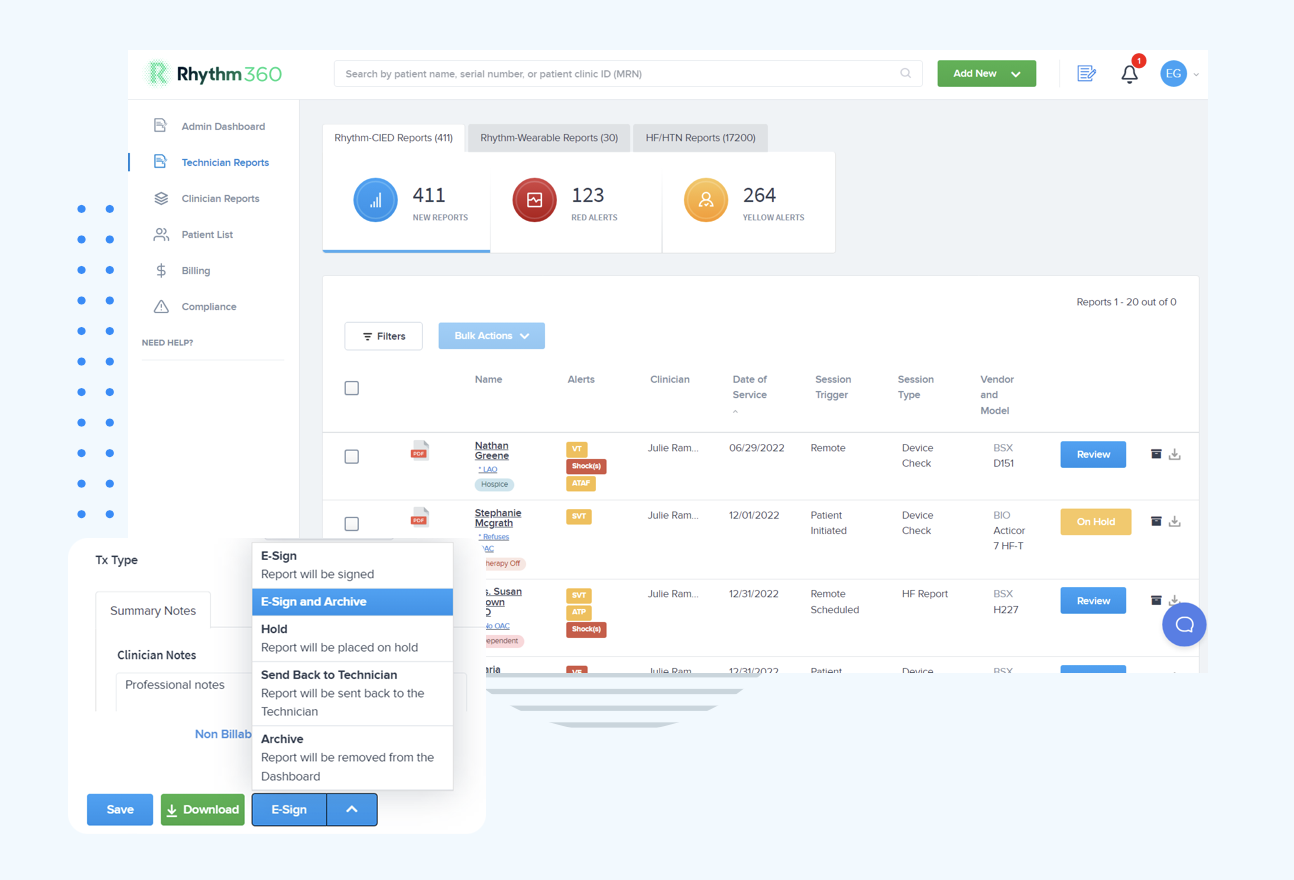
The 2023 international consensus statement on remote device clinics provides guidance on clinic staffing to handle multi-manufacturer portal management alongside clinical duties. Rhythm360’s unified ingestion model reduces that administrative overhead by consolidating all manufacturer feeds into a single source of truth, which removes redundant logins and manual data transcription.
The platform supports pacemakers, ICDs, implantable loop recorders, CRT and CCM devices, and specialized sensors such as CardioMEMS pulmonary artery monitors. Bi-directional EHR integration with Epic, Cerner, Athenahealth, eClinicalWorks, Greenway Health, and other systems via HL7 sends normalized device data directly into the patient record without manual re-entry.
Andrew Beaser, MD, Associate Professor of Medicine at University of Chicago Medicine, described pre-implementation workflows managing multiple OEM portals as “a major challenge and incredibly difficult.” After implementing Rhythm360, UCM reviewed more than 73,000 reports annually through the platform in calendar year 2025, averaging more than 18,000 reports per quarter.
Unified data ingestion solves the portal fragmentation problem but also concentrates a large volume of alerts in one place. That volume makes alert fatigue a patient safety issue, not merely an inconvenience. Legacy systems generate many non-actionable notifications, and clinicians who become desensitized to alert volume are more likely to miss genuinely critical events such as new-onset atrial fibrillation, ventricular tachycardia, or device malfunction.
Kubica et al. (Cardiology Journal 2026) identify AI-driven systems as capable of analyzing physiological trajectories over time, fusing signals from multiple domains, including rhythm, weight, blood pressure, oxygen saturation, fluid status, and medication patterns, and triaging alerts according to clinical context. These systems substantially reduce staff workload by directing human review only to events most likely to benefit from intervention.
Published evidence quantifies the impact of AI-based filtering. A 2026 multicentre observational study of 445 patients with implantable loop recorders across NHS Scotland sites found that AI-based alert adjudication reduced total transmitted alert volume from 4,261 to 2,509, a 29% relative reduction and released an estimated 185 to 218 hours of physiologist review time annually. That gain equals roughly 3.6 to 4.2 hours per week of redeployable staff capacity. A separate analysis of Assert-IQ insertable cardiac monitors found that AI algorithms can reduce AF and pause EGM data burden and cut transmissions containing AF or pause alerts.
Rhythm360’s AI-powered triage layer filters non-actionable notifications and surfaces clinically significant events in priority order, delivering the response-time improvements outlined earlier. For practices that require around-the-clock coverage, Rhythm360 offers an optional 24/7/365 oversight model staffed by certified cardiac technicians (CCTs) supervised by physicians. This model helps ensure that a Saturday-morning arrhythmia flag reaches the right clinician before it becomes a Saturday-afternoon stroke.
Andrew Beaser, MD, at UCM noted: “Decision support, including AI-assisted decision support, will become increasingly important as data volumes grow.”
Revenue leakage from uncaptured RPM billing codes is widespread and largely preventable. The September 2024 OIG report OEI-02-23-00260 found that about 43% of Medicare RPM enrollees did not receive all three required components of the service. Only 4,639 of the 10,388 medical practices that billed at least one RPM service in 2024 were billing routinely, which shows that adoption and consistent revenue capture remain disconnected for most practices.
The specific billing gaps are well-documented:
CMS notes that many patients do not receive education or help with device setup when RPM services are provided and billed, and automated onboarding workflows directly address that gap.
Rhythm360 automates CPT code documentation and time tracking across the full billing cycle. The platform’s administrative dashboard provides a real-time view of captured and potential revenue based on CPT code requirements. It ensures that 99453 enrollment triggers fire at the correct moment, that 99454 transmission-day counts are tracked continuously, and that 99457 and 99458 time logs are documented with the audit trail required for compliant claims. Practices implementing Rhythm360 have achieved the revenue increases outlined earlier through improved CPT code capture, better staff efficiency, and the addition of new RPM service lines. Gaurav A. Upadhyay, MD, FACC, FHRS, Professor of Medicine and Director of the Pacing and Defibrillation Device Clinic at UCM, stated: “We have improved billing and accountability for our patients after the integration.”
The table below summarizes Rhythm360’s performance across the five evaluation criteria identified in the Executive Overview. All figures come from platform specifications and published outcomes data cited throughout this article.
| Evaluation Criterion | Rhythm360 Capability | Documented Outcome |
|---|---|---|
| Multi-OEM Interoperability | API, HL7, XML, and computer-vision PDF ingestion from all major CIED manufacturers, with redundant data feeds | >99.9% transmissibility, single-dashboard view removes multiple daily logins |
| AI Alert Triage | AI-powered filtering of non-actionable notifications, optional 24/7 CCT oversight | Up to 80% reduction in critical-alert response time |
| Billing Automation | Automated CPT documentation and time tracking for 99453, 99454, 99457, 99458, 93298, and related codes | Up to 300% revenue increase through improved CPT capture |
| Mobile Access | HIPAA-compliant mobile app for transmission review, report signing, and care coordination | Clinicians review and sign reports from any location, including during meetings |
| Implementation Speed | EHR integration (Epic, Cerner, Athenahealth, eClinicalWorks, Greenway Health, HL7) with staff training and compliance documentation | Onboarding completed in days to weeks |
The single-dashboard workflow consolidates all manufacturer feeds at ingestion, applies AI filtering before alerts reach the clinical inbox, and generates automated reports with billing documentation attached. This structure removes the three manual steps where revenue and response time are most commonly lost.
Rhythm360 operates two integrated but distinct service lines within the same platform. The Rhythm-CIED service line covers pacemakers, ICDs, implantable loop recorders, CRT and CCM devices, and CardioMEMS pulmonary artery monitors. The HF/HTN service line supports remote physiological monitoring for heart failure and hypertension patients, with turnkey patient onboarding checklists and automated billing support for CPT codes 99453, 99454, and 99457.
A 2026 cross-sectional survey of 28 French cardiology departments and community practices using RPM for chronic heart failure found that 96.4% reported a reduction in time between cardiac decompensation and initiation of medical care. Integrated monitoring across both implantable devices and chronic conditions enables the kind of early intervention that drives those outcomes.
The optional 24/7 CCT oversight model applies to both service lines. Critical alerts from either a device transmission or a physiological reading breach, such as significant weight gain in a heart failure patient, reach a qualified reviewer at any hour.
Practices evaluating Rhythm360 should confirm readiness across four areas before onboarding begins.
The full onboarding process, including EHR integration setup, staff training, and compliance documentation, typically completes in a few days to a few weeks. The SaaS-based pricing model scales with clinic size and platform usage, which avoids the high setup fees associated with legacy on-premise systems.
The financial case for unified RPM varies by practice size, but the underlying drivers remain consistent. Practices benefit from reduced staff hours on portal management, elimination of missed CPT claims, and new HF/HTN RPM service lines that generate recurring monthly revenue.
For a smaller practice managing 100 to 200 CIED patients, staff time recovery is the primary ROI driver. With the significant daily time loss documented in the Black Book Research survey, a two-person device team recaptures meaningful clinical capacity within the first billing cycle.
For a mid-size practice managing 300 to 600 patients, the CPT capture gap becomes the dominant opportunity. The billing-component gap identified in the OIG report translates directly to unclaimed monthly revenue at scale. Rhythm360’s automated time tracking and transmission-day counting close that gap systematically.
For a large practice or integrated health system managing 600 to 1,000 or more patients, scalability is the critical factor. UCM sustained the high report volume mentioned earlier with stable dismissal rates, which shows that the platform maintains performance at high volume without proportional increases in staffing. Andrew Beaser, MD, noted: “We are able to address these issues earlier; rather than waiting for a 3-month visit, we can call patients in for evaluation.”
Across practice sizes, Rhythm360 clients have documented up to an 80% reduction in critical-alert response times and the revenue improvements described earlier through improved CPT code capture and new service line activation.
Rhythm360 is a fully HIPAA-compliant, cloud-based platform. All data transmission and storage meet HIPAA Security Rule requirements, and RhythmScience executes a Business Associate Agreement with each client practice. The platform’s mobile application is also HIPAA-compliant, so clinicians can review transmissions, sign reports, and coordinate care from their smartphones without exposing protected health information outside the secure environment. All communications, including phone call logs facilitated through the integrated messaging framework, are tracked with a full audit trail within the patient record.
The full onboarding process, which includes EHR integration with systems such as Epic, Cerner, Athenahealth, eClinicalWorks, and Greenway Health via HL7, staff training for clinical and administrative users, and compliance documentation, typically completes in a few days to a few weeks. The timeline depends on the complexity of the practice’s existing EHR environment and the number of OEM manufacturer feeds being connected. RhythmScience’s implementation team manages the integration process to minimize disruption to existing clinical workflows.
Rhythm360 supports automated documentation and time tracking for the full range of cardiac remote monitoring CPT codes, including 99453 for one-time device setup and patient education, 99454 for monthly device supply with data transmission, 99457 for the first 20 minutes of monthly treatment management, 99458 for additional 20-minute increments, 93298, 93299, and related codes. The platform tracks transmission-day counts continuously to ensure 99454 eligibility thresholds are met, triggers 99453 billing at the correct enrollment moment, and logs interactive clinical time for 99457 and 99458 with the documentation required for compliant claims. Practices using Rhythm360 have achieved the revenue gains described earlier through these automated capture mechanisms.
Rhythm360 includes a secure, HIPAA-compliant mobile application that allows electrophysiologists, cardiologists, nurse practitioners, physician assistants, and device technicians to review transmissions, sign reports, and coordinate care from any location. This access is particularly valuable for on-call coverage. A clinician can receive a prioritized alert for new-onset atrial fibrillation on a weekend, review the transmission on a phone, and initiate anticoagulation protocols before the patient’s next scheduled visit. Andrew Beaser, MD, at University of Chicago Medicine noted that mobile access made him more likely to sign off on reports during meetings because of how easily he could access them on his phone.
Rhythm360 operates two integrated service lines within a single platform. The Rhythm-CIED service line covers all major implantable cardiac devices, including pacemakers, ICDs, implantable loop recorders, CRT and CCM devices, and CardioMEMS pulmonary artery monitors. The HF/HTN service line supports remote physiological monitoring for heart failure and hypertension patients, complete with patient onboarding checklists and automated billing support for RPM CPT codes. Both service lines share the same AI-powered alert triage system, the same administrative dashboard, and the same EHR integration layer, which allows practices to manage rhythm disorders and chronic cardiometabolic conditions from a single workspace.
Multi-OEM fragmentation in 2026 is a measurable source of administrative burden, missed critical events, and lost CPT revenue for cardiology practices of every size. Separate OEM portals create data silos that cost staff hours daily, generate alert fatigue that increases clinical risk, and produce billing gaps that OIG audits are actively identifying.
Rhythm360 addresses all three problems through a single, vendor-neutral, AI-powered platform. It delivers unified data ingestion with greater than 99.9% transmissibility, AI-driven alert triage that provides the critical-alert response-time reductions described earlier, and automated CPT documentation that delivers the revenue improvements outlined throughout this guide. Combined CIED and HF/HTN service lines, bi-directional EHR integration, HIPAA-compliant mobile access, and an onboarding timeline measured in days to weeks make Rhythm360 a practical replacement for fragmented portal workflows at practices managing 100 to 1,000 or more patients.