Last updated: September 18, 2026
Talk With Rhythm360 About Remote Monitoring
This list of warning signs comes from guidance by Olivia Gilbert, MD, MSc, advanced heart failure and transplant cardiologist at Atrium Health Wake Forest Baptist and aligns with the 2026 AHA/ACC/ESC/WHF Second Universal Definition of Heart Failure:
Your daily check-in sets the baseline that keeps you in the green zone. Every morning, weigh yourself after using the bathroom and before eating, on the same scale, and write the number down. That number anchors the rest of your check: compare your legs, ankles, feet, and belly for new swelling, note how many pillows you used, and listen for new cough or wheezing. This is the green zone when weight stays within 2 lb of your established dry weight and you have no resting shortness of breath. The Heart Failure Society of America defines this stable range as the baseline from which all escalation decisions are measured. Adhering to daily weighing strongly predicts whether a fluid-monitoring program catches changes early enough to treat at home.
Early changes often feel quiet and easy to dismiss. Unusual fatigue, loss of appetite, feeling full after only a few bites, mild nausea, or new confusion are often noticed by a caregiver before the patient reports them. A 2026 scoping review in Health Expectations found that patients with chronic heart failure compare current sensations with past illness experiences to sort familiar symptoms from new ones, and that family members help confirm those impressions.
If you are the caregiver, write down what feels new or different and when it started. Call the care team if you feel unsure, because uncertainty itself is a valid reason to reach out.
Gaining 2–3 pounds in a day or 5 pounds in a week is a sign of worsening heart failure and should be reported to your care team the same day. Dr. Olivia Gilbert, advanced heart failure cardiologist at Atrium Health Wake Forest Baptist, states this threshold directly: "If you gain more than two pounds in a day or more than five pounds in a week… it's time to call your doctor. Don't wait for your next appointment." This weight gain reflects fluid accumulation. A 5-pound weight gain corresponds to roughly 2.3 liters of fluid, based on the approximation that 1 liter of fluid weighs about 2.2 pounds.
Also call your care team today if you need extra pillows to sleep, feel more short of breath than usual with everyday activity, notice new or worsening swelling, or feel more fatigued than your baseline. Most cardiology practices have someone on call around the clock, so call even at night or on weekends.
Your goal at this level is to give your care team clear facts they can act on quickly. When you call, have these three data points ready:
State your current weight, the change from your baseline, and the new or worsening symptom. Tomorrow morning, weigh yourself again at the same time and write down the number. This structured fact pattern gives your clinician what is needed to decide whether a medication change can be made by phone or whether you should be seen in person. Catching warning signs early often allows the care team to correct the problem with a phone call and medication adjustment instead of an ambulance and hospital admission.
Head to the emergency room when symptoms move beyond what a same-day phone call can safely manage. Go to the ER if you have new or worsening shortness of breath that does not improve with rest, chest discomfort that comes and goes, or swelling that has spread to your abdomen. MSD Manuals, reviewed October 2025 by Nowell M. Fine, MD, SM, identifies heart failure unresponsive to outpatient treatment as a clear trigger for immediate inpatient care. Do not wait to see whether symptoms resolve on their own. Do not drive yourself if you feel severely short of breath.
Emergency symptoms require a 911 call without delay. Call 911 for any of the following:
Cleveland Heart's patient guide labels these findings as "Call 911 immediately," because they suggest heart failure has progressed to a stage where minutes matter. Do not drive yourself. Do not wait.
In advanced (Stage D) heart failure, symptoms occur at rest and may no longer respond to standard medications. Anuradha Godishala, MD, cardiologist at URochester Medicine, notes that early referral to an advanced heart failure program can help patients stay independent for longer, while waiting too long can limit treatment options. For a full discussion of advanced disease management, see our Advanced Heart Failure Management guide.
Explore Advanced Monitoring With Rhythm360
Breathing changes often move a patient up the escalation ladder, so they deserve close attention. Breathing problems are also among the most common reasons heart failure patients go to the emergency department. A 2026 review in Heart Failure Reviews by Garus et al. identifies dyspnea as the leading cause of presentation to hospital emergency departments in acute heart failure. Three patterns are clinically distinct.
Orthopnea is shortness of breath that appears or worsens when lying flat. Garus et al. define it as worsening dyspnea in the supine position caused by increased venous return and left ventricular overload, which improves when the patient sits upright. Patients often sleep with multiple pillows. A jump from one or two pillows to three or four, or sleeping upright in a recliner, is a meaningful trend to report.
Paroxysmal nocturnal dyspnea (PND) means waking up gasping for air, typically 1–3 hours after falling asleep. Garus et al. describe it as sudden episodes of severe breathlessness at night caused by fluid redistribution, requiring the patient to sit or stand to relieve symptoms. PND does not improve just by adding pillows and may take 15–30 minutes of sitting or standing to resolve. This pattern distinguishes it from orthopnea, which occurs immediately upon lying flat.
Exertional dyspnea is shortness of breath during activities that were recently easy. When it progresses to breathlessness at rest, escalation on the ladder is required.
If you are the caregiver, note how many pillows your loved one now uses compared with their usual number, and whether they have woken gasping. Both details are useful data points for the care team.
Swelling from fluid retention is one of the most visible signs of congestive heart failure getting worse. Look for shoes or socks feeling tight, new pitting edema where an indentation remains after you press a finger into the shin for five seconds, swelling that no longer goes down overnight, and abdominal bloating or tenderness. Cleveland Heart notes that people in acute heart failure may carry 10–15 extra pounds of fluid, which places additional strain on an already struggling heart.
Swelling signals fluid retention and reflects how hard the heart is working. It does not map to a single NYHA functional class. Swollen feet and ankles typically indicate Stage C heart failure or beyond, because visible fluid retention usually appears after the heart has developed structural abnormalities and cannot pump efficiently. Clinicians determine staging based on symptoms, structural findings, and functional limits. For a full explanation, see our NYHA Heart Failure Classification guide.
Sudden weight gain and increased swelling are two of the most common early signs of worsening heart failure. Weight gain from fluid retention often appears a day or more before the breathlessness that drives an emergency visit, which explains the emphasis on daily weighing.
The pattern of change over several days tells the clearest story. Watch weight, swelling, breathing, and energy together. Heart failure usually drifts over a few days as fluid accumulates, rather than collapsing all at once, so early reporting lets the care team act while problems remain manageable. The same early correction described above can keep a manageable change from turning into a hospital admission.
Report changes early rather than waiting for a crisis. When congestive heart failure is getting worse, a cluster of changes such as weight up, swelling worse, breathing harder, and energy lower matters more than any single symptom alone. For a structured approach to home monitoring, see our Heart Failure Remote Monitoring: 10-Step Roadmap.
Continuous remote monitoring gives care teams the data they need to act before a yellow-zone situation becomes a red-zone emergency. Andrew Beaser, MD, at the University of Chicago Medicine, explained: "We are able to address these issues earlier; rather than waiting for a 3-month visit, we can call patients in for evaluation."
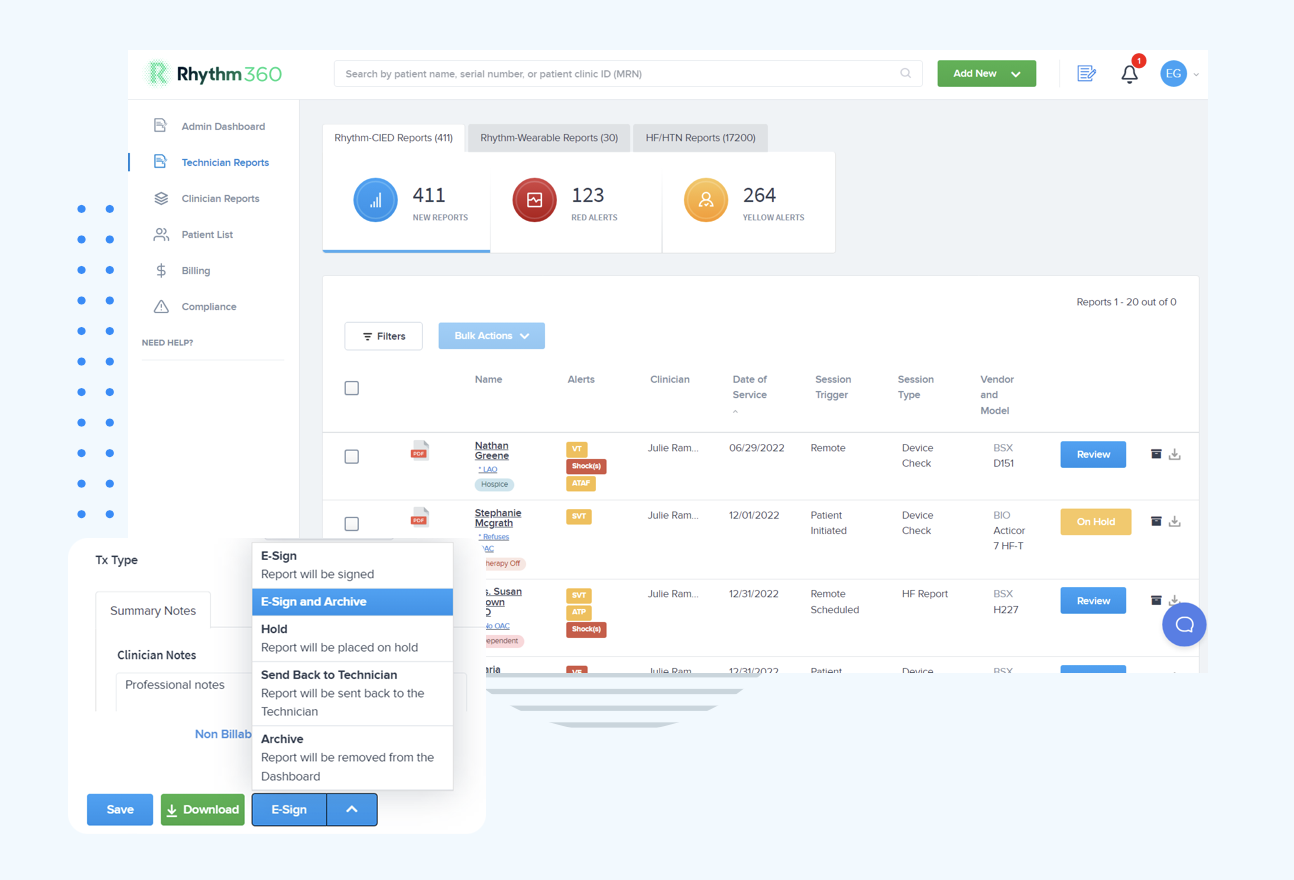
Rhythm360 by RhythmScience is a vendor-neutral, HIPAA-compliant platform. It consolidates data from all major cardiac device manufacturers, including Medtronic, Boston Scientific, Abbott, and Biotronik, alongside remote physiologic monitoring, all in a single AI-powered dashboard. The platform provides automated CPT code capture and documentation, helping practices recover previously lost revenue and improve billing outcomes. Practices using Rhythm360 have reported up to an 80% reduction in critical alert response times and up to a 300% increase in revenue capture and profitability. Other platforms in this space include Murj, Implicity, Rhythm Management Group, and Octagos. As Beaser also noted, "Decision support, including AI-assisted decision support, will become increasingly important as data volumes grow." Rhythm360 is built for that high-volume environment.
See How Rhythm360 Catches Warning Signs Earlier
A gain of 2–3 pounds in a single day or 5 pounds in a week is the threshold that should prompt a same-day call to your care team. This threshold reflects fluid accumulation and aligns with patient-education frameworks from the Heart Failure Society of America and guidance from cardiologists at major academic medical centers. Your clinician may set a personalized threshold based on your specific condition.
Acute decompensated heart failure can develop rapidly, with severe shortness of breath, rapid swelling, and reduced oxygen levels appearing over hours. More often, fluid builds gradually over several days before symptoms become obvious. Daily weight monitoring often shows the change before you feel it.
The earliest signs are often subtle. Unusual fatigue, mild loss of appetite, needing an extra pillow to sleep, or a small weight gain that might seem like a heavy meal can all be early clues. These quiet changes, especially when they occur together, are the body's early signal that fluid is accumulating and the care team should be contacted.
Call 911 immediately if the person you are caring for has chest pain lasting more than 15 minutes, severe shortness of breath at rest or inability to speak in full sentences, fainting, a racing or irregular heartbeat that will not stop, new confusion or difficulty waking, blue or gray lips or fingertips, or is coughing up pink or frothy mucus. Do not drive them to the hospital yourself, because paramedics can begin treatment the moment they arrive.
Have three pieces of information ready: today's weight and your usual baseline (dry) weight, the amount and duration of the weight change, and a description of the new or worsening symptom and when it started. This structured fact pattern allows your care team to make a faster, more accurate decision about next steps.
Recognizing the signs of worsening heart failure and matching each sign to a specific action turns uncertainty into a clear plan. Weigh yourself every morning, report changes early, and use the escalation ladder to decide whether to monitor, call, go to the ER, or call 911. Continuous remote monitoring helps care teams catch these changes earlier, before a yellow-zone problem becomes a red-zone emergency. Rhythm360 gives cardiology practices the vendor-neutral, AI-powered infrastructure to support that level of proactive care at scale.
Get Started With Rhythm360 Remote Monitoring