Last updated: August 24, 2026
Start by mapping every device type in your patient population to its corresponding FHIR resource. The HL7 Point-of-Care Device Implementation Guide maps IEEE 11073 DIM object classes (MDS, VMD, Channel, Numeric, Enumeration, and SampleArray) to FHIR Device, DeviceMetric, and Observation resources. This creates a cross-manufacturer normalization layer before any data reaches the EHR. Rhythm360's EHR integration typically completes in 4-8 weeks.
Contact Rhythm360 to review your device population and integration architecture.
Medtronic's Carelink network transmits via proprietary XML and API formats. Rhythm360 ingests these feeds directly, then normalizes device identifiers against the HL7 POCD IG's UDI mapping, including Device.udiCarrier.deviceIdentifier and Device.serialNumber fields. The platform then pushes structured Observation resources into Epic, Cerner, or Athenahealth using HL7 v2 ORU messages or FHIR Backend Services APIs. Bidirectional sync ensures that clinician sign-offs in the EHR flow back into Rhythm360's audit trail without manual re-entry.
Abbott's Merlin.net portal uses a distinct data schema for its Confirm Rx ICM and Gallant ICD lines. Rhythm360 applies computer-vision OCR to parse unstructured PDF reports when direct API access is unavailable. Each transmission is then mapped to the correct FHIR Observation profile. A redundant data feed architecture acts as a fail-safe when any OEM server experiences downtime, sustaining the platform's more than 99.9% transmissibility rate. University of Chicago Medicine processed more than 73,000 CIED reports annually through Rhythm360, averaging more than 18,000 reports per quarter, which validates the platform's data reliability at scale.
Boston Scientific's Latitude and Biotronik's Home Monitoring each expose transmission data through separate authenticated portals. Rhythm360 ingests both via API and HL7 pipelines, then normalizes device metadata using the same IEEE 11073-10207 SDC-to-FHIR mapping framework applied in Steps 2 and 3. For practices on Athenahealth, Rhythm360 routes structured results through HL7 v2 interfaces, with Tier 2 cloud-native API webhooks as a fallback. This multi-OEM remote monitoring platform approach eliminates the daily manual logins that a typical 800-patient practice with three or four device brands would otherwise require.
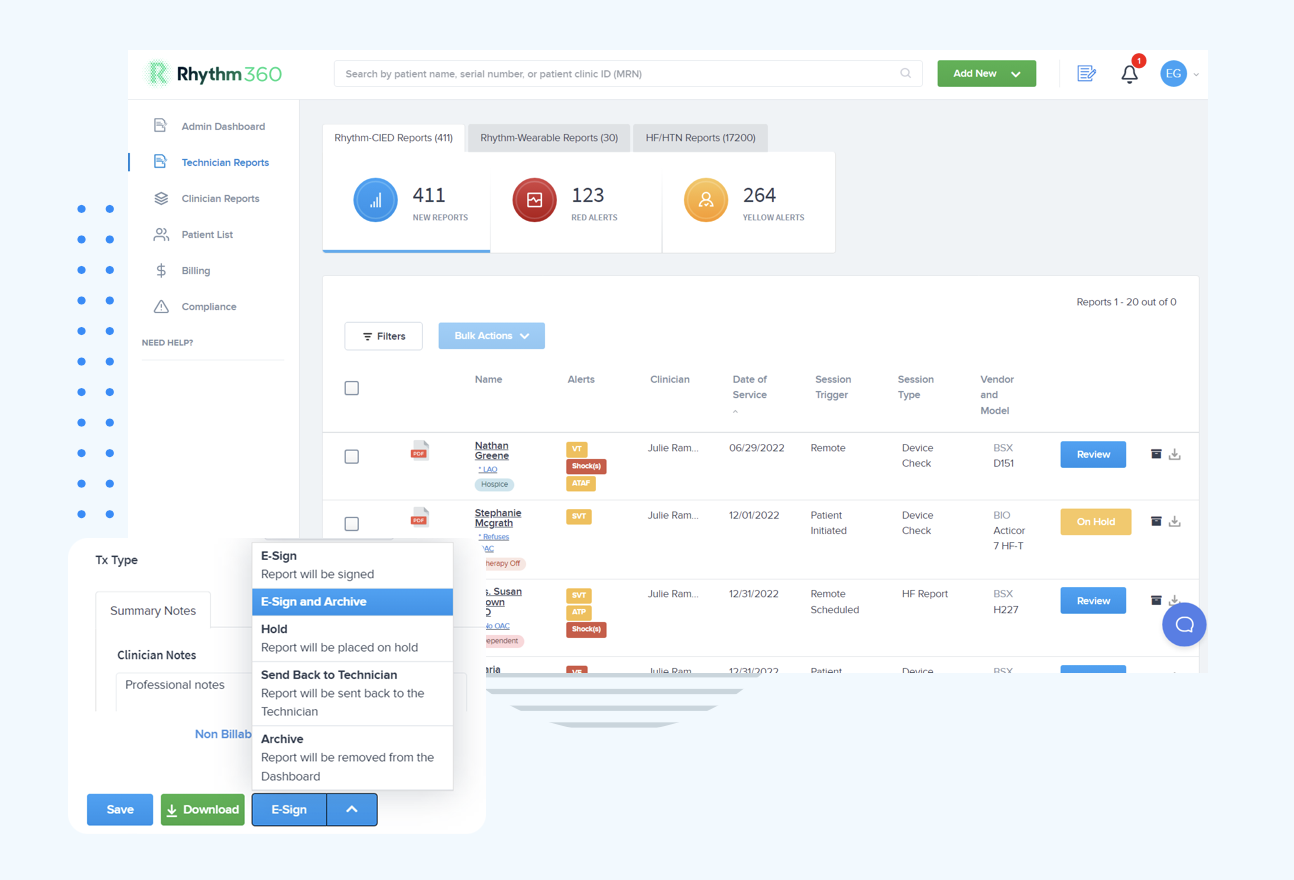
With all four OEM feeds flowing into a single platform, the next challenge becomes managing the volume of alerts those feeds generate. Alert fatigue is a documented clinical risk. A 2026 cross-manufacturer analysis of 2,659 rhythm episodes from 1,710 patients with ICMs from Medtronic, Biotronik, Abbott, and Boston Scientific found that even AI-equipped devices produced 32.9% non-actionable episodes. Rhythm360's AI triage layer filters non-actionable transmissions before they reach clinical staff and prioritizes events such as new-onset AFib, ventricular tachycardia, lead malfunction, and ERI/RRT indicators. Optional 24/7/365 oversight by certified cardiac technicians (CCTs) supervised by physicians provides a human safety net for edge cases. Together, these capabilities reduce critical alert response times by up to 80%. As noted at University of Chicago Medicine, "Decision support, including AI-assisted decision support, will become increasingly important as data volumes grow."
See Rhythm360's AI triage workflow in action by requesting a personalized demo.
Incomplete CPT documentation is the primary driver of remote monitoring revenue leakage. The 2026 CPT landscape introduced new code 99445 for 2–15 days of RPM device supply, while CPT 99454 continues to require 16–30 days of data transmission per 30-day period. In parallel, the 2026 Medicare updates reduced minimum monitoring thresholds for certain RPM and RTM codes but left CPT 93298 unchanged. Rhythm360 automatically tracks transmission-day counts and management minutes per patient per billing interval. The platform then selects the correct code from the 93294–93298 and 99453–99458 families and generates billing-ready documentation that pushes directly into the EHR. Practices using this automated approach have reported up to 300% more captured revenue. "We have improved billing and accountability for our patients after the integration," noted a clinical leader at University of Chicago Medicine following Rhythm360 implementation.
Critical events occur outside business hours, so mobile access keeps coverage continuous. Rhythm360's HIPAA-compliant mobile application allows clinicians to review transmissions, sign reports, and coordinate care from any location. A nurse receiving a prioritized AFib notification on a Saturday morning can initiate anticoagulation protocols before the afternoon, which helps prevent potential strokes and hospitalizations. The mobile layer also supports the HRS/EHRA/APHRS/LAHRS consensus recommendation of responding to red alerts within one business day and extends that responsiveness across weekends and on-call periods.
Explore how mobile workflows support your on-call teams.
| Capability | How Rhythm360 Delivers It | Measured Outcome |
|---|---|---|
| Multi-OEM data ingestion | API, HL7, XML, and computer-vision OCR for PDF parsing across Medtronic, Abbott, Boston Scientific, and Biotronik | More than 73,000 reports processed annually at a single academic medical center |
| Data transmissibility | Redundant data feeds and AI-powered extrapolation as fail-safes against OEM server downtime | More than 99.9% transmissibility rate |
| AI alert triage | Filters non-actionable transmissions and offers optional 24/7 CCT oversight for critical events | Up to 80% reduction in critical alert response times |
| Automated CPT documentation | Tracks transmission days and management minutes, auto-selects correct code from 93294–93298 and 99453–99458 families, and pushes billing-ready notes to the EHR | Up to 300% increase in captured remote monitoring revenue |
| EHR integration | Bidirectional HL7/FHIR sync with Epic, Cerner, Athenahealth, eClinicalWorks, and others | Onboarding typically completes in 4-8 weeks |
| Mobile access | HIPAA-compliant app for transmission review, report signing, and care coordination | 24/7 clinical coverage including weekends and on-call periods |
Non-actionable alerts create a structural burden in multi-vendor remote monitoring environments. A 2026 cross-manufacturer analysis of 2,659 rhythm episodes found that 32.9% were non-actionable for AI-equipped ICMs. The cross-manufacturer analysis cited earlier shows that even AI-equipped devices from all four major manufacturers generate meaningful false-positive burdens. A 2026 review published in Frontiers in Digital Health recommends post-deployment monitoring of alert rates, threshold stability, and subgroup behavior as part of structured AI governance for cardiovascular monitoring programs.
Rhythm360 addresses this problem through a layered approach:
Other platforms in the cardiac device management space have developed their own approaches to alert filtering. Rhythm360 combines AI triage, redundant data architecture, and optional human oversight into a single vendor-neutral workflow that covers all four major OEMs simultaneously.
Correct CPT selection depends on device type, service component, and monitoring interval. The 2026 fee schedule introduced meaningful changes that affect practices managing patients across multiple device brands.
For implantable cardiac devices, the primary billing codes are:
For remote physiological monitoring of chronic conditions such as heart failure and hypertension, the 2026 code set includes:
CPT parentheticals block reporting of general home monitoring codes 99453 and 99454 alongside more specific cardiac monitoring codes such as 93296, 93297, and 93298 in the same period. Practices therefore must track each patient's active monitoring modality to avoid claim denials. Rhythm360 enforces these mutual exclusions automatically and selects the correct code family based on device type and logged transmission data.
Operating across separate Medtronic, Abbott, Boston Scientific, and Biotronik portals increases administrative cost, clinical risk, and billing leakage every day. The 7-step blueprint above reflects the architecture Rhythm360 already deploys for cardiology practices and health systems, with rapid onboarding and EHR sync that covers Epic, Cerner, Athenahealth, and more via HL7 and FHIR.
The outcomes are documented: up to 80% faster response to critical alerts, more than 99.9% data transmissibility through redundant feeds and AI-powered extrapolation, and up to 300% more captured remote monitoring revenue through automated CPT documentation. As noted earlier, the University of Chicago Medicine implementation resulted in clinicians identifying more abnormalities and improving billing accountability.
Rhythm360's onboarding process, including EHR integration setup, typically completes in 4-8 weeks for most practices. The timeline depends on the number of OEM feeds being connected, the EHR system in use, and the complexity of existing workflows. Rhythm360 supports Epic, Cerner, Athenahealth, eClinicalWorks, Greenway Health, and others via HL7 and FHIR. The platform's pre-built connectors significantly reduce the configuration work compared with custom point-to-point integrations.
Vendor-neutral in this context means Rhythm360 ingests and normalizes data from all major cardiac device manufacturers, including Medtronic, Abbott, Boston Scientific, Biotronik, and others, without requiring a practice to standardize on a single OEM's hardware or portal. The platform uses a combination of direct APIs, HL7 messaging, XML parsing, and computer-vision OCR to capture data from each manufacturer's transmission format and map it to a unified FHIR-compatible data model. A practice can therefore implant devices from any combination of manufacturers and still manage every patient from a single dashboard, with no manual portal switching.
Rhythm360 automatically tracks the variables that determine CPT eligibility, including transmission days per monitoring period, management minutes per calendar month, device type, and monitoring interval. For CPT 93298, the platform logs each ILR or ICM transmission and flags when the monitoring window meets billing thresholds, then generates a billing-ready clinical interpretation note that pushes directly into the EHR. For CPT 99454, the system counts transmission days against the 16–30 day requirement for the full-period code and routes shorter windows to the appropriate 2026 code. Mutual exclusions, such as the prohibition on billing 99454 alongside 93296 or 93298 in the same period, are enforced automatically to prevent claim denials.
Alert fatigue in multi-vendor environments stems from transmission volume, the proportion of non-actionable episodes, and the lack of clinical context at the point of notification. Rhythm360 addresses all three factors. Its AI triage layer classifies each incoming transmission by device type and clinical urgency, filtering non-actionable events before they reach clinical staff. Configurable alert thresholds allow practices to tune sensitivity to their patient population. For ambiguous or high-stakes episodes, optional 24/7 oversight by certified cardiac technicians (CCTs) supervised by physicians provides a human review layer before escalation. Together, these capabilities deliver up to an 80% reduction in critical alert response times and give clinicians prioritized, contextualized notifications instead of undifferentiated alert queues.
Yes. Rhythm360 offers distinct but integrated service lines for Rhythm-CIED (implantable devices including pacemakers, ICDs, CRT devices, and implantable loop recorders) and for heart failure and hypertension remote physiological monitoring. Both service lines operate within the same dashboard, share the same patient record, and feed into the same automated CPT documentation workflow. A practice managing a patient with both a CIED and a heart failure diagnosis can monitor device transmissions, track daily weight and blood pressure readings, and generate compliant billing documentation for both service lines from a single workspace without switching platforms or reconciling data across separate systems.