

Last updated: August 24, 2026
The first step is an honest audit of every data source your team currently manages. A typical mid-volume device clinic touches Medtronic CareLink, Abbott Merlin.net, Boston Scientific Latitude, and Biotronik Home Monitoring as separate portals, each with its own login, alert queue, and report format. The single biggest roadblock to efficient cardiac monitoring management is the absence of a unified system that encompasses all device vendors and device types, which forces staff into time-consuming portal-hopping that pulls focus from complex cases and direct patient interaction.
Andrew Beaser, MD, Associate Professor of Medicine at the University of Chicago Medicine, described pre-unification workflows as “a major challenge and incredibly difficult.” Gaurav A. Upadhyay, MD, FACC, FHRS, Professor of Medicine and Director of the Pacing and Defibrillation Device Clinic at UCM, noted that “staffing was always an issue for our center, because our device clinic had struggled with technician turnover and timely weekend coverage.”
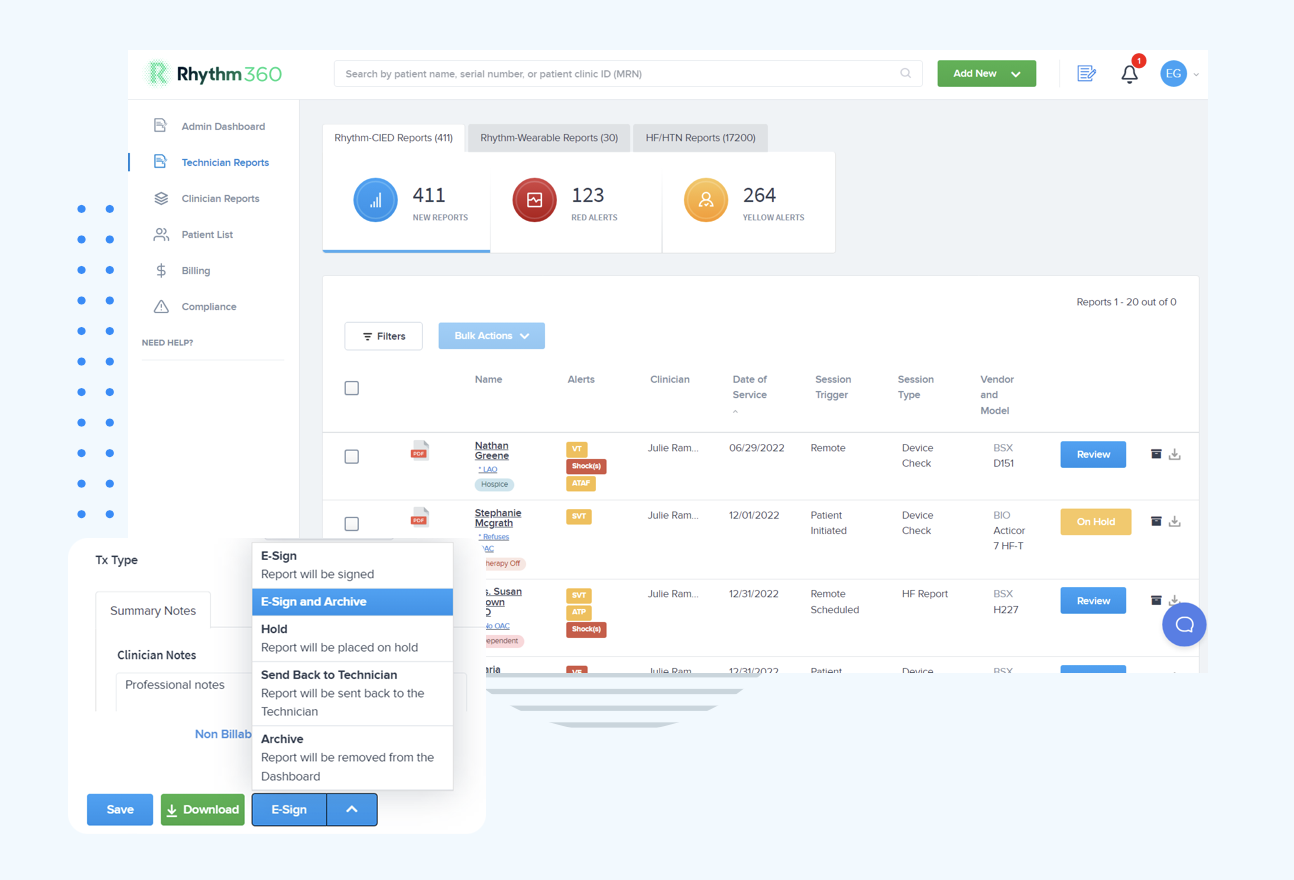
These staffing challenges intensify when each vendor portal requires separate expertise and manual data handling. Rhythm360 addresses this at the ingestion layer by automating the data consolidation that would otherwise require dedicated staff for each manufacturer. Its computer-vision engine reads unstructured PDF reports via OCR, normalizes API and HL7 feeds, and maintains redundant data feeds so that an OEM server outage does not create a gap in patient data. The platform achieves greater than 99.9% data transmissibility even during manufacturer downtime.
Troubleshooting callout: OEM server outages
Your vendor-neutral platform must ingest data in every format that device manufacturers and EHR systems produce. The HL7 CardX-CIED Implementation Guide defines the Implantable Device Cardiac Observation use case to represent remote and in-clinic CIED interrogations as computable FHIR data. This structure enables downstream workflows including inbox review, longitudinal trending, decision support, and incorporation into the medical record. Without standardized data exchange protocols such as HL7 FHIR or direct EHR pipeline integration, semantic interoperability of arrhythmia data from multiple device ecosystems remains weak, which places a considerable burden on providers who must manually review raw, unstructured data.
Rhythm360 natively supports API, HL7, XML, and OCR-based PDF parsing. Its bi-directional EHR integrations cover Epic, Cerner, Athenahealth, eClinicalWorks, and Greenway Health via HL7. FHIR R4 API integration sends validated FHIR resources directly to the target EHR's FHIR server in environments that support native clinical views of external device data.
Troubleshooting callout: data-format fragmentation
Once data is normalized across vendors, the next challenge is keeping the unified alert stream clinically useful. Alarm fatigue is the desensitization that occurs when a high frequency of non-actionable alerts conditions caregivers to distrust or systematically ignore subsequent signals. In monitored inpatient environments, alarms are often technical and unrelated to patient condition. The same pattern appears in device-clinic workflows, where the majority of incoming transmissions contain no clinically actionable findings.
Rhythm360's AI-powered alert triage filters non-actionable noise and surfaces clinically significant events first, reducing critical alert response times by up to 80%. UCM's implementation of Rhythm360 enabled clinicians to review more transmissions daily and identify more abnormalities. Dr. Beaser noted that “we are able to address these issues earlier; rather than waiting for a 3-month visit, we can call patients in for evaluation.” UCM processed more than 73,000 reports annually through Rhythm360 in calendar year 2025, averaging more than 18,000 reports per quarter, which demonstrates the platform's reliability at high volume. As Dr. Beaser observed, “decision support, including AI-assisted decision support, will become increasingly important as data volumes grow.”
Troubleshooting callout: alert fatigue
Under the CPT 2026 update, remote physiologic monitoring device supply and data transmission for 2–15 days within a 30-day period is reported with new code 99445, while code 99454 now covers the 16–30 day range. Billing automation systems must track transmitted-data days per 30-day period, monthly clinical staff time in 20-minute increments, and confirmation of at least one interactive communication to support compliant claim submission for CPT 99454, 99457, and 99458.
Rhythm360 automates CPT capture for CIED codes 93298 and 93299 and RPM codes 99454, 99453, and 99457, generating compliant documentation within the platform's audit trail. Practices implementing Rhythm360 have reported up to a 300% increase in remote monitoring revenue through improved CPT code capture and better staff efficiency. Dr. Upadhyay confirmed that “we have improved billing and accountability for our patients after the integration.”
Troubleshooting callout: claim rejections
With billing automation in place, the next bottleneck is clinician availability. Physicians' time is too valuable to manually process every transmission, and being tethered to a specific workstation compounds that problem for on-call clinicians managing weekend or after-hours alerts. Rhythm360's HIPAA-compliant mobile application allows clinicians to review transmissions, sign reports, and coordinate care from any location.
A critical arrhythmia flagged on a Saturday morning can be reviewed, documented, and acted upon before the afternoon. This mobile workflow can prevent a stroke or hospitalization that a delayed, workstation-dependent process might miss.
Troubleshooting callout: workstation tethering
Schedule a demo to see Rhythm360's mobile workflow in action.
Rhythm360's onboarding process, including EHR integration setup, takes from a few days to a few weeks depending on the number of OEM feeds and EHR environment complexity. Infrastructure wins when it removes friction rather than adding it, so you need clear, measurable outcomes to know when the system is truly ready.
A successful implementation should be measured against concrete, observable outcomes rather than subjective assessments. The following four criteria define a fully operational unified monitoring system.
Troubleshooting callout: onboarding friction
Unified CIED monitoring infrastructure creates a foundation for broader remote care programs. Once CIED monitoring runs through a single platform, the same data pipelines, alerting rules, and billing workflows can support heart failure and hypertension remote physiological monitoring service lines. Rhythm360 offers distinct but integrated service lines for Rhythm-CIED and HF/HTN RPM, including patient onboarding checklists and automated billing support for the full 2026 RPM code set.
The platform also ingests data from specialized sensors such as CardioMEMS pulmonary artery monitors and supports additional wearable modalities as practices grow their chronic disease management programs. No evidence in the provided sources supports a $3.3 billion projection for the ambulatory cardiac monitoring market in 2026, so leaders should treat scalable infrastructure as a strategic requirement rather than a convenience.
Rhythm360 uses a redundant data feed architecture that operates independently of any single OEM's server availability. When a manufacturer portal experiences downtime, the platform's computer-vision OCR engine continues to parse available PDF reports, and its AI-powered gap-filling logic identifies and flags missing transmissions rather than silently dropping them. This layered approach, which combines redundant feeds, OCR fallback, and AI extrapolation, produces the transmissibility figure mentioned earlier across the full device population, including pacemakers, ICDs, implantable loop recorders, and CRT devices from Medtronic, Abbott, Boston Scientific, Biotronik, and others.
Rhythm360 automates documentation and capture for CIED remote monitoring codes 93298 and 93299, as well as the full RPM code set including 99453 for initial setup and patient education, 99454 for device supply and data transmission covering 16–30 days per 30-day period, 99445 for the 2026 short-duration 2–15 day tier, 99457 for the first 20 minutes of monthly treatment management, and 99458 for each additional 20-minute increment. The platform tracks transmitted-data days, management time, and interactive communication requirements within a single audit trail, generating documentation that meets Medicare and commercial payer requirements and reduces the risk of claim rejection from missing components.
Most practices reach full single-dashboard visibility within a few days to a few weeks of beginning implementation, depending on the number of OEM feeds being connected and the complexity of the EHR environment. Rhythm360's onboarding process includes EHR integration setup and is supported by a dedicated implementation team. A parallel-run period, during which both legacy portals and Rhythm360 operate simultaneously, allows practices to validate data parity before completing the cutover. The University of Chicago Medicine, which handles the high-volume workload described earlier, completed its integration and achieved stable, scalable monitoring at that volume.
Rhythm360 includes a HIPAA-compliant mobile application that supports full report review and sign-off, not read-only access. Clinicians can receive push notifications for critical alerts, review transmission details, sign completed reports, and coordinate care directly from a smartphone. This capability is particularly relevant for weekend and after-hours on-call coverage, where a critical arrhythmia or device malfunction alert requires immediate review and action. All mobile activity is logged within the patient record's audit trail, which maintains documentation integrity regardless of where the review occurs.
The six-step framework above, which covers mapping data sources, defining interoperability requirements, evaluating normalization reliability and alert triage, quantifying billing automation, assessing mobile access, and planning a realistic implementation timeline, provides a structured basis for selecting a unified arrhythmia monitoring platform in 2026. Each step surfaces a specific requirement that fragmented OEM portal workflows cannot satisfy, including the data reliability established in Step 1, AI triage that delivers the response-time improvements described in Step 3, automated CPT documentation that supports significant revenue gains, and a days-to-weeks implementation path with measurable success criteria.
Rhythm360 is purpose-built to meet all of these requirements in a single, vendor-neutral, HIPAA-compliant platform. The University of Chicago Medicine's real-world results, which include more than 73,000 reports reviewed annually, earlier clinical interventions, and improved billing accountability, show what unified monitoring delivers at scale. Other platforms in this space, including Octagos, Murj, Implicity, and Rhythm Management Group, address portions of the monitoring workflow. Rhythm360 delivers redundant-feed data reliability, AI-powered triage, automated 2026-compliant CPT documentation, bi-directional EHR integration, and mobile clinician access in one platform.





